Abstract Expressionism
Squall (Carol Jackson)
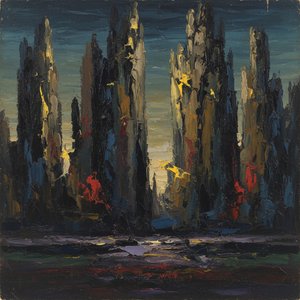
Carol Jackson (1962) made Squall. It belongs to the Abstract Expressionism movement. It is kept at The Met Office in Exeter, United Kingdom. It measures 122 × 122 cm (48 × 48 in).
- 122 × 122 cm (48 × 48 in)
- The Met Office, Exeter

 Preview

 Hand Made Oil Painting
 Send
 Share
 Fact sheet


 Download
 Similars
 X-Ray
 Diaporama
 Q&A

 Stats
Squall, in brief
- Title
- Squall
- Artist
- Carol Jackson (1962)
- Artist born in
- Los Angeles, United States
- Dimensions
- 122 × 122 cm (48 × 48 in)
- Where to see it
- The Met Office, Exeter, United Kingdom
- Movement
- Abstract Expressionism
- Subject
- abstract, seascape, storm, landscape, light, turbulence
Which museum holds Squall?
The Met Office
Exeter, United Kingdom
A Symphony of Science and Soul: The Met Office in Exeter Nestled within the historic, cobblestone charm of Exeter, Devon, The Met Office stands as a singular institution—a profound testament to the harmonious convergence of meteorological science and artistic expression. It is far more than a mere repository for weather records; it is a cultural sanctuary that invites the discerning visitor on a journey through time, innovation, and breathtaking visual artistry. To step into this space is to witness a dialogue between the measurable atmosphere and the felt emotion of the natural world.


High-resolution images of Squall

Protected by copyright: these files are for personal reference, not a licence to republish.
Carol Jackson, Squall.
Carol Jackson (1962), Squall, The Met Office, Exeter, United Kingdom. Image: OriginalUniqueArt.com.
Questions on Squall, answered
Which museum holds the original "Squall"?
"Squall" by Carol Jackson is on display at The Met Office, Exeter, United Kingdom. The museum listing refers to the original work, not to reproductions.
What are the dimensions of the original "Squall" by Carol Jackson?
"Squall" measures 122 x 122 cm (48 × 48 in) in its original form. Original dimensions are a useful reference when choosing a reproduction size.
What subjects appear in "Squall" by Carol Jackson?
"Squall" by Carol Jackson depicts: abstract, seascape, storm, landscape, light, turbulence, power, nature.
Is "Squall" free of copyright?
The copyright answer for "Squall" by Carol Jackson: the work is still protected by copyright. This determines whether reproductions of the image may be freely made.
Which artist is "Squall" attributed to?
"Squall" is attributed to Carol Jackson.
What art movement does "Squall" by Carol Jackson belong to?
"Squall" by Carol Jackson belongs to the Abstract Expressionism movement. This movement provides the stylistic context of the work.
Where does "Squall" fall in Carol Jackson's career?
"Squall" belongs to the Mature Period of Carol Jackson's career. This classification relates the work to the artist's development.
Is "Squall" held in the country of its creator?
No - the artwork is kept abroad. Carol Jackson was born in United States, and the original "Squall" is held in a museum in United Kingdom.
How does "Squall" fit into Carol Jackson's themes and style?
Within Carol Jackson's output, "Squall" sits in the Abstract Expressionism style, alongside the themes of impressionism, early abex, nature's raw power", gestural abstraction, storm's dominance", human insignificance, environmental themes.
About the artist, Carol Jackson

1962, United States
Carol Jackson
Kurt Jackson: Bridging Abstract Expressionism and Landscape Impression Kurt Jackson (b. 1961) stands as a distinctive voice within contemporary British art, blending the dynamism of Abstract Expressionism with the serene beauty of landscape painting. Born in Stoke-on-Trent, Staffordshire, his artistic journey began amidst the industrial heritage of the Potteries, fostering an early fascination with texture and materiality – influences that would permeate his subsequent work. Jackson’s distinctive style is characterized by bold color palettes juxtaposed against textured impasto surfaces, creating canvases brimming with emotion and capturing fleeting moments of natural grandeur.
Also by Carol Jackson
 Several Winter Evenings Delabole
 Crushing and Screening Plant1998
 Greece1997
 Sun and Rain, Strong Winds, Drilling Carnsew Mine1999
Essays around Squall
 Clyfford Still's Abstract Expressionism: A Study of Color, Form & the Existential LandscapeExplore the profound world of Clyfford Still's Abstract Expressionism with OriginalUniqueArt. Discover his unique style, existential themes…
 Master of Light: The Top 25 Essential Artworks by J. M. W. TurnerBorn the son of a barber in Covent Garden, London, Turner evolved from precise architectural studies into a revolutionary language of light.
 Abstract Expressionism vs. Pop Art: A Comparison of Two American MovementsRobert Motherwell used stark black tones in Elegy to the Spanish Republic No. 110 to address political trauma. Compare his brushwork to War…