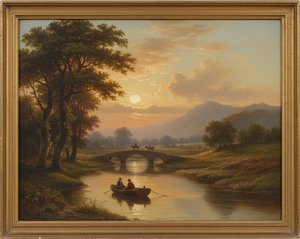
The Explorer of Light and Landscape
William Hodges stands as a singular figure in the annals of English art, a painter whose brush served as both a scientific instrument and a romantic lens. Born in London, his early artistic development was shaped by the rigorous traditions of his mentors, studying under William Shipley and later refining his craft within the studio of Richard Wilson. Before he became a chronicler of distant horizons, Hodges found his footing in the ephemeral world of theatrical scenery, a period that undoubtedly prepared him for the grand, sweeping compositions that would later define his legacy. His career was fundamentally transformed when he joined Captain James Cook’s second voyage to the Pacific Ocean, an expedition that would provide him with the raw, breathtaking imagery that remains his greatest contribution to Western art history.
As the official artist of this monumental voyage, Hodges embarked on a journey through some of the most remote corners of the globe. His sketches and paintings captured the essence of places such as Table Bay, Tahiti, Easter Island, New Zealand, Dusky Sound, and the icy reaches of the Antarctic. These works were more than mere geographical records; they represented a profound, often visceral encounter with the unknown. In pieces like A View in Dusky Bay, New Zealand, one can sense the tension between his classical training and the immediate, overwhelming reality of first contact with the Māori people. His ability to translate the immediacy of these encounters into a visual language allowed European audiences to glimpse a world that was simultaneously exotic and deeply human.
A Mastery of Contrast and Colonial Vision
The evolution of Hodges’ technique marked a departure from the established landscape traditions of his era. While many of his contemporaries adhered to more subdued palettes, Hodges embraced a dramatic use of light and shadow. This approach, though occasionally criticized by contemporary critics who found his work too rough or unfinished, allowed him to imbue his landscapes with an epic scope reminiscent of the later Hudson River School. His large-scale oil paintings, often completed in London following his travels, utilized intense color contrasts to evoke the atmospheric power of the Pacific islands and the rugged coastlines he had traversed.
Beyond the Pacific, Hodges’ artistic journey led him to the heart of colonial India. Under the patronage of Governor-General Warren Hastings, he traveled through the country between 1780 and 1783, becoming one of the first professional British landscape painters to document the subcontinent. His time in Benares (Varanasi) resulted in profound works such as The Ghauts at Benares, where he applied Neoclassical compositional arrangements to the sacred riverbanks of the Ganges. In these works, a fascinating interplay emerges between meticulous observation and European idealism, as he sought to record the culture and architecture of India through a lens that blended scientific curiosity with a romanticized, picturesque sensibility.
The enduring significance of William Hodges lies in his role as a visual bridge between worlds. His oeuvre remains a vital archive of exploration, capturing the fleeting moments of discovery and the shifting landscapes of a changing world. Through his mastery of light and his courageous engagement with new territories, he expanded the boundaries of what landscape painting could achieve, leaving behind a legacy that continues to resonate with the spirit of adventure and the beauty of the natural world.
Ερωτήσεις και Απαντήσεις
Πώς χωρίζεται η καριέρα του/της Ουίλιαμ Χότζες σε περιόδους;
Μια χρονολογική καταγραφή του έργου του/της Ουίλιαμ Χότζες είναι διαθέσιμη στη σελίδα Χρονικό έργο, όπου τα έργα παρουσιάζονται με σειρά δημιουργίας, χωρισμένα σε περιόδους της καριέρας του/της.
Πού μπορώ να δω τα έργα του/της Ουίλιαμ Χότζες ταξινομημένα ανά ατμόσφαιρα;
Στη σελίδα Κόρνερ Αίσθησης του καλλιτέχνη, μπορείτε να δείτε τα έργα του Ουίλιαμ Χότζες ταξινομημένα ανάλογα με την ατμόσφαιρά τους.
Μπορώ να περιηγηθώ στα έργα του/της Ουίλιαμ Χότζες ανά παλέτα χρώματος;
Στη σελίδα Κατά Παλέτα Χρωμάτων, τα έργα του/της Ουίλιαμ Χότζες ομαδοποιούνται ανάλογα με τις χρωματικές τους παλέτες.
Πού και πότε γεννήθηκε ο/η Ουίλιαμ Χότζες;
Ο/Η Ουίλιαμ Χότζες γεννήθηκε στην/στη Λονδίνο το 1744.