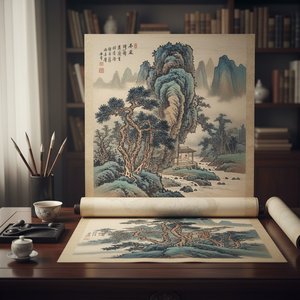
Wang Shimin: A Master of Ming-Qing Landscape Painting
Early Life and Background
- Born: Approximately 1592 in Taichung, China.
- Died: 1680.
- Wang Shimin grew up in a highly cultured and scholarly environment. His grandfather was a prime minister during the late Ming dynasty, and his father served as an editor at the Hanlin Academy.
- This upbringing instilled in him a deep appreciation for art and literature from a young age.
Artistic Development and Influences
- Wang Shimin received early training in both painting and calligraphy. His father, having studied with Tung Ch'i-ch'ang, passed on valuable artistic knowledge.
- Key Influence: He was profoundly influenced by the landscape paintings of Wang Wei, particularly “Snow over Rivers and Mountains,” which he later emulated in his own work.
- He also drew inspiration from earlier masters like Huang Gongwang, often creating variations on their established styles.
Career as an Official and Artistic Pursuit
- Initially, Wang Shimin pursued a career as a government official. However, illness contracted during a trip to Nanking in 1630 forced him to return home.
- Turning Point: This period of convalescence marked a turning point in his life, leading him to dedicate himself fully to the pursuit of art.
- He immersed himself in painting and created numerous landscapes, establishing his reputation as a skilled artist.
Artistic Style and Major Works
- Style: Wang Shimin’s landscape paintings are characterized by their serene atmosphere, meticulous brushwork, and atmospheric depth. He often employed a restrained palette and focused on capturing the essence of nature.
- His works exemplify the literati painting tradition, emphasizing intellectual and emotional expression alongside technical skill.
- Notable Works:
- “Landscape after Huang Gongwang” (1677) – A refined work on a folding fan.
- “Cloudy Mountains” – Showcases his mastery of ink wash techniques.
The Four Wangs and Historical Significance
- The Four Wangs: Wang Shimin is considered one of the “Four Wangs” – a group of influential landscape painters who dominated the art scene during the late Ming and early Qing dynasties.
- Along with his grandson, Wang Yuanqi (also a member of the Six Masters), they played a crucial role in shaping the development of Chinese landscape painting.
- Their emphasis on tradition and refinement helped to preserve and promote classical styles during a period of significant social and political upheaval.
- Legacy: Wang Shimin’s work continues to be admired for its beauty, technical skill, and profound connection to the natural world. He remains an important figure in the history of Chinese art.
Ερωτήσεις και Απαντήσεις
Σε ποια πόλη και χώρα γεννήθηκε ο/η Wáng Shímín;
Ο/Η Wáng Shímín γεννήθηκε στην/στη Ταϊτσάνγκ, στο/στη Λαϊκή Δημοκρατία της Κίνας.
Μπορώ να περιηγηθώ στα έργα του/της Wáng Shímín ανά παλέτα χρώματος;
Για να βρείτε έργα του Wáng Shímín σε μια συγκεκριμένη παλέτα χρωμάτων, επισκεφθείτε τη σελίδα Κατά Παλέτα Χρωμάτων του καλλιτέχνη.
Μπορώ να περιηγηθώ στα έργα του/της Wáng Shímín ανάλογα με τη διάθεση;
Μπορείτε να περιηγηθείτε στα έργα του/της Wáng Shímín ανάλογα με τη διάθεση στη σελίδα Κόρνερ Αίσθησης, όπου τα œuvres έχουν ταξινομηθεί σύμφωνα με την ατμόσφαιρα που αποπንέουν.
Πού μπορώ να δω τα έργα του/της Wáng Shímín σε χρονολογική σειρά;
Μπορείτε να δείτε τη χρονολογία των έργων του/της Wáng Shímín στη σελίδα Χρονολόγιο Έργων, όπου τα έργα είναι ταξινομημένα ανά ημερομηνία δημιουργίας.