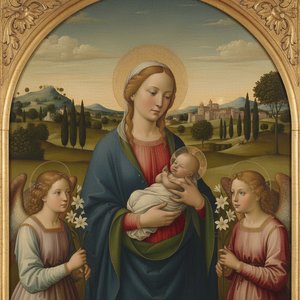
The Legacy of Pietro Melchiorre Ferrari
In the vibrant artistic landscape of the eighteenth century, Pietro Melchiorre Ferrari emerged as a painter of profound distinction, capturing the transition between two monumental eras of art history. Born in Sissa, within the Province of Parma, his very lineage was steeped in the traditions of the brush; his father, Paolo, served as a painter in the Ducal court, providing Pietro with an early immersion into the world of courtly aesthetics. His artistic journey was shaped by rigorous training under the guidance of Giuseppe Peroni and later refined at the Academy of Fine Arts at Parma under the mentorship of Giuseppe Baldrighi. This academic foundation allowed him to master a style that seamlessly bridged the dramatic, emotive depths of the late Baroque with the disciplined, clear elegance of the early Neoclassical movement.
Ferrari’s work is often characterized by its quiet dignity and an ability to transport the viewer into the opulent atmosphere of the late eighteenth-century courts. His portraiture, in particular, serves as a vital historical window, offering more than mere likenesses of his subjects. In masterpieces such as his Portrait of the Marquis Lorenzo di Canossa, one observes a masterclass in the use of chiaroscuro, where a sophisticated interplay of light and shadow pulls figures from the darkness into a sharp, luminous focus. Through his technique, he imbued his subjects with a sculptural quality, highlighting the intricate textures of powdered wigs and the heavy, commanding folds of crimson garments.
Symbolism and Artistic Mastery
Beyond the technical brilliance of his brushwork, Ferrari possessed a remarkable talent for weaving narrative depth into his compositions. He utilized objects not merely as decorative elements but as potent symbols of the Enlightenment era. In his portraits of the aristocracy and intellectuals, the inclusion of heavy volumes of books, scholarly desks, and even the steady presence of a clock served to reinforce themes of wisdom, law, and the fleeting nature of time. This intentionality allowed him to present his subjects as figures of profound intellectual rigor and poise, rooted in knowledge rather than mere status.
His repertoire also extended to capturing the essence of contemporary cultural figures, such as the celebrated singer Lucrezia Agujari. Through these works, Ferrari documented the social and musical fabric of Parma, preserving the likenesses of those whose talents were admired by the great masters of the age. His ability to navigate the shifting tides of artistic fashion—moving from the theatricality of the Baroque to the structured grace of Neoclassicism—ensures his place as a significant figure in the history of Italian painting, leaving behind a body of work that continues to resonate with the grandeur and intellectual spirit of his time.
Ερωτήσεις και Απαντήσεις
Από πού προέρχεται ο/η Pietro Melchiorre Ferrari;
Ο/Η Pietro Melchiorre Ferrari γεννήθηκε στην/στη Italy.
Πού μπορώ να δω τα έργα του/της Pietro Melchiorre Ferrari ταξινομημένα ανά ατμόσφαιρα;
Μπορείτε να περιηγηθείτε στα έργα του/της Pietro Melchiorre Ferrari ανάλογα με τη διάθεση στη σελίδα Κόρνερ Αίσθησης, όπου τα œuvres έχουν ταξινομηθεί σύμφωνα με την ατμόσφαιρα που αποπንέουν.
Μπορώ να εξερευνήσω τα έργα του/της Pietro Melchiorre Ferrari μέσω λέξεων-κλειδιών;
Ανακαλύψτε τα έργα του/της Pietro Melchiorre Ferrari ανά λέξη-κλειδί στη σελίδα των λέξεων-κλειδιών του/της Με Λέξεις-Κλειδιά. Κάθε λέξη-κλειδί ομαδοποιεί τα σχετικά έργα.