Πορτρέτο του Πίτερ Σνάιερς

Τα 75 πιο διάσημα έργα του Πίτερ Σνάιερς, μια επιλογή γκαλερί

Ενημερωμένο Νοέμβριος 2026 · κατάταξη βάσει του σκορ δημοφιλίας μας (αναζητήσεις, επισκέψεις και παραγγελίες για κάθε έργο) · 75 έργα του Πίτερ Σνάιερς στον κατάλογό μας

Με σύντομη περιγραφή

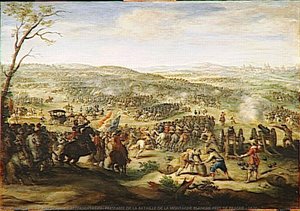
Από όλα τα πρωτότυπα έργα που άφησε ο Πίτερ Σνάιερς, το πιο διάσημο είναι το REPRESENTATION PRESUMEE DE LA BATAILLE DE LA MONTAGNE BLANCHE PRES DE PRAGUE (1620), το οποίο βρίσκεται στη συλλογή του Μουσείο του Λούβρου, Παρίσι. Ακολουθούν στενά η Philip IV hunting Deer (1636) και η Halt of Horsemen in a Forest (1657). Ο κατάλογός μας περιλαμβάνει 75 έργα του Πίτερ Σνάιερς· η γκαλερί έχει διατηρήσει τα 75 κομμάτια που θαυμάζει ο κόσμος, το καθένα με την ημερομηνία, το μουσείο και την ιστορία του.

1592 – 1667, Αντβέρπη Baroque Περισσότερα έργα: Kunsthistorisches Museum

Τα 10 κορυφαία έργα του Πίτερ Σνάιερς: η επιλογή της γκαλερί

1
REPRESENTATION PRESUMEE DE LA BATAILLE DE LA MONTAGNE BLANCHE PRES DE PRAGUE (1620) του Πίτερ Σνάιερς

REPRESENTATION PRESUMEE DE LA BATAILLE DE LA MONTAGNE BLANCHE PRES DE PRAGUE (1620)

Oil On Canvas · Μουσείο του Λούβρου, Παρίσι

Pieter Snayers’ “Representation Presumée de la Bataille de la Montagne Blanche près de Prague (1620)” is not merely a depiction of warfare; it's a meticulously crafted panorama of conflict, a vibrant testament to the tumultuous events that shaped 17th-century Europe. Painted in the heart of the Baroque era, this monumental work transports the viewer directly into the chaotic drama unfolding on the slopes of White Mountain near Prague, a pivotal…

2
Philip IV hunting Deer (1636) του Πίτερ Σνάιερς

Philip IV hunting Deer

1636 · Oil On Canvas · Μουσείο του Πράδο, Μαδρίτη

The composition is structured around a dense, vertical woodland where towering trees frame the edges of the canvas. A central clearing allows pale, diffused light to penetrate the canopy, creating a sharp contrast against the deep shadows of the foreground. In this light, a white horse stands on the left, its coat bright against the dark, organic lines of the surrounding bark. To the right, a hunter dressed in dark…

3
Halt of Horsemen in a Forest (1657) του Πίτερ Σνάιερς

Halt of Horsemen in a Forest

1657 · Oil On Canvas · Ερμιτάζ, Σουζ ή Αγία Πετρούπολη

Pieter Snayers' "Halt of Horsemen in a Forest," painted in 1657, isn’t merely a depiction of a battlefield; it’s a meticulously crafted panorama that breathes with the anxieties and ambitions of 17th-century Europe. This imposing oil painting, measuring an impressive 82 x 107 cm, transports the viewer directly into the heart of a military engagement, yet simultaneously offers a profound glimpse into the social fabric and artistic conventions of the…

4
The crossing of the Somme (1650) του Πίτερ Σνάιερς

The crossing of the Somme

1650 · Oil On Canvas · Kunsthistorisches Museum, Βιέννη

The air hangs heavy with the scent of damp earth and the sharp, sulfurous tang of gunpowder. From a high, sweeping vantage point, the landscape unfolds as a vast theater of war, where the horizon stretches wide under a pale, overcast sky. Below, the terrain is a chaotic dance of movement and strategy. On a dark, earthy ridge in the foreground, clusters of soldiers and cavalry huddle, their presence grounding…

5
El marques de Leganes on horseback (1602) του Πίτερ Σνάιερς

El marques de Leganes on horseback

1602 · Oil On Canvas · Goya Museum, Castres

The painting titled El marques de Leganes on horseback is an equestrian portrait executed by the artist Peter Snayers. This work, also identified by the alternative title Portrait équestre du marquis de Leganes, functions as a formal depiction of a high-ranking figure. The subject is presented in a mounted position, a common convention for portraying nobility and military command.

7
The defeat at Grancourt, 1639 (1650) του Πίτερ Σνάιερς

The defeat at Grancourt, 1639

1650 · Oil On Canvas · Kunsthistorisches Museum, Βιέννη

The landscape unfolds from a high, detached vantage point, a sweeping panorama of undulating terrain that swallows the individual. From this height, the violence of the 1639 conflict is reduced to a complex geometry of movement. Tiny figures of cavalry and infantry form rhythmic, jagged lines across the earth, their presence marked by small flashes of red and white from military banners. The terrain itself is a study in muted…

9
Landscape with bandits overhauling a covered wagon (1645) του Πίτερ Σνάιερς

Landscape with bandits overhauling a covered wagon

1645 · Oil On Canvas

The composition centers on a wooden covered wagon, positioned at a diagonal intersection where the path meets a dense line of trees. A group of figures on horseback and on foot surround the vehicle, creating a sense of sudden, violent movement. To the left, a man lies flat on the ground, his body angled toward the viewer, while a robber stands over him. On the right, a woman gestures toward…

10
Charles Bonaventure de Longueval, Count of Bucquoy (1650) του Πίτερ Σνάιερς

Charles Bonaventure de Longueval, Count of Bucquoy

1650 · Oil On Canvas · Schloss Rohrau, Rohrau

In this portrait of Charles Bonaventure de Longueval, Count of Bucquoy, Peter Snayers employs a low-angle perspective to establish a sense of monumental presence. The composition is dominated by a large, rearing brown horse that occupies much of the central space. Positioned in the upper two-thirds of the frame, the armored rider commands the viewer's attention against a vast, sprawling landscape. This elevated viewpoint looks down upon a distant military…

Η επιλογή του Πίτερ Σνάιερς συνεχίζεται, από τον 11 έως τον 75

11Landscape with Looting Riders (1668) του Πίτερ ΣνάιερςLandscape with Looting Riders1668 · Amsterdam Museum 12The siege of Neuburg, 1641 (1645) του Πίτερ ΣνάιερςThe siege of Neuburg, 16411645 · Kunsthistorisches Museum 13The Conversion of Paul on the Way to Damascus (1656) του Πίτερ ΣνάιερςThe Conversion of Paul on the Way to Damascus1656 · Βασιλικά Μουσεία Καλών Τεχνών της Βελγίου 14The battle at Lützen, 1632 (1642) του Πίτερ ΣνάιερςThe battle at Lützen, 16321642 · Kunsthistorisches Museum 15Dwarf in a Landscape του Πίτερ ΣνάιερςDwarf in a LandscapeNationalmuseum 16Philip IV Deer Hunt (1636) του Πίτερ ΣνάιερςPhilip IV Deer Hunt1636 · Μουσείο του Πράδο 17Wooded landscape with hunters (1628) του Πίτερ ΣνάιερςWooded landscape with hunters1628 · Μουσείο του Πράδο 18Large cavalry battle (1650) του Πίτερ ΣνάιερςLarge cavalry battle1650 · Kunsthistorisches Museum 19Ambush on a Convoy (1620) του Πίτερ ΣνάιερςAmbush on a Convoy1620 · Bonnefanten Museum 20The Battle at the White Mountains, November 8, 1620 (1620) του Πίτερ ΣνάιερςThe Battle at the White Mountains, November 8, 16201620 · Bavarian State Painting Collections 21Field camp (1620) του Πίτερ ΣνάιερςField camp1620 · Kunsthistorisches Museum 22Cavalry Skirmish near Bois-le-Duc (5.2.1600) (1629) του Πίτερ ΣνάιερςCavalry Skirmish near Bois-le-Duc (5.2.1600)1629 · Bavarian State Painting Collections 23Battle in the Eighty Years' War (1629) του Πίτερ ΣνάιερςBattle in the Eighty Years' War1629 · Bavarian State Painting Collections 24Cavalry Skirmish Uprising (1629) του Πίτερ ΣνάιερςCavalry Skirmish Uprising1629 · Bavarian State Painting Collections 25Cavalry Skirmish (1629) του Πίτερ ΣνάιερςCavalry Skirmish1629 · Bavarian State Painting Collections 26Capture of Saint-Venant (1628) του Πίτερ ΣνάιερςCapture of Saint-Venant1628 · Μουσείο του Πράδο 27Isabella Clara Eugenia and the siege of Breda, 1624-1625 (1628) του Πίτερ ΣνάιερςIsabella Clara Eugenia and the siege of Breda, 1624-16251628 · Μουσείο του Πράδο 28Aerial View of the Siege of Breda (1628) του Πίτερ ΣνάιερςAerial View of the Siege of Breda1628 · Μουσείο του Πράδο 29Chicken yard (1629) του Πίτερ ΣνάιερςChicken yard1629 · Bavarian State Painting Collections 30Soldiers camp (1624) του Πίτερ ΣνάιερςSoldiers camp1624 31The siege of Lens (1635) του Πίτερ ΣνάιερςThe siege of Lens1635 · Kunsthistorisches Museum 32Scene from the Thirty Years' War (1635) του Πίτερ ΣνάιερςScene from the Thirty Years' War1635 · Kunsthistorisches Museum 33Riders in a Forest (1636) του Πίτερ ΣνάιερςRiders in a Forest1636 · Noordbrabants Museum 34The Fall of Neunburg (1645) του Πίτερ ΣνάιερςThe Fall of Neunburg1645 35The relief of the plaza de Lérida (1646) του Πίτερ ΣνάιερςThe relief of the plaza de Lérida1646 · Μουσείο του Πράδο 36a fight in a village ? (1637) του Πίτερ Σνάιερςa fight in a village ?1637 · Legermuseum 37The siege of Einbeck (1644) του Πίτερ ΣνάιερςThe siege of Einbeck1644 · Kunsthistorisches Museum 38The Siege of Presnitz, 1641 (1648) του Πίτερ ΣνάιερςThe Siege of Presnitz, 16411648 · Kunsthistorisches Museum 39The Battle of Thionville, the Arrival of the Imperial forces under Piccolomini , 19 June 1639 (1642) του Πίτερ ΣνάιερςThe Battle of Thionville, the Arrival of the Imperial forces under Piccolomini , 19 June 16391642 · Kunsthistorisches Museum 40The Battle of Thionville, 19 June 1639 between the Imperial forces under Piccolomini and the French (1644) του Πίτερ ΣνάιερςThe Battle of Thionville, 19 June 1639 between the Imperial forces under Piccolomini and the French1644 · Kunsthistorisches Museum 41Relief from Saint-Omer, 12 July 1638 (1645) του Πίτερ ΣνάιερςRelief from Saint-Omer, 12 July 16381645 · Kunsthistorisches Museum 42The relief of Louvain, 24 June-4 July, 1639, by Ottavio Piccolomini (1639) του Πίτερ ΣνάιερςThe relief of Louvain, 24 June-4 July, 1639, by Ottavio Piccolomini1639 · Kunsthistorisches Museum 43Cavalry troop (1640) του Πίτερ ΣνάιερςCavalry troop1640 · Kunsthistorisches Museum 44Crossing the Somme in Cérisy (1638) του Πίτερ ΣνάιερςCrossing the Somme in Cérisy1638 · Βασικό Μουσείο Καλών Τεχνών Αντβέρπη 45Battle on Vught Heath (1638) του Πίτερ ΣνάιερςBattle on Vught Heath1638 · Εθνικό Μουσείο Βαρσοβίας 46Battle in the Forest (1653) του Πίτερ ΣνάιερςBattle in the Forest1653 · Bavarian State Painting Collections 47The taking of Ypres (1649) του Πίτερ ΣνάιερςThe taking of Ypres1649 · Μουσείο του Πράδο 48Siege of Saint-Omer, 1638 (1650) του Πίτερ ΣνάιερςSiege of Saint-Omer, 16381650 · Μουσείο του Πράδο 49Capture of Breda, 1637 (1650) του Πίτερ ΣνάιερςCapture of Breda, 16371650 · Μουσείο του Πράδο 50The Siege of Aire-sur-la-Lys (1653) του Πίτερ ΣνάιερςThe Siege of Aire-sur-la-Lys1653 · Μουσείο του Πράδο 51The Siege of Gravelines (1652) του Πίτερ ΣνάιερςThe Siege of Gravelines1652 · Μουσείο του Πράδο 52The battle of Honnecourt (1650) του Πίτερ ΣνάιερςThe battle of Honnecourt1650 · Μουσείο του Πράδο 53Night-time Attack on Lille (1650) του Πίτερ ΣνάιερςNight-time Attack on Lille1650 · Μουσείο του Πράδο 54The Munich Affair (1650) του Πίτερ ΣνάιερςThe Munich Affair1650 · Kunsthistorisches Museum 55The Relief of Meissen (1650) του Πίτερ ΣνάιερςThe Relief of Meissen1650 · Kunsthistorisches Museum 56Battlefield (1650) του Πίτερ ΣνάιερςBattlefield1650 · Kunsthistorisches Museum 57Mountainous landscape with castle (1650) του Πίτερ ΣνάιερςMountainous landscape with castle1650 · Kunsthistorisches Museum 58The Battle of Fleurus, 1622 (1650) του Πίτερ ΣνάιερςThe Battle of Fleurus, 16221650 · Rijksmuseum 59The Siege of Kortrijk, 1648 (1650) του Πίτερ ΣνάιερςThe Siege of Kortrijk, 16481650 · Βασιλικά Μουσεία Καλών Τεχνών της Βελγίου 60Attacking regiment before the town of Hattem, 1629 (1650) του Πίτερ ΣνάιερςAttacking regiment before the town of Hattem, 16291650 · Voerman Stadsmuseum Hattem 61The siege of Diksmuide (1649) του Πίτερ ΣνάιερςThe siege of Diksmuide1649 62The Siege of Armentières with a rainbow (1649) του Πίτερ ΣνάιερςThe Siege of Armentières with a rainbow1649 63Attaque d'un convoi par des brigands του Πίτερ ΣνάιερςAttaque d'un convoi par des brigands 64Paysage avec gibets aux abords d'une ville του Πίτερ ΣνάιερςPaysage avec gibets aux abords d'une villeMusée National Magnin 65Voyageurs attaqués par des brigands του Πίτερ ΣνάιερςVoyageurs attaqués par des brigands 66Cavalry Attack του Πίτερ ΣνάιερςCavalry AttackMuseum of Fine Arts Ghent (MSK) 67Cavalry Battle του Πίτερ ΣνάιερςCavalry BattleMuseum of Fine Arts Ghent (MSK) 68The Battle of Kalloo του Πίτερ ΣνάιερςThe Battle of Kalloo 69Landscape with Cavalry Skirmish in a Wood του Πίτερ ΣνάιερςLandscape with Cavalry Skirmish in a Wood 70Horsemen pursuing one another του Πίτερ ΣνάιερςHorsemen pursuing one another 71Cavalry skirmish του Πίτερ ΣνάιερςCavalry skirmishDulwich Picture Gallery 72A Cavalry Engagement on a Bridge του Πίτερ ΣνάιερςA Cavalry Engagement on a Bridge 73An Engagement on a Bridge outside a Fort του Πίτερ ΣνάιερςAn Engagement on a Bridge outside a Fort 74Paysage boisé à la mare του Πίτερ ΣνάιερςPaysage boisé à la mare 75A Wooded Landscape with Travellers του Πίτερ ΣνάιερςA Wooded Landscape with Travellers

Τα θέματα που κίνησαν το ενδιαφέρον του Πίτερ Σνάιερς

Τα τέσσερα θέματα που εμφανίζονται πιο συχνά σε αυτά τα πρωτότυπα έργα, το καθένα με το εξαιρετικό του παράδειγμα.

Τα μουσεία που διατηρούν τα πρωτότυπα έργα του Πίτερ Σνάιερς

Τα 8 μουσεία που φιλοξενούν το μεγαλύτερο μέρος των έργων σε αυτήν τη σελίδα.

Μουσείο Πόλη Έργα του Πίτερ Σνάιερς Πάτρια από αυτή τη λίστα
Kunsthistorisches Museum, ΒιέννηKunsthistorisches Museum Βιέννη 19 The crossing of the Somme, The defeat at Grancourt, 1639, The siege of Neuburg, 1641
Μουσείο του Πράδο, ΜαδρίτηΜουσείο του Πράδο Μαδρίτη 14 Philip IV hunting Deer, Philip IV Deer Hunt, Wooded landscape with hunters
Bavarian State Painting Collections, ΜόναχοBavarian State Painting Collections Μόναχο 7 The Battle at the White Mountains, November 8, 1620, Cavalry Skirmish near Bois-le-Duc (5.2.1600), Battle in the Eighty Years' War
Βασιλικά Μουσεία Καλών Τεχνών της Βελγίου, ΒρυξέλλεςΒασιλικά Μουσεία Καλών Τεχνών της Βελγίου Βρυξέλλες 2 The Conversion of Paul on the Way to Damascus, The Siege of Kortrijk, 1648
Museum of Fine Arts Ghent (MSK), GhentMuseum of Fine Arts Ghent (MSK) Ghent 2 Cavalry Attack, Cavalry Battle
Μουσείο του Λούβρου, ΠαρίσιΜουσείο του Λούβρου Παρίσι 1 REPRESENTATION PRESUMEE DE LA BATAILLE DE LA MONTAGNE BLANCHE PRES DE PRAGUE (1620)
Ερμιτάζ, Σουζ ή Αγία ΠετρούποληΕρμιτάζ Σουζ ή Αγία Πετρούπολη 1 Halt of Horsemen in a Forest
Goya Museum, CastresGoya Museum Castres 1 El marques de Leganes on horseback

Ο Πίτερ Σνάιερς δεκαετία προς δεκαετία: το πρωτότυπο που ορίζει κάθε μία

Έργα ανά δεκαετία

Επιλέξτε μια δεκαετία για να δείτε το πρωτότυπο έργο που την χαρακτηρίζει.

Ερωτήσεις συλλεκτών για τα έργα του Πίτερ Σνάιερς

Για ποιο έργο είναι πιο γνωστός ο Πίτερ Σνάιερς;Αποκαλύψτε την απάντηση

REPRESENTATION PRESUMEE DE LA BATAILLE DE LA MONTAGNE BLANCHE PRES DE PRAGUE (1620), Μουσείο του Λούβρου, Παρίσι. Στη συνέχεια ακολουθούν το Philip IV hunting Deer (1636) και το Halt of Horsemen in a Forest (1657).

Ποια είναι τα δέκα πιο διάσημα έργα του Πίτερ Σνάιερς;Αποκαλύψτε την απάντηση

REPRESENTATION PRESUMEE DE LA BATAILLE DE LA MONTAGNE BLANCHE PRES DE PRAGUE (1620), Philip IV hunting Deer, Halt of Horsemen in a Forest, The crossing of the Somme, El marques de Leganes on horseback, A Cavalry Engagement, The defeat at Grancourt, 1639, Soldiers Bivouacking, Landscape with bandits overhauling a covered wagon και Charles Bonaventure de Longueval, Count of Bucquoy. Η κατάταξη παραπάνω αναγράφει το έτος και το μουσείο για το κάθε έργο.

Πόσα έργα δημιούργησε ο/η Πίτερ Σνάιερς;Αποκαλύψτε την απάντηση

Ο κατάλογός μας περιλαμβάνει 75 έργα του Πίτερ Σνάιερς, με ημερομηνίες από 1602 έως 1657.

Σε ποια μουσεία εκτίθενται τα αριστούργημα του Πίτερ Σνάιερς;Αποκαλύψτε την απάντηση

Κυρίως σε Kunsthistorisches Museum (Βιέννη), Μουσείο του Πράδο (Μαδρίτη) και Bavarian State Painting Collections (Μόναχο). Ο πίνακας μουσείου παραπάνω τους περιλαμβάνει όλους.

Σε ποιες χρονιές δημιούργησε ο/η Πίτερ Σνάιερς τα πιο διάσημα έργα του/της;Αποκαλύψτε την απάντηση

Κατά την περίοδο 1650s: 20 από τα 75 έργα σε αυτήν τη σελίδα δημιουργήθηκαν τότε, με Halt of Horsemen in a Forest από αυτά να είναι μοναδικά.

Ποια είναι τα πρώτα και τα τελευταία διάσημα πρωτότυπα του Πίτερ Σνάιερς;Αποκαλύψτε την απάντηση

Σε αυτήν τη σελίδα, το παλαιότερο είναι El marques de Leganes on horseback (1602) και το νεότερο Halt of Horsemen in a Forest (1657).

Ποια θέματα επέλεξε πιο συχνά ο Πίτερ Σνάιερς;Αποκαλύψτε την απάντηση

Landscape (50), Sky (39) και Soldiers (37), σε συνολικά 75 έργα σε αυτήν τη σελίδα.

Ποια τεχνική χρησιμοποίησε περισσότερο ο Πίτερ Σνάιερς;Αποκαλύψτε την απάντηση

Oil On Canvas, για 45 από τα 75 έργα σε αυτήν τη σελίδα.

Σε ποιο καλλιτεχνικό κίνημα ανήκει ο/η Πίτερ Σνάιερς;Αποκαλύψτε την απάντηση

Baroque, όπως προκύπτει από τα πρωτότυπα σε αυτήν τη σελίδα.

Ποια έργα του Πίτερ Σνάιερς εκτίθενται στο Kunsthistorisches Museum;Αποκαλύψτε την απάντηση

The crossing of the Somme, The defeat at Grancourt, 1639 και The siege of Neuburg, 1641: το Kunsthistorisches Museum, Βιέννη διαθέτει 19 από τα έργα σε αυτήν τη σελίδα.

Πίτερ Σνάιερς: ζωή και έργο

The Panoramic Visionary of Flemish Baroque

Pieter Snayers (1592–1667) stands as a pivotal figure in the artistic landscape of the Dutch Golden Age, renowned primarily for his breathtaking panoramic battle scenes and meticulously rendered depictions of aristocratic life. More than just a skilled painter, Snayers possessed an unparalleled ability to capture the drama and grandeur of conflict—a talent that cemented his place amongst the most celebrated topographical artists of his era. His canvases offer a unique glimpse into the military strategies and visual spectacle of 17th-century warfare, alongside portraits reflecting the opulent tastes and social hierarchies of the time.

Born in Antwerp, Snayers’ early life was shaped by his father's position as city messenger—a role that instilled in him an appreciation for observation and detail. He formally enrolled as a pupil of Sebastiaen Vrancx, a fellow Antwerp guild artist who championed similar dramatic compositions, establishing a crucial artistic lineage. Vrancxi’s influence is evident in Snayers’ stylistic choices, particularly his masterful use of perspective and chiaroscuro—techniques that heighten the emotional impact of his paintings. By 1613, Snayers achieved mastership within the St. Luke Guild, signifying his commitment to honing his craft and integrating into Antwerp's vibrant artistic community.

A Master of Military Iconography

Snayers’ career was defined by a remarkable transition from the local guilds of Antwerp to the prestigious courts of Europe. His marriage to Anna Schut brought him a family life rooted in the artistic milieu of Brussels, where he would later establish himself as a court painter—a position that afforded him considerable prestige and access to influential patrons. His appointment by Archduke Albert in 1621 marked a significant turning point, propelling him into the service of Habsburg royalty and securing his reputation as a military iconographer. As the principal military iconographer for the court in Brussels, he even held the distinguished rank of lieutenant-colonel.

What truly set Snayers apart was his dedication to documenting battles with a level of precision that bordered on the scientific. He meticulously researched troop movements, siege fortifications, and battlefield conditions, allowing him to create large-scale topographical battle scenes that provided a bird's-eye view over the chaos of war. His works, such as the Siege of Armentières and the Battle of White Mountain, are celebrated for their remarkable accuracy. Interestingly, contemporary biographers like Cornelis De Bie noted that while Snayers achieved legendary status for his battlefield depictions, he possessed a talent so profound that he could render these intense conflicts with lifelike quality without ever having personally set foot on a battlefield.

Legacy and Artistic Contributions

Beyond the smoke and steel of cavalry skirmishes and sieges, Snayers’ repertoire was remarkably diverse. He was a regular collaborator with other masters of the age, including the legendary Rubens, and contributed to the rich tapestry of Flemish landscape painting. His ability to pivot from the violent energy of an attack on a village to the serene beauty of hunting scenes or the dignified stillness of aristocratic portraits demonstrates a versatile mastery over both movement and atmosphere.

The historical significance of Pieter Snayers lies in his role as a visual chronicler of his age. Through his work, we can trace the evolution of 17th-century warfare and the shifting political landscapes of the Low Countries. His artistic legacy is characterized by several key elements:

  • Topographical Precision: The use of high-altitude perspectives to document contemporary military feats with scientific clarity.
  • Narrative Grandeur: The ability to blend large-scale landscape painting with the intense, localized drama of cavalry engagements and infantry clashes.
  • Collaborative Spirit: His integration into the highest echelons of Flemish art through his work with Rubens and the Brussels court.
  • Versatility of Subject: A range that spanned from the brutal reality of the Siege of Dixmude to the refined elegance of aristocratic portraiture.

Today, Snayers remains a cornerstone of Baroque art, remembered not just as a painter of war, but as a visionary who could transform the terrifying scale of battle into a structured, breathtakingly beautiful panoramic experience.