


1


Ενημερωμένο Νοέμβριος 2026 · κατάταξη βάσει του σκορ δημοφιλίας μας (αναζητήσεις, επισκέψεις και παραγγελίες για κάθε έργο) · 60 έργα του Peter Jacob Horemans στον κατάλογό μας
Με σύντομη περιγραφή
Από όλα τα πρωτότυπα έργα που άφησε ο Peter Jacob Horemans, το πιο διάσημο είναι το Portrait of Frau Heigl (1738), το οποίο βρίσκεται στη συλλογή του Bavarian State Painting Collections, Μόναχο. Ακολουθούν στενά η Kitchen Still Life with Coffee Drinker (1765) και η Musical Still Life with Horn Player (1765). Ο κατάλογός μας περιλαμβάνει 60 έργα του Peter Jacob Horemans· η γκαλερί έχει διατηρήσει τα 58 κομμάτια που θαυμάζει ο κόσμος, το καθένα με την ημερομηνία, το μουσείο και την ιστορία του.


 The Smoker1764 · Bavarian State Painting Collections
12
 Hunting Still Life with Hunter1765 · Bavarian State Painting Collections
13
 Hunting Still Life with Hunter1765 · Bavarian State Painting Collections
14
 Kitchen Interior with Beer Drinker1765 · Bavarian State Painting Collections
15
 Kitchen Still Life with Female Figure Counting Money and Parrot1760 · Bavarian State Painting Collections
16
 Still Life with Violinist1763 · Bavarian State Painting Collections
17
 The Tailor's Workshop1759
18
 Still life with a distinguished gentleman1762 · Bavarian State Painting Collections
19
 Fruit still life with a female figure drinking wine1764 · Bavarian State Painting Collections
20
 Kitchen still life with female figure and parrot (An allegory of feeling)1760 · Bavarian State Painting Collections
21
 Shoemakers-shop1759
22
 Still Life with Female Figure1770 · Bavarian State Painting Collections
23
 Kitchen Still Life with Female Figure and Parrot1771 · Bavarian State Painting Collections
24
 Court Musician Felix Reiner with Bassoon1774 · Bavarian State Painting Collections
25
 Court Musician with Violin (Johann Georg Holzbogen)1774 · Bavarian State Painting Collections
26
 Still Life "The Treasurer"1773 · Bavarian State Painting Collections
27
 Kitchen Still Life with Female Figure and Parrot1771 · Bavarian State Painting Collections
28
 Portrait of District Administrator Josef Heigl1768 · Bavarian State Painting Collections
29
 Spring (Johanna de Lasence Having Coffee in the Garden)1767 · Bavarian State Painting Collections
30
 Self-portrait in the artist's atelier1766 · Bavarian State Painting Collections
31
 Bildnis eines Silberdieners1772 · Bavarian State Painting Collections
32
 Portrait of court sculptor Roman Anton Boos (1730-1810) in his studio next to a bust of elector Maximilian III1766 · Bavarian State Painting Collections
33
 Hunting a wild boar1773 · Εθνικό Μουσείο Βαρσοβίας
34
 Hunting with falcons1773 · Εθνικό Μουσείο Βαρσοβίας
35
 Picnic in the park1776 · Lenbachhaus
36
 Concert in the garden1776 · Lenbachhaus
37
 Still Life with Plucked Chicken1764 · Bavarian State Painting Collections
38
 Still Life with Pork Knuckle and Squirrel1765 · Bavarian State Painting Collections
39
 Still Life with Dead Partridge1764 · Bavarian State Painting Collections
40
 Still Life with Fish1765 · Bavarian State Painting Collections
41
 Still Life with Pork Knuckle and Parrot1765 · Bavarian State Painting Collections
42
 Still Life with Fruit1765 · Bavarian State Painting Collections
43
 Still Life with Dead Lamb1765 · Bavarian State Painting Collections
44
 Still Life with Dead Hare1764 · Bavarian State Painting Collections
45
 Still Life with Fruit1765 · Bavarian State Painting Collections
46
 Still Life with Kitchen Utensils and Plucked Chicken1765 · Bavarian State Painting Collections
47
 Still Life with Kitchen Utensils and Dead Partridge1765 · Bavarian State Painting Collections
48
 Still Life with Lobster1765 · Bavarian State Painting Collections
49
 Still Life with Lobster1766 · Bavarian State Painting Collections
50
 Still Life with Grapes and Apples1768 · Bavarian State Painting Collections
51
 Fruit Still Life1770 · Bavarian State Painting Collections
52
 Still Life with Crabs1766 · Bavarian State Painting Collections
53
 Fruit Still Life1768 · Bavarian State Painting Collections
54
 Fruit Snack1770 · Bavarian State Painting Collections
55
 Still Life with Fruit and Dead Birds1771 · Bavarian State Painting Collections
56
 Still Life with Fruit and Dead Birds1771 · Bavarian State Painting Collections
57
 A Musical Gathering at the Court of the Elector Karl Albrecht of Bavaria1730 · Μετροπολιτικό Μουσείο Τέχνης
58
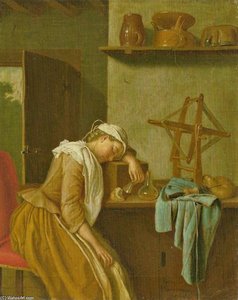 Schlafendes KüchenmädchenBavarian State Painting Collections
Τα 4 μουσεία που φιλοξενούν το μεγαλύτερο μέρος των έργων σε αυτήν τη σελίδα.
| Μουσείο | Πόλη | Έργα του Peter Jacob Horemans | Πάτρια από αυτή τη λίστα |
|---|---|---|---|
 Bavarian State Painting Collections |
Μόναχο | 51 | Portrait of Frau Heigl, Kitchen Still Life with Coffee Drinker, Musical Still Life with Horn Player |
 Εθνικό Μουσείο Βαρσοβίας |
Βαρσοβία | 2 | Hunting a wild boar, Hunting with falcons |
 Lenbachhaus |
Μόναχο | 2 | Picnic in the park, Concert in the garden |
 Μετροπολιτικό Μουσείο Τέχνης |
Νέα Υόρκη | 1 | A Musical Gathering at the Court of the Elector Karl Albrecht of Bavaria |
Επιλέξτε μια δεκαετία για να δείτε το πρωτότυπο έργο που την χαρακτηρίζει.

Portrait of Frau Heigl (1738), Bavarian State Painting Collections, Μόναχο. Στη συνέχεια ακολουθούν το Kitchen Still Life with Coffee Drinker (1765) και το Musical Still Life with Horn Player (1765).
38 ετών: το έργο Portrait of Frau Heigl είναι του 1738, και ο/η Peter Jacob Horemans γεννήθηκε το 1700.
Portrait of Frau Heigl, Kitchen Still Life with Coffee Drinker, Musical Still Life with Horn Player, Still Life with Female Figure with Flowers, Still Life with Elegant Lady, Still Life with Fruit and Female Figure, The Soup Eater, Still Life with Female Figure with Beer Glass, Still Life with Female Figure και Musical Still Life with Male Figure. Η κατάταξη παραπάνω αναγράφει το έτος και το μουσείο για το κάθε έργο.
Ο κατάλογός μας περιλαμβάνει 60 έργα του Peter Jacob Horemans, με ημερομηνίες από 1730 έως 1776.
Κυρίως σε Bavarian State Painting Collections (Μόναχο), Εθνικό Μουσείο Βαρσοβίας (Βαρσοβία) και Lenbachhaus (Μόναχο). Ο πίνακας μουσείου παραπάνω τους περιλαμβάνει όλους.
Κατά την περίοδο 1760s: 36 από τα 58 έργα σε αυτήν τη σελίδα δημιουργήθηκαν τότε, με Kitchen Still Life with Coffee Drinker από αυτά να είναι μοναδικά.
Σε αυτήν τη σελίδα, το παλαιότερο είναι A Musical Gathering at the Court of the Elector Karl Albrecht of Bavaria (1730) και το νεότερο Picnic in the park (1776).
Portrait of Frau Heigl, Kitchen Still Life with Coffee Drinker και Musical Still Life with Horn Player: το Bavarian State Painting Collections, Μόναχο διαθέτει 51 από τα έργα σε αυτήν τη σελίδα.