The Chronicler of an Empire: The Life and Vision of Luigi Mayer
In the twilight of the eighteenth century, as the Enlightenment sought to map the unknown corners of the globe, one artist emerged with a vision that would forever bridge the gap between the European imagination and the vibrant reality of the Ottoman East. Luigi Mayer, an Italian-born talent whose spirit wandered through the heart of the Mediterranean and beyond, stands as a singular figure in the annals of Orientalism. He was far more than a mere painter; he was a meticulous observer and a devoted chronic and draftsman, capturing a world at its imperial zenith before the tides of modernity would irrevocably alter its landscape.
Mayer’s artistic foundation was rooted in the classical traditions of his Italian heritage, yet his brushwork whispered of the burgeoning dynamism found in German Romanticism. Trained under the guidance of Giuseppe Cesati, a master of the Bolognese school, Mayer inherited a profound respect for anatomical precision and classical ideals. This early education instilled in him a unique ability to blend rigorous, almost scientific detail with an expressive, emotive quality that allowed his landscapes to breathe with life. His development was not merely a matter of technical refinement but an evolution of perspective, as he learned to translate the vast, sun-drenched expanses of distant territories into a visual language accessible to the European eye.
A Journey Through the Ottoman Heartland
The true destiny of Mayer’s art was forged in the streets of Constantinople and the ancient sands of Egypt. Between 1776 and 1792, Mayer served as an artist-in-residence at the British Embassy in Istanbul, a position made possible through the influential patronage of Sir Robert Ainslie. This period marked the most prolific and transformative era of his career. Under Ainslie’s ambitious direction, Mayer embarked on extensive expeditions that took him far beyond the embassy walls, traversing the rugged terrains of the Balkans, the lush Greek Islands, Anatolia, and the majestic banks of the Nile.
His work during these years became a vital historical record. He did not merely paint scenery; he documented the soul of a civilization. His canvases captured:
- Architectural Grandeur: The awe-inspiring silhouettes of ancient monuments, including the Karnak and Philae temples, rendered with a reverence for their enduring majesty.
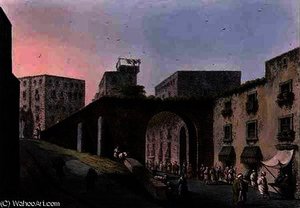
- Urban Vitality: The bustling energy of Ottoman marketplaces and the intimate, daily rhythms of urban existence in Constantinople.
- Panoramic Landscapes: Sweeping vistas that showcased the diverse topography of the Middle East, from arid deserts to fertile river valleys.
Working alongside his wife, Clara Barthold Mayer, who served as both an assistant and a fellow painter, Luigi created a body of work that was as much an intellectual endeavor as an artistic one. His sketches were not just aesthetic objects but ethnographic documents, providing a window into the cultural nuances, clothing, and social structures of the Ottoman territories during a period of profound historical significance.
Legacy and Historical Significance
The legacy of Luigi Mayer is inextricably linked to the way the West perceived the East for generations. Much of his monumental output was preserved within the collection of Sir Robert Ainslie, which was eventually presented to the British Museum, ensuring that his meticulous observations would remain a cornerstone of Middle Eastern studies and art history. His drawings served as the foundational material for the multi-volume work, Views in Turkey in Europe and Asia, which brought the splendors of the Ottoman Empire to the libraries of Europe.
Mayer’s significance lies in his role as a pioneer of Orientalism. Unlike later iterations of the movement that often leaned into fantasy or exoticized tropes, Mayer’s approach was characterized by a documentary precision. He provided a sense of place that was grounded in reality, making him one of the most important visual chroniclers of the late eighteenth century. Through his eyes, the ancient ruins and vibrant cities of the East were not mere myths, but tangible, breathing realities, forever etched into the collective memory of the Western world through the delicate stroke of his brush.