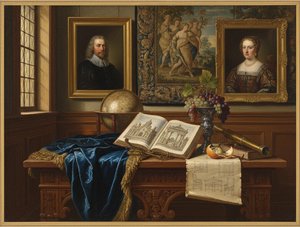
The Divine Geometry of the Heavens
In the twilight of the seventeenth century, a period where the boundaries between the sacred and the empirical were often blurred by the light of burgeoning discovery, Johann Ludwig Andreae emerged as a master of synthesis. Born in the quietude of Meßstetten, his journey was not merely one of artistic pursuit but a profound intellectual pilgrimage. His early years at Tübingen University, culminating in a magister degree in 1688, instilled in him a theological foundation that would forever color his creative vision. To Andreae, the cosmos was not a cold, mechanical void, but a magnificent tapestry woven with divine intent—a belief that transformed his scientific endeavors into acts of artistic devotion.The Artistry of the Infinite
As his career unfolded, Andreae transitioned from the study of scripture to the mapping of the stars, finding a unique medium in the creation of globes and engravings. His work in Nürnberg, particularly through his celebrated collaboration with Samuel Faber, represents a pinnacle of Baroque craftsmanship. He did not merely record positions of celestial bodies; he breathed life into them through meticulous hand-painted maps and intricate wood engravings. His artistry was characterized by a rare duality:- The Precision of the Cartographer: His celestial globes, often presented on majestic mahogany stands, served as both scientific instruments and breathtaking works of an astronomical nature.
- The Vision of the Engraver: Through wood engravings of botanical specimens and architectural designs, he demonstrated a technical skill that captured the delicate textures of the natural world.
A Legacy Written in the Stars
The significance of Johann Ludwig Andreae lies in his refusal to separate the eye of the scientist from the soul of the artist. In an era defined by the tension between tradition and revolution, he stood as a pioneer who utilized the tools of cartography to celebrate the wonders of creation. His legacy remains etched in the delicate lines of his engravings and the sweeping arcs of his celestial globes, reminding us that true discovery requires both the rigor of the mind and the wonder of the heart.Ερωτήσεις και Απαντήσεις
Πού μπορώ να δω όλα τα έργα του/της Johann Ludwig Andreae;
Μπορείτε να περιηγηθείτε σε όλα τα έργα του/της Johann Ludwig Andreae στο αυτή η ιστοσελίδα μέσω της σελίδας με την πλήρη συλλογή τους (Όλα τα έργα).
Μπορώ να περιηγηθώ στα έργα του/της Johann Ludwig Andreae ανά τεχνική;
Μπορείτε να περιηγηθείτε στα έργα του/της Johann Ludwig Andreae ανά τεχνική στη σελίδα των δημιουργημάτων ανά τεχνική του/της Johann Ludwig Andreae (Κατά Τεχνική).
Μπορώ να περιηγηθώ στα έργα του/της Johann Ludwig Andreae ανά παλέτα χρώματος;
Μπορείτε να περιηγηθείτε στα έργα του/της Johann Ludwig Andreae ανά χρωματική παλέτα στη σελίδα των χρωμάτων του/της Johann Ludwig Andreae, στην ενότητα Κατά Παλέτα Χρωμάτων.