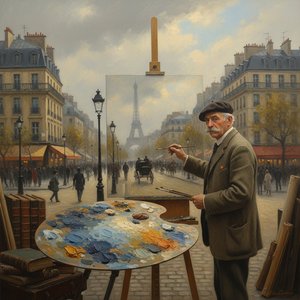
The Life and Career of Jean Vignaud
Born in Beaucaire, France, Jean Vignaud was the son of a tailor. Rather than following his father's trade, he dedicated himself to the passion of painting. After beginning his journey as a self-taught artist, he served as a drawing teacher at the École Centrale de Nîmes. In 1796, he moved to Paris, where he worked for a engraver, using his leisure time to copy old masters in the Louvre and modern masters in the Luxembourg. His growing talent led to financial support from the Dutchman Wander Wold and eventually brought him into the studio of Jacques-Louis David. Supported by the Prefect of Police Dubois, who provided him with a studio and portrait commissions, Vignaud became a recognized figure at the Salon between 1806 and 1824.
Artistic Legacy and Notable Works
Vignaud was a history painter and portraitist whose works were frequently acquired by the State for museums and churches. His notable achievements include receiving a gold medal for La Mort de Lesueur chez les Chartreux, which is held at the Palace of Versailles. Other significant works include:
In 1820, he returned to Nîmes to serve as the first director of the newly opened school of drawing. He was also a collector of paintings, a collection that was acquired by the city of Nîmes in 1827 to enrich the newly founded Musée des Beaux-Arts.
Ερωτήσεις και Απαντήσεις
Υπάρχει χρονολόγιο με τα έργα του/της Jean Vignaud;
Μπορείτε να δείτε τη χρονολογία των έργων του/της Jean Vignaud στη σελίδα Χρονολόγιο Έργων, όπου τα έργα είναι ταξινομημένα ανά ημερομηνία δημιουργίας.
Πώς μπορώ να βρω έργα του/της Jean Vignaud με ένα συγκεκριμένο θέμα;
Ανακαλύψτε τα έργα του/της Jean Vignaud ανά λέξη-κλειδί στη σελίδα των λέξεων-κλειδιών του/της Με Λέξεις-Κλειδιά. Κάθε λέξη-κλειδί ομαδοποιεί τα σχετικά έργα.
Πού μπορώ να δω τα έργα του/της Jean Vignaud ταξινομημένα ανά ατμόσφαιρα;
Μπορείτε να περιηγηθείτε στα έργα του/της Jean Vignaud ανάλογα με τη διάθεση στη σελίδα Κόρνερ Αίσθησης, όπου τα œuvres έχουν ταξινομηθεί σύμφωνα με την ατμόσφαιρα που αποπንέουν.