Early Life, Family and Training
Jean-Baptiste-Camille Corot was born in Paris in 1796. He grew up in a household defined by practical crafts, the second of three children. His father worked as a wig maker, and his mother, Marie-Françoise Corot, was a milliner. These early years in a Parisian family provided a steady, if modest, foundation before he turned toward the study of light and form.
His formal training began in the studios of established painters. Between 1821 and 1822, he studied under Achille Etna Michallon. This period of instruction provided the technical grounding necessary for his later explorations. He also spent time studying with Jean-Victor Bertin, absorbing the methods of the landscape tradition that would inform his approach to the natural world.
Technique and Artistic Style
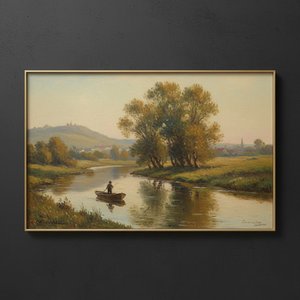
His process began outdoors. He spent time sketching and making preliminary paintings directly in the landscape to capture the immediate light. Once the initial observations were gathered, he moved to his studio to perform the finishing work indoors. This method allowed him to build up his compositions through a specific layering of thin washes of oil paint onto the canvas. He favored a smooth and thin technique, often using lightly and loosely dabbed strokes to build texture. This approach helped him render vegetation in its fresh beginnings, capturing the specific look of new growth.
His style leaned toward Realism, focusing on the way light and atmosphere interact with the physical world. Rather than relying on heavy, thick applications of paint, he used tonal gradations to create a sense of depth and dimensionality. This careful handling of color and composition allowed him to depict the play of light across a scene without the need for excessive detail. His later works often took the form of landscape souvenirs, which were dreamy, imagined paintings based on the locations he had previously visited.
- Agostina (about 1866)
- The Studio (about 1865)
- A Woman Reading (about 1870)
Legacy and Influence on Art
By the time he reached his final decade, he was known in Parisian circles as "Père Corot." This title reflected more than just his age; it spoke to his position as a central figure for those navigating the shift from academic traditions toward new ways of seeing. His work began to move toward an increasingly impressionistic style by the mid-1850s. He moved away from the rigid structures of the past, favoring a way of painting that anticipated the plein-air innovations of the Impressionist movement. He found a way to capture the way light settles on leaves and the way atmosphere softens a distant horizon.
His influence was felt in the way he handled the brush, using lightly and loosely dabbed strokes to render the fresh beginnings of vegetation. This approach helped pave the way for later artists who sought to capture the fleeting qualities of the natural world directly from the source. He was recognized as one of the greatest landscape painters the world had seen, a status built through a vast output of over 3,000 paintings. His ability to balance the precision of organic forms with a sense of mood left a mark on the history of landscape painting.
- Agostina
- The Studio
- A Woman Reading
Where to See His Works Today
To find his traces, one often looks to Paris. The Louvre holds a large presence of his output, with 35 works kept within its walls. Nearby, the Musée d'Orsay preserves 6 of his paintings. These collections allow for a close look at how he handled light and the way he rendered vegetation in its fresh beginnings. In Reims, the Musée des Beaux-Arts holds an exceptional collection of 27 canvases, a group second only to the Louvre in its holdings of his work.
Across the Atlantic, his presence is felt in several major institutions. The Metropolitan Museum of Art in New York maintains 26 of his works, including pieces like Agostina, which was painted in 1866. The National Gallery of Art in Washington holds 6 works, while the Philadelphia Museum of Art keeps 4. These pieces offer a way to see his transition from more structured compositions toward the looser, more atmospheric style he developed later in life.
- Self-portrait (1825)
- Waterfall at Terni (1826)
- The Italian Goatherd, Evening (1847)
- A Woman Reading (1870)
- The Gypsies (1872)
Ερωτήσεις και Απαντήσεις
Υπάρχει μια επισκόπηση όλων των θεμάτων που έχει ζωγραφίσει ο/η Ζαν-Μπαστιάν Κορώ;
Η σελίδα Ατλάς Θεμάτων αναλύει τα έργα του Ζαν-Μπαστιάν Κορώ ανά θέμα.
Με τι άλλα ονόματα είναι γνωστός/η ο/η Ζαν-Μπαστιάν Κορώ;
Ο/Η Ζαν-Μπαστιάν Κορώ είναι γνωστός/η επίσης ως Jean-Baptiste-Camille Corot, Camille Corot, Père Corot.
Από πού προέρχεται ο/η Ζαν-Μπαστιάν Κορώ;
Ο/Η Ζαν-Μπαστιάν Κορώ γεννήθηκε στην/στη Γαλλία.