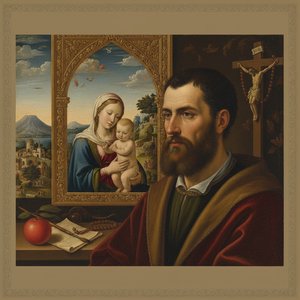
Alessandro Varotari (Padovanino) – Life & Legacy
Early Life and Training
- Born: Padua, Italy in 1588.
- Family Background: Padovanino was born into a family of artists. His father, Dario Varotari the Elder, was a local painter and architect who provided his initial training.
- Early influences included the style of Titian, which would remain central to his artistic approach throughout his career.
Career Development & Artistic Style
- Padovanino moved to Venice in 1614 and quickly established himself as a skilled painter.
- Artistic Period: He worked during the transition between Late Mannerism and Early Baroque, blending elements of both styles.
- He traveled to Rome twice (mid-1610s & 1625), gaining recognition for his ability to create high-quality copies of works by Renaissance masters.
- Key Characteristics: His paintings are known for their narrative strength, sensuality, and faithful adherence to the Titianesque tradition. He excelled in depicting mythological and historical scenes.
Major Works & Commissions
- Notable Paintings: Included “Samson and Delilah”, “Orpheus Enchanting the Animals”, “Sleeping Venus with Putti”, “The Three Graces” and “Semiramis called to arms”.
- He contributed mosaics to the Basilica of San Marco in Venice (1619).
- He also undertook decorative projects for the Church of Santa Maria Maggiore.
- “The Victory of the Carnuti over the Normans”: A significant large-scale battle scene demonstrating his skill in composition and dramatic storytelling.
Influence & Legacy
- Mentorship: Padovanino was a respected teacher, mentoring several prominent Venetian painters including Pietro Liberi, Bartolomeo Scaliger, Pietro della Vecchia, and Giulio Carpioni.
- His sister, Chiara Varotari, was also a well-known portraitist, further cementing the family’s artistic reputation.
- Caterina Tarabotti: A notable female intellectual of the time, was among his students.
- Although celebrated for his copying skills, Padovanino's original compositions and influence on subsequent generations secure his place in art history.
Historical Significance
- Bridging Styles: He represents a crucial link between the Mannerist and Baroque periods, adapting earlier traditions to evolving artistic tastes.
- His work reflects the vibrant cultural climate of 17th-century Venice, a major center for art and commerce.
- Preservation of Tradition: His dedication to Titian’s style helped preserve and disseminate the legacy of one of Italy's greatest masters.
Ερωτήσεις και Απαντήσεις
Ποιες διαθέσεις εκφράζουν τα έργα του/της Αλεσσάνδρο Βαροτάρι;
Στη σελίδα Κόρνερ Αίσθησης του καλλιτέχνη, μπορείτε να δείτε τα έργα του Αλεσσάνδρο Βαροτάρι ταξινομημένα ανάλογα με την ατμόσφαιρά τους.
Πού μπορώ να βρω τα έργα του/της Αλεσσάνδρο Βαροτάρι ομαδοποιημένα ανά τεχνική;
Μπορείτε να περιηγηθείτε στα έργα του/της Αλεσσάνδρο Βαροτάρι ανά τεχνική στη σελίδα των δημιουργημάτων ανά τεχνική του/της Αλεσσάνδρο Βαροτάρι (Κατά Τεχνική).
Πού μπορώ να δω όλα τα έργα του/της Αλεσσάνδρο Βαροτάρι;
Μπορείτε να περιηγηθείτε σε όλα τα έργα του/της Αλεσσάνδρο Βαροτάρι στο αυτή η ιστοσελίδα μέσω της σελίδας με την πλήρη συλλογή τους (Όλα τα έργα).
Ποια χρώματα χρησιμοποίησε πιο συχνά ο/η Αλεσσάνδρο Βαροτάρι;
Το χρωματικό προφίλ των έργων του/της Αλεσσάνδρο Βαροτάρι εμφανίζεται στη σελίδα Γενετικό Σύστατο Παλέτας του καλλιτέχνη/της.