Μετάβαση σε Εκτυπώσεις
 Περισσότερα







































 Για έργα τέχνης ή αναπαραγωγές με πλευρά υπερβαίνουσα των 105 εκ. (περίπου 41 ίντσες), το πλαίσιο θα αποσταλεί αποσυναρμολογημένο, σε μορφή κιτ. Η μέθοδος αυτή διασφαλίζει την ασφαλή παράδοση και προλαμβάνει τυχόν ζημιές κατά τη μεταφορά.


The Weight of Daily Labor
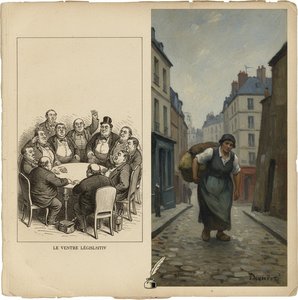
In this 1853 lithograph, a woman moves through a Parisian street, her form defined by the heavy burden she carries. A large basket, filled to the brim with laundry, rests upon her head. She wears clothing characteristic of the mid-nineteenth century, and her gait is steady despite the mass of fabric above her. Following closely at her heels is a young child, whose presence creates a small familial group within the larger urban setting. The background contains several other figures, including passersby moving along the street, which provides a sense of movement to the scene. The composition relies on a black and white palette, using varying tones of grey and deep blacks to establish shape and depth.
The artist utilizes chiaroscuro to sculpt the physical presence of the woman. Light hits the edges of her clothing and the texture of the laundry, while heavy shadows settle into the folds of the fabric and the spaces between the figures. This interplay of light and shadow emphasizes the physical strain of the task. The textures of the woven basket and the heavy cloth are rendered through precise tonal gradations rather than fine lines alone.
Social Realities of the Second Empire
The scene is set during the era of Napoleon III, a period marked by rapid industrialization in Paris and widening economic gaps. The subject matter focuses on the working class, specifically women tasked with domestic labor. The basket functions as a literal and figurative weight, representing the responsibilities required to maintain a household amidst economic hardship. Through the depiction of this woman and her child, the work documents the lived experience of ordinary Parisians during a time of significant social change.
The technique of lithography allows for an expressive draftsmanship that captures the grit of urban life. By avoiding bright colors and focusing on stark contrasts, the artist directs attention to the physical reality of the subject's struggle. The woman’s direct and unwavering gaze provides a point of contact for the viewer, presenting a face of resilience. This approach avoids sentimentalizing the labor, instead offering a factual observation of the endurance required by those in the working class.
Ερωτήσεις και Απαντήσεις
Πόσο φως φαίνεται να αντανακλούν τα χρώματα του "Load (Washerwoman)";
Το έργο "Load (Washerwoman)" του Ονοράν Νταμιέ έχει φωτεινότητα Dark. Η φωτεινότητα περιγράφει το πόσο φως φαίνεται να αντανακλούν τα χρώματα.
Πώς περιγράφεται η ατμόσφαιρα του έργου "Load (Washerwoman)" του Ονοράν Νταμιέ;
Το έργο "Load (Washerwoman)" του Ονοράν Νταμιέ περιγράφεται ως Calm ως προς τη διάθεσή του. Αυτή η ταξινόμηση μπορεί να βοηθήσει στον συνδυασμό του έργου με ένα κατάλληλο περιβάλλον.
Γιατί το "Load (Washerwoman)" του Ονοράν Νταμιέ αποτελεί ένα ιδανικό δώρο;
Το "Load (Washerwoman)" αποπνέει μια αίσθηση Reflective, και η προτεινόμενη δόρα για δώρο είναι Mother's Day.
 Προεπισκόπηση σε πραγματική κλίμακα
 Αποστολή
 Κοινοποίηση
 Λεπτομέρειες
 Οδηγός

 Λήψη
Λήψη
 Παρόμοια αντικείμενα συλλογής
 Ακτινογραφία
 Παρουσίαση
 Q&A
Q&A Στατιστικά