Προεπισκόπηση σε πραγματική κλίμακα
 Αποστολή
 Κοινοποίηση
 Λεπτομέρειες
 Οδηγός

 Λήψη
Λήψη
 Παρόμοια αντικείμενα συλλογής
 Ακτινογραφία
 Παρουσίαση
 Ερωτήσεις & Απαντήσεις
 Στατιστικά
Dieppe


 Περισσότερα
Giclée / Εκτυπώσεις Τέχνης
Εκτύπωση giclée ή σε καμβά ποιότητας μουσείου με γρήγορη παραγωγή και ευέλικτες επιλογές φινιρίσματος. ( Αγορά χειροποίητου πίνακα Μετάβαση σε Ψηφιακή Αποτέλεσμα)




P118B €10

P118H €10

P118W €10

P438Z €10

P508JH €12

P508YH €12

P805H €10

P805Z €10

P919BZ €10

P919G €10

P919XJ €10

P959ZH €10

P968JZ €12

W106C €8

W218G €10

W218JH €8

W218Y €10

W307PJ €10

W316G €10

W316PJ €8

W316Y €10

W398PJ €8

W4111J €10

W500HY €15

W500JH €15

W692G €12

W849H €8

W940BG €15

W953PJ €8




Επιλέξτε από τις προκαθορισμένες διαστάσεις μας που διατηρούν τις αρχικές αναλογίες του έργου τέχνης.

Εισάγετε το πλάτος και το ύψος που επιθυμείτε, ώστε να ταιριάζουν στο κάδሮ ή στον τοίχο σας. Μια εκτύπωση μπορεί μόνο να υποστεί κοψίμό και ποτέ να μην γίνει μεγαλύτερη από την αρχική εικόνα, επομένως η επιλογή μεγέθους με διαφορετικό σχήμα συνεπάγεται απώλεια ενός μέρους της εικόνας. Σας στέλνουμε ένα ψηφιακό mockup για έγκριση πριν προχωρήσουμε σε οποιαδήποτε εκτύπωση. Η εικόνα που εμφανίζεται σε αυτή τη σελίδα δεν δείχνει την πραγματική κοπή — μόνο το mockup την παρουσιάζει.
Παγκόσμια Αποστολή () σε 2 εβδομάδες αντί για τις συνήθεις 4/5 εβδομάδες. (6 Νοέμβριος)

Δωρεάν γρήγορη διεθνής αποστολή

Κάμβας από Λινό Υψηλής Ποιότητας

Πλήρης ασφάλιση μεταφοράς

Εγγύηση επιστροφής δασμών και φόρων εισαγωγής

Εγγύηση Απόλυτης Ομοιότητας Χρωμάτων

Πολιτική Επιστροφής 100 Ημερών (Μόνο σε περίπτωση ελαττωμάτων)

Εγγύηση επιστροφής 100% των χρημάτων

Προσφορά για πολλαπλές παραγγελίες
 Η επιλογή με γυαλί είναι διαθέσιμη μόνο για μεγέθη κάτω από 110 εκ.

Dieppe
Giclée / Εκτυπώσεις Τέχνης
Διαστάσεις Αναπαραγωγής
-


Τελική Τιμή
€ 72
The Scene Unfolds: A Seaside Moment Captured
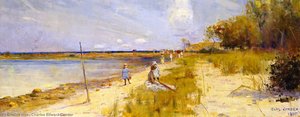
Charles Edward Conder’s “Dieppe,” painted in 1895, isn't merely a depiction of a coastal scene; it’s an immersion into a fleeting moment of tranquility and observation. The canvas breathes with the muted palette of a late afternoon – a symphony of blues deepening towards the horizon, punctuated by the warm ochres and yellows of the sand and distant buildings. The composition immediately draws the eye along a gentle diagonal path created by the sandy track leading toward the figures strolling along the beach. This isn’t a dramatic seascape; rather, it's an invitation to pause, to contemplate the quiet rhythm of daily life unfolding against the vastness of the sea.
The subject matter itself is deceptively simple: a group of people enjoying a seaside walk. Yet Conder elevates this commonplace activity through his masterful use of Impressionistic techniques. He’s less concerned with precise representation and more interested in capturing the *feeling* of the scene – the diffused light, the sense of warmth, the subtle interplay of color and texture. The figures are rendered with loose brushstrokes, their forms dissolving into the atmosphere, suggesting a momentary impression rather than a detailed portrait.
Impressionistic Techniques: A Dance of Light and Color
Conder’s approach is deeply rooted in Impressionism, a movement that sought to capture the subjective experience of light and color. Notice how he employs broken brushstrokes – short, distinct marks applied side-by-side rather than blended smoothly. This creates a shimmering effect, mimicking the way sunlight dances on water and reflects off surfaces. The layering of paint is equally significant; visible texture adds depth and richness to the canvas, inviting the viewer to examine the surface closely.
The color choices are deliberately restrained, contributing to the overall mood of serenity. He avoids bright, saturated hues, opting instead for a harmonious blend of blues, yellows, and browns. This creates a sense of atmospheric perspective – distant elements appear paler and less distinct, reinforcing the feeling of depth and distance. The use of complementary colors—the blue sky contrasted with the warm sand—further enhances the visual interest and vibrancy of the scene.
Historical Context: The Heidelberg School and Australian Modernism
To understand “Dieppe,” it’s crucial to consider Conder's place within the broader context of Australian art. He was a key figure in the Heidelberg School, a group of artists who developed a distinctly Australian style influenced by Impressionism and Post-Impressionism. Based in Melbourne, the Heidelberg School sought to capture the unique landscapes and light conditions of Victoria’s rural areas.
Conder's move to Sydney in 1884 marked a pivotal moment in his career. He quickly established himself as a talented landscape painter, experimenting with new techniques and styles. “Dieppe” reflects this period of artistic exploration, showcasing Conder’s growing mastery of Impressionistic principles while retaining a distinctly Australian sensibility. The painting's subject matter – a seaside scene – resonated deeply with the Heidelberg School’s focus on capturing the beauty of the natural world.
Symbolism and Emotional Resonance: A Moment of Quiet Reflection
Beyond its technical merits, “Dieppe” possesses a subtle yet powerful symbolic resonance. The figures strolling along the beach represent leisure, connection, and the simple pleasures of life. The vast expanse of the sea symbolizes both opportunity and uncertainty – a reminder of the world beyond our immediate surroundings. The painting evokes a sense of quiet contemplation, inviting the viewer to slow down and appreciate the beauty of the present moment.
Ultimately, “Dieppe” is more than just a landscape; it’s a meditation on light, color, and human experience. It's a testament to Conder's artistic vision and his ability to capture the essence of a fleeting scene with remarkable sensitivity and skill. A reproduction of this work offers a beautiful addition to any collection, bringing a touch of Impressionistic serenity into your home.
Ερωτήσεις και Απαντήσεις
Ποιος είναι ο δημιουργός και σε ποια χρονιά δημιουργήθηκε το "Dieppe";
Το έργο "Dieppe" δημιουργήθηκε από τον/την Χάρλς Έντουαρδος Κόντερ το 1895.
Το έργο "Dieppe" του Χάρλς Έντουαρδος Κόντερ είναι πορτρέτο, τοπίο ή τετράγωνη σύνθεση;
Το σχήμα του "Dieppe" είναι Landscape. Αυτό είναι χρήσιμο όταν σχεδιάζετε την τοποθέτηση μιας αναπαραγωγής.
Τι απεικονίζει το "Dieppe" του Χάρλς Έντουαρδος Κόντερ;
Τα θέματα που περιλαμβάνονται στο "Dieppe" του Χάρλς Έντουαρδος Κόντερ περιλαμβάνουν το/τα seaside, beach, landscape, impressionism, leisure, tranquility, figures, atmosphere. Μαζί, συνοψίζουν το περιεχόμενο του έργου τέχνης.
Βιογραφικό Καλλιτέχνη
Early Life and Artistic Journey
Charles Edward Conder (1868 – 1909) was an English-born painter, lithographer and designer who emigrated to Australia and became a pivotal figure in the Heidelberg School*, arguably marking the genesis of a distinctive Australian tradition within Western art. Born in Tottenham, Middlesex, the second son of six children, James Conder, civil engineer and Mary Ann Ayres, possessed a lineage steeped in artistic heritage – his father was Louis-François Roubiliac, renowned sculptor.
From a young age, Conder experienced profound influence from India, where he resided until his mother’s untimely passing in May 1873 at the tender age of 31. Subsequently, he returned to England and attended several schools including Eastbourne School, fostering an early inclination towards formal education.
Despite his father's preference for a career in engineering—a path antithetical to Conder’s innate artistic sensibilities—he pursued his passion relentlessly, recognizing it as a fundamental aspect of his identity.
Australia and the Heidelberg School
In 1884, at the age of 16, Conder embarked on a transformative journey to Sydney, Australia, where he joined his uncle’s firm as a land surveyor. However, this profession proved unfulfilling compared to his burgeoning fascination with landscape painting—a pursuit that swiftly superseded his surveyor's duties.
By 1886, Conder secured employment at *Illustrated Sydney News*, collaborating alongside fellow artists such as Albert Henry Fullwood and Frank Mahony. He enrolled in painting classes under Alfred James Daplyn and quickly established connections with Julian Ashton, immersing himself in the vibrant artistic milieu of Melbourne.
Crucially, Conder’s association with G. P. Nerli—an itinerant Italian painter—significantly broadened his artistic horizons, introducing him to European stylistic innovations. This encounter profoundly shaped his creative trajectory.
Together with Tom Roberts and Arthur Streeton, Conder participated in the Heidelberg School exhibition of 1888, cementing his position as a cornerstone of this groundbreaking movement. The exhibition showcased a bold departure from academic conventions, prioritizing spontaneity and capturing the ephemeral beauty of the Australian bush.
Notable Works and Artistic Style
Conder’s magnum opus, *Departure of the Orient – Circular Quay* (1888), exemplifies his mastery of form and brushwork. This evocative depiction of Sydney Harbour at dusk—the moment when the *has cast off for her voyage to England*—immediately garnered acclaim from the Art Gallery of New South Wales, securing its place as Conder’s inaugural work within a public collection.
Alongside Roberts, Conder captured the idyllic charm of Mentone (1888), portraying a serene seaside scene replete with leisurely figures enjoying the warmth of the Australian sun. The painting's composition—borrowed from Whistler’s celebrated bridge motif—underscores Conder’s sensitivity to artistic precedent.
Conder’s oeuvre encompasses a diverse range of subjects, including portraits and lithographs, reflecting his versatility as an artist. His paintings are characterized by luminous color palettes, textured brushstrokes, and a masterful rendering of light—elements that imbue his artworks with palpable emotion and immediacy.
Legacy and Later Life
Despite facing debilitating health challenges—including paralysis and delirium tremens—Conder persevered in his artistic endeavors until his untimely demise in 1909. His art gained considerable recognition upon returning to England, surpassing the acclaim he received during his Australian years.
Henri de Toulouse-Lautrec immortalized Conder’s likeness in a portrait completed in 1892—a testament to Conder's enduring presence within the artistic landscape of his time.

Χάρλς Έντουαρδος Κόντερ
1868 - 1909 , Ηνωμένο Βασίλειο
Γρήγορα στοιχεία
- Artistic Movement Or Style: Heidelberg School
- Artists Who Influenced This Artist:
- Alfred Daplyn
- Victor Mann
- Julian Ashton
- Date Of Birth: October 24, 1868
- Date Of Death: February 9, 1909
- Full Name: Charles Edward Conder
- Nationality: British
- Notable Artworks:
- Departure of the Orient – Circular Quay
- A holiday at Mentone
- Under The Southern Sun
- Place Of Birth: Tottenham, United Kingdom
Σχετικά άρθρα
Capturing the Soul: The Most Emotionally Moving Impressionist and Post-Impressionist Masterpieces
Discover the profound emotional depth of Impressionist and Post-Impressionist masterpieces. Explore how legends like Monet, Van Gogh, and Gauguin captured light and soul through evocative landscapes and vibrant brushwork for a timeless connection to art history.

Beyond the Horizon: A Curated Guide to Integrating Post-Impressionist Landscapes into Modern Interiors
Transform your home with the emotive power of Post-Impressionist landscapes. Discover expert tips on selecting hand-painted oil reproductions to create a soulful, vibrant interior that reflects your unique style and connection to nature.

Οι 10 Κορυφαίοι Καμβάδες που Όρισαν τον Ιμπρεσιονισμό: Ένα Ταξίδι στην Φύση και την Τέχνη
Ανακαλύψτε τους 10 κορυφαίους πίνακες ιμπρεσιονισμού που καθόρισαν το τοπίο στην τέχνη! Μονέ, Ρενουάρ & άλλοι ζωγράφοι. Βρείτε αναπαραγωγές υψηλής ποιότητας για να εμπνεύσετε τον χώρο σας. Εξερευνήστε τη συλλογή στο OriginalUniqueArt.com
Golden Fields & Sun-Drenched Meadows: Capturing the Soul of Impressionist Landscapes
Immerse yourself in the luminous world of Impressionist landscapes. Discover how masters like Monet and Gauguin captured ephemeral light through plein air painting, and learn to bring the soul of sun-drenched meadows into your home with exquisite, hand-painted oil reproductions.

Οι 10 Κορυφαίοι Καμβάδες που Όρισαν τον Ιμπρεσιονισμό και το Τοπίο
Ανακαλύψτε τους 10 κορυφαίους πίνακες ιμπρεσιονισμού που καθόρισαν το τοπίο! Μονέ, Ρενουάρ & άλλοι. Ιστορίες τεχνικής και έμπνευσης. Βρείτε αναπαραγωγές υψηλής ποιότητας για τον χώρο σας στο OriginalUniqueArt.com