Πορτρέτο του Hieronymus Janssens

Τα 21 πιο διάσημα έργα του Hieronymus Janssens, κάθε ένα μοναδικό

Ενημερωμένο Νοέμβριος 2026 · κατάταξη βάσει του σκορ δημοφιλίας μας (αναζητήσεις, επισκέψεις και παραγγελίες για κάθε έργο) · 22 έργα του Hieronymus Janssens στον κατάλογό μας

Με σύντομη περιγραφή

Το έργο The Menuet (1650) είναι το ποίτευμα του Hieronymus Janssens που τραβάει τα περισσότερα βλέμματα· το πρωτότυπο ανήκει στο Bavarian State Painting Collections, Μόναχο. Μετά από αυτό, το βλέμμα στρέφεται στο Charles II dancing at a Ball at Court (1660) και στο Game of Main chaude"" (1650). Ανάμεσα στα 22 έργα του Hieronymus Janssens στον κατάλογό μας, αυτά τα 21 είναι τα πιο διάσημα, το καθένα ένα μοναδικό πρωτότυπο που παρουσιάζεται με την χρονολογία του, το μουσείο του και τον λόγο για τον οποίο παραμένει αιώνιο.

1624 – 1693, Antwerp Baroque Περισσότερα έργα: Bavarian State Painting Collections

Τα 10 κορυφαία έργα του Hieronymus Janssens, μέσα από το βλέμμα της γκαλερί

2
Charles II dancing at a Ball at Court (1660) του Hieronymus Janssens

Charles II dancing at a Ball at Court

1660 · Oil · Royal Collection, Λονδίνο

The scene unfolds within the grand, crowded atmosphere of a ball in The Hague, where the air seems to hum with the movement of a courtly gathering. In this lively moment, Hieronymus Janssens captures King Charles II of England as he engages in dance. He moves through the hall alongside his sister, Mary of Orange, their figures central to the swirling activity of the room. This elegant display of social…

6
A Picture Gallery with Fashionable Visitors (1664) του Hieronymus Janssens

A Picture Gallery with Fashionable Visitors

1664 · Oil On Canvas · Uppark

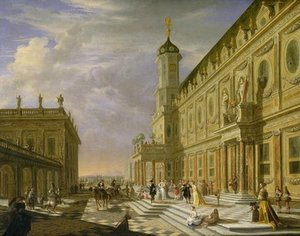
In the quiet, grand halls of an imaginary gallery, we find ourselves amidst the elegant company of A Picture Gallery with Fashionable Visitors. This work, painted by Hieronymus Janssens, transports the viewer into a meticulously constructed space where the boundaries between reality and art dissolve. The scene unfolds within a vast, opulent interior, a setting that invites us to linger among the figures gathered there. It is a moment frozen…

7
The Game of Pat-a-Cake (1675) του Hieronymus Janssens

The Game of Pat-a-Cake

1675 · Oil On Canvas

The Game of Pat-a-Cake is an oil painting by the Flemish genre painter Hieronymus Janssens. This work originates from the mid-seventeenth century. The subject matter focuses on social interaction and leisure among a group of figures. The scene is set within a landscape that includes trees and architectural elements such as columns.

Τα διάσημα έργα του Hieronymus Janssens, από το 11 έως το 21

Τα θέματα που κίνησαν το ενδιαφέρον του Hieronymus Janssens

Τα τέσσερα θέματα που εμφανίζονται πιο συχνά σε αυτά τα πρωτότυπα έργα, το καθένα με το εξαιρετικό του παράδειγμα.

Τα μουσεία που διατηρούν τα πρωτότυπα έργα του Hieronymus Janssens

Τα 8 μουσεία που φιλοξενούν το μεγαλύτερο μέρος των έργων σε αυτήν τη σελίδα.

Μουσείο Πόλη Έργα του Hieronymus Janssens Πάτρια από αυτή τη λίστα
Bavarian State Painting Collections, ΜόναχοBavarian State Painting Collections Μόναχο 1 The Menuet
Royal Collection, ΛονδίνοRoyal Collection Λονδίνο 1 Charles II dancing at a Ball at Court
Museum of Fine Arts Ghent (MSK), GhentMuseum of Fine Arts Ghent (MSK) Ghent 1 Game of Main chaude""
Βασιλικά Μουσεία Καλών Τεχνών της Βελγίου, ΒρυξέλλεςΒασιλικά Μουσεία Καλών Τεχνών της Βελγίου Βρυξέλλες 1 Patty-cake
Hallwyl Museum, ΣτοκχόλμηHallwyl Museum Στοκχόλμη 1 Portrait of a Family
UpparkUppark 1 A Picture Gallery with Fashionable Visitors
Palais des Beaux-Arts de Lille, ΛιλPalais des Beaux-Arts de Lille Λιλ 1 A Ball on the Terrace of a Palace
Ερμιτάζ, Σουζ ή Αγία ΠετρούποληΕρμιτάζ Σουζ ή Αγία Πετρούπολη 1 The Ball -

Ο Hieronymus Janssens μέσα από τις δεκαετίες: ένα μοναδικό πρωτότυπο για κάθε εποχή

Έργα ανά δεκαετία

Επιλέξτε μια δεκαετία για να δείτε το πρωτότυπο έργο που την χαρακτηρίζει.

Οι πίνακες του Hieronymus Janssens: ερωτήσεις για την γκαλερί

Ποιο είναι το πιο διάσημο έργο του Hieronymus Janssens;Αποκαλύψτε την απάντηση

The Menuet (1650), Bavarian State Painting Collections, Μόναχο. Στη συνέχεια ακολουθούν το Charles II dancing at a Ball at Court (1660) και το Game of Main chaude"" (1650).

Σε τι ηλικία δημιούργησε ο/η Hieronymus Janssens το έργο The Menuet;Αποκαλύψτε την απάντηση

26 ετών: το έργο The Menuet είναι του 1650, και ο/η Hieronymus Janssens γεννήθηκε το 1624.

Ποια είναι τα δέκα πιο διάσημα έργα του Hieronymus Janssens;Αποκαλύψτε την απάντηση

The Menuet, Charles II dancing at a Ball at Court, Game of Main chaude"", Patty-cake, Portrait of a Family, A Picture Gallery with Fashionable Visitors, The Game of Pat-a-Cake, A Gentleman Paying Court, A Ball on the Terrace of a Palace και A Feast in an Interior. Η κατάταξη παραπάνω αναγράφει το έτος και το μουσείο για το κάθε έργο.

Πόσα έργα του Hieronymus Janssens είναι γνωστά;Αποκαλύψτε την απάντηση

Ο κατάλογός μας περιλαμβάνει 22 έργα του Hieronymus Janssens, με ημερομηνίες από 1650 έως 1675.

Πού μπορούν να θαυμαστούν τα πιο διάσημα πρωτότυπα έργα του Hieronymus Janssens;Αποκαλύψτε την απάντηση

Κυρίως σε Bavarian State Painting Collections (Μόναχο), Royal Collection (Λονδίνο) και Museum of Fine Arts Ghent (MSK) (Ghent). Ο πίνακας μουσείου παραπάνω τους περιλαμβάνει όλους.

Κατά ποια περίοδο δημιούργησε ο/η Hieronymus Janssens τα πιο γνωστά του/της έργα;Αποκαλύψτε την απάντηση

Κατά την περίοδο 1650s: 4 από τα 21 έργα σε αυτήν τη σελίδα δημιουργήθηκαν τότε, με The Menuet από αυτά να είναι μοναδικά.

Ποιο διάσημο έργο του Hieronymus Janssens είναι το παλαιότερο και ποιο το νεότερο;Αποκαλύψτε την απάντηση

Σε αυτήν τη σελίδα, το παλαιότερο είναι The Menuet (1650) και το νεότερο The Game of Pat-a-Cake (1675).

Ποια θέματα προτίμησε ο/η Hieronymus Janssens;Αποκαλύψτε την απάντηση

People (7), Architecture (5) και Figures (4), σε συνολικά 21 έργα σε αυτήν τη σελίδα.

Με ποια υλικά χρησιμοποίησε περισσότερο ο Hieronymus Janssens;Αποκαλύψτε την απάντηση

Oil On Canvas, για 4 από τα 21 έργα σε αυτήν τη σελίδα.

Ποιο καλλιτεχνικό κίνημα ανήκει το έργο του Hieronymus Janssens;Αποκαλύψτε την απάντηση

Baroque, όπως προκύπτει από τα πρωτότυπα σε αυτήν τη σελίδα.

Hieronymus Janssens: ένα πορτρέτο του καλλιτέχνη

Hieronymus Janssens: The Painter of Elegant Company

Born in Antwerp in 1624 and passing away there in 1693, Hieronymus Janssens – often referred to as “Den Danser” or “the dancer” – stands as a pivotal figure in the development of Flemish genre painting during the mid-seventeenth century. His legacy isn’t one of grand historical narratives or religious fervor, but rather a captivating portrayal of aristocratic leisure and social life within meticulously rendered interiors and expansive outdoor settings. Janssens wasn't merely documenting scenes; he was crafting carefully constructed conversations, inviting viewers into a world of refined entertainment, musical performance, and subtle moral commentary.

Janssens’ artistic journey began under the tutelage of Christoffel Jacobsz van der Laemen in 1636-1637. This early training laid the groundwork for his future specialization in dance scenes – a genre he would master with remarkable skill and influence. He formally registered as a master in the Guild of Saint Luke in Antwerp in 1643-1644, marking his entry into the professional art world. His marriage to Catharina van Dooren in 1650 solidified his domestic life while simultaneously fueling his artistic output. Throughout his career, Janssens was a prolific artist, taking on four pupils – including Jacob Lafosse (III) – demonstrating a commitment to passing down his techniques and vision. His works are frequently signed and dated between 1646 and 1661, providing valuable insight into the timeline of his creative endeavors.

The World of ‘Conversation Pieces’

Janssens' paintings primarily fall under the umbrella of what became known as “conversation pieces.” This burgeoning genre, particularly prominent in Antwerp during this period, moved away from the dominant themes of religious and mythological subjects. Instead, it focused on depicting scenes of everyday aristocratic life – gatherings filled with music, dance, conversation, and often, a touch of revelry. These paintings weren’t intended as mere decorative objects; they were designed to be viewed and discussed, fostering social interaction amongst their patrons.

His compositions are characterized by an acute attention to detail, meticulously rendered costumes, elaborate interiors, and the subtle nuances of human expression. Janssens skillfully captured the atmosphere of these gatherings, conveying a sense of both elegance and underlying tension. He frequently depicted dance scenes set within grand houses or on expansive terraces – locations that served as backdrops for intricate social interactions. The nickname “Den Danser” arose from his specialization in these dynamic depictions of movement and grace.

Architectural Visions and Influences

Beyond the lively gatherings, Janssens also excelled at architectural paintings, often creating imaginary palaces, churches, temples, and art galleries. These works demonstrate a sophisticated understanding of perspective and design, drawing inspiration from both existing buildings – notably the house of Rubens in Antwerp – and prints by Hans Vredeman de Vries, a prominent Northern Renaissance artist known for his innovative use of linear perspective. Janssens skillfully combined elements of classical architecture with imaginative embellishments, creating visually stunning and often theatrical spaces.

His architectural paintings frequently incorporated chiaroscuro—the dramatic contrast between light and shadow—to heighten the sense of drama and depth. He collaborated on several projects with other artists like Dirck van Delen, Wilhelm Schubert van Ehrenberg, and Jacobus Ferdinandus Saey, showcasing a collaborative approach to artistic creation.

Rubens’ Legacy and Moral Undertones

Janssens' work is inextricably linked to the legacy of Peter Paul Rubens, one of the most influential painters of the Baroque era. Janssens admired Rubens’ ability to capture movement and emotion, particularly evident in his famous “Garden of Love” (Prado Museum). Rubens demonstrated how a garden could be used as a setting for amorous dalliance and courtship – an idea that Janssens adopted and developed in his own paintings. Many of Janssens' elegant company scenes, such as depictions of the Prodigal Son dining with a music-making party, subtly carry moralistic messages, reflecting the societal concerns of the time.

For example, some of these scenes depict excessive drinking and apparent dissolute behavior, suggesting a critique of aristocratic excess. However, Janssens’ art wasn't simply didactic; it also celebrated the pleasures of refined society, capturing the beauty and sophistication of the Dutch elite. His work served as a visual commentary on social norms and values, offering both entertainment and subtle moral instruction.

Notable Works and Lasting Influence

Among Janssens’ most notable works are “Ball on the Terrace of a Palace” (Palais des Beaux-Arts de Lille, 1658) and “A Picture Gallery with Fashionable Visitors” (Uppark House and Garden, West Sussex), both dated to the 1660s. These paintings exemplify his mastery of composition, detail, and atmospheric perspective. Janssens’ influence extended beyond his own lifetime, inspiring later Flemish genre painters such as Jan Josef Horemans the Younger, whose “Presenting the Newborn” borrowed heavily from Janssens' "Ball on the Terrace." His contributions to the development of the ‘conversation piece’ genre cemented his place as a significant figure in 17th-century art.