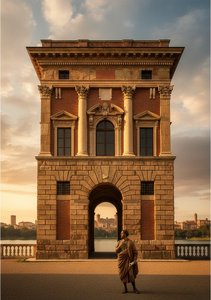
Eine Symphonie der Mannerismen: Palazzo del Te enthüllt
Nestled just outside the walls of Mantua, Italy, Palazzo del Te stands as a breathtaking testament to Renaissance artistry and architectural innovation. More than simply a palace, it’s an immersive experience—a journey into the mind of Giulio Romano, Raphael’s brilliant pupil, and a profound reflection on power, leisure, and the very nature of illusion. Constructed between 1524 and 1534 for Federico II Gonzaga, the shrewd and ambitious Marquess of Mantua, this suburban masterpiece initially served as a private retreat—a space designed to embody the opulent lifestyle of its patron and showcase his burgeoning authority.
The palace’s genesis is rooted in the Gonzaga family's ambition and their strategic use of landscape. The site itself—an island connected to the city by a bridge—was chosen for its relative seclusion and proximity to the marshlands, providing both privacy and access to resources. Romano was tasked with transforming this humble location into a dazzling spectacle, blending elements of palace architecture with the more relaxed aesthetic of a villa – a deliberate choice that signaled a shift away from rigid formality and towards a more dynamic, playful approach to design. The resulting structure is characterized by its asymmetrical facades, irregular spans, and a masterful interplay of light and shadow, creating an atmosphere both grand and intimate.
Die außergewöhnliche Freskenkunst: Eine Reise in die Welt der Mythologie und Emotionen
The true heart of Palazzo del Te lies within its extraordinary frescoes, a series of interconnected narratives that unfold across the palace’s numerous rooms. Giulio Romano, alongside his team of skilled artisans including Benedetto Pagni and Rinaldo Mantovano, embarked on an ambitious project to transform every surface into a canvas for myth, allegory, and sheer visual delight. The Hall of Giants is arguably the most famous—a chaotic spectacle where colossal figures wrestle with gods and demons, creating a dizzying sense of movement and drama. Here, Romano’s signature style – known as Mannerism – is fully realized: elongated forms, distorted perspectives, and an emphasis on emotional intensity over realistic representation.
Other notable fresco cycles include the Hall of Psyche, depicting the goddess's passionate love affair with Cupid, and the Hall of Horses, a vibrant celebration of equestrian prowess. Each room tells a story, often interwoven with mythological themes and subtle political commentary reflecting Federico II Gonzaga’s ambitions. The sheer scale and complexity of these frescoes are astonishing, demanding careful observation to fully appreciate their intricate details and layered meanings. The use of *spezzato*—a technique involving deliberately blemished plaster—adds depth and texture to the surfaces, further enhancing the illusionistic effect.
Über die Mauern hinaus: Mesopotamische Schätze
While the palace’s frescoes are undoubtedly its primary draw, Palazzo del Te also houses a fascinating collection of Mesopotamian artifacts within the Museo Civico. This unexpected addition provides a compelling contrast to the Renaissance setting, showcasing the Gonzaga family's interest in ancient civilizations and their connections to broader historical narratives. The museum’s holdings include cuneiform tablets, cylinder seals, pottery fragments, and other objects that offer insights into the daily life, religious beliefs, and artistic traditions of Mesopotamia—a civilization thousands of years removed from Renaissance Italy.
Ein Vermächtnis bewahrt: Geschichte und Restaurierung
Palazzo del Te’s history is marked by both triumph and tragedy. Constructed during a period of intense political instability, it witnessed the tumultuous events of the War of the Mantuan Succession in 1630, when the palace was ravaged by Imperial troops. Despite this devastating damage, the palace was meticulously restored over centuries, preserving its artistic treasures for future generations. Today, Palazzo del Te stands as a UNESCO World Heritage Site—a testament to the enduring power of art and architecture. It continues to evolve as a cultural center, hosting exhibitions, educational programs, and events that celebrate its rich history and artistic legacy.