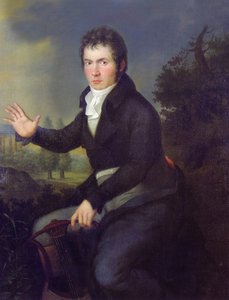
Andy Warhol's Beethoven ist ein einzigartiges Pop Art Gemälde von Ludwig Van Beethoven und verkörpert seinen innovativen Stil. Entdecken Sie dieses ikonische Werk und seine Bedeutung im Kontext der Kunstgeschichte.
Joseph Karl Stieler (1781-1858) war ein bedeutender deutscher Neoklassik Maler und königlich bayerischer Hofmaler. Bekannt für seine beeindruckende Galerie der Schönheiten am Schloss Nymphenburg sowie sein ikonisches Beethoven-Porträt, verkörpert sein Werk die Eleganz und künstlerische Bedeutung des frühen 19. Jahrhunderts.
Als Meister der neoklassizistischen Porträtmalerei ist Joseph Willibrord Mähler berühmt für seine tiefgründigen Darstellungen von Ludwig van Beethoven, die das Wesen des musikalischen Genies mit bemerkenswerter Sensibilität einfangen.
Nestled within the cobblestone heart of Bonn, a city steeped in Prussian grandeur and Rhineland charm, lies the Beethoven-Haus – more than just a museum, it's an immersive journey into the genesis of one of music’s most enduring legacies. This isn’t merely a collection of portraits and manuscripts; it’s a palpable encounter with Ludwig van Beethoven himself, a chance to breathe the same air he breathed as a young boy grappling with genius and tragedy. The building itself, originally constructed in the mid-1700s as a modest townhouse for Johann Baptist Cramer, Bonn’s court organist, whispers stories of aristocratic pasts and quiet reverence – a grounding element that underscores the revolutionary spirit contained within its walls. Careful preservation efforts have meticulously recreated the domestic life surrounding Beethoven's childhood, allowing visitors to almost hear the echoes of his formative years, a crucial context often overlooked in accounts of his later triumphs. The understated elegance of the sandstone façade belies the extraordinary concentration of artistic energy held within, a testament to the city’s role as the cradle of a musical giant.
A Historical Tapestry:
The Beethoven-Haus stands on the site of a building that has witnessed centuries of Bonn's history, evolving from a simple residence to a symbol of musical heritage. Its origins trace back to the early 18th century, reflecting the city’s aristocratic roots and its role as a cultural center.
The Cramer Residence:
Initially home to Johann Baptist Cramer, the court organist, the building gradually became associated with Beethoven's family through various tenants – a testament to its central location within Bonn’s social fabric.
A Birthplace Declared:
In 1840, the house was officially recognized as Beethoven’s birthplace, solidifying its significance and prompting extensive restoration efforts to preserve its historical integrity.
Treasures of a Boyhood: Unveiling Beethoven's Legacy
The museum’s collection is a breathtaking tapestry woven from the threads of Beethoven’s prodigious talent and intellectual curiosity. Dominating the space are original manuscripts – drafts of symphonies like No. 5 (“Fate”) and No. 9 (“Ode to Joy”), sketches for piano sonatas, and handwritten letters documenting his correspondence with fellow musicians and friends. These documents aren't simply historical relics; they’re intimate windows into Beethoven’s creative mind, revealing the painstaking process of transforming musical concepts into masterpieces. Alongside these manuscripts are reproductions of portraits depicting Beethoven at various stages of his life – a young man brimming with ambition, a celebrated composer commanding respect, and an aging artist battling deafness—each image capturing a facet of his complex personality. A particular highlight is the collection of educational materials used by Beethoven himself during his early years, offering a rare glimpse into the rigorous training that shaped his extraordinary abilities. The museum also showcases works by Nikolaus Lauer, a renowned portrait painter who captured the essence of Bonn’s aristocratic society and whose depictions of Beethoven's family provide invaluable insights into the boy's upbringing.
Key Artifacts:
Beethoven’s original manuscripts for his early compositions
Letters exchanged with prominent musicians of his time
Educational materials used during his childhood training
Portraits depicting Beethoven at various stages of his life
The Chamber Music Hall: A Sonic Time Machine
What truly distinguishes the Beethoven-Haus from other museums is its commitment to bringing Beethoven’s music to life within the very space where it originated. The chamber music hall—a beautifully restored room furnished with instruments reminiscent of those Beethoven would have known—hosts regular concerts featuring historic keyboards, recreating the sonic landscape of Beethoven's Bonn. Listening to Schubert’s Piano Trio No. 8 in E-flat Major or Schumann’s Piano Quartet No. 1 in C minor performed on instruments crafted during Beethoven’s time is an immersive experience unlike any other – a chance to connect with Beethoven’s music on a visceral level and understand its intended soundscape within the intimate setting of his birthplace. The hall isn’t just a performance space; it's a portal, transporting visitors back in time to witness the birth of musical innovation.
The significance of this space lies not only in its historical authenticity but also in its ability to evoke the atmosphere of Beethoven’s early years and provide a unique perspective on his creative process.
Architecture and Historical Context
The building itself is a remarkable example of late Baroque architecture, reflecting Bonn's aristocratic past. Constructed around 1700, it showcases the elegance and grandeur characteristic of the period, with its sandstone façade, symmetrical design, and intricate detailing. The restoration efforts undertaken to preserve the Beethoven-Haus have been meticulous, ensuring that the building’s historical integrity is maintained while providing a welcoming space for visitors. Its location in the heart of Bonn—near the city's main square and the Beethovenhalle concert hall—further underscores its cultural significance.
Baroque Elegance:
The building’s design reflects the architectural trends of the late Baroque period, characterized by symmetry, ornamentation, and a sense of grandeur.
Historical Evolution:
Over centuries, the building has undergone various transformations, adapting to different uses while retaining its core structure and historical character.
Strategic Location:
Situated in Bonn’s historic center, the Beethoven-Haus is easily accessible and surrounded by other cultural landmarks, enhancing its appeal as a destination for visitors.
A Singular Resonance: Why Visit Beethoven-Haus Bonn?
A visit to Beethoven-Haus Bonn transcends mere sightseeing; it’s an encounter with the genesis of musical innovation—a pilgrimage to the birthplace of one of history’s most revered composers. The museum’s deliberate focus on Beethoven’s early life and influences – often overshadowed by accounts of his later triumphs – provides crucial insight into the foundations upon which his genius was built. As you wander through its rooms, surrounded by echoes of Bonn’s past and bathed in the glow of musical remembrance, you'll grasp why Beethoven-Haus Bonn remains a beacon for those captivated by art, history, and the enduring power of human creativity—a place where Beethoven’s spirit continues to resonate powerfully into the 21st century.
Vom OriginalUniqueArt.com Redaktionsteam
Kunst-Quiz
Jede Frage hat nur eine richtige Antwort.
Frage 1:
Welche Hauptfokus hat das Beethoven-Haus Bonn?
Frage 2:
In welcher Stadt befindet sich das Beethoven-Haus Bonn?
Frage 3:
Welches beschreibt am besten den Gebäudekomplex, in dem das Beethoven-Haus steht?
Frage 4:
Welche Art von musikalischer Erfahrung wird im Kammermusiksaal angeboten?
Frage 5:
Welchen Aspekt von Beethovens Entwicklung beleuchtet das Museum besonders?
Discover the technical excellence of OriginalUniqueArt.com's premium Giclée prints. Featuring 12-color archival pigments and museum-grade canvas, our prints offer unparalleled vivid detail and longevity for the discerning art collector seeking world-class reproductions.
OStudio-AssistentOnline · antwortet innerhalb einer Minute
Hallo! Ich kann Ihnen dabei helfen, ein Kunstwerk auszuwählen, eine Bestellung zu verfolgen oder Fragen zur Garantie zu beantworten. Wie kann ich Ihnen heute behilflich sein?