In echtem Maßstab anzeigen
 Versenden als Grußkarte
 Teilen
 Details anzeigen
 Leitfaden öffnen

 Herunterladen
 Ähnliche Objekte
 Röntgenaufnahme
 Diashow
 Besucherstatistiken
Abstraction
 Acryl auf Leinwand
- Wandkunst
- Abstract Expressionism
 1950
1950- Moderne
 46.0 x 37.0 cm
 Mehr anzeigen
Die auf dieser Seite dargestellten Kunstwerke sind urheberrechtlich geschützt, was bedeutet, dass wir keine identische Reproduktion rechtmäßig erstellen oder verkaufen dürfen. Dieser Schutz wird durch internationale Abkommen wie die Berner Übereinkunft und durch nationale Gesetze, einschließlich derer, die von den ... festgelegt wurden US-Urheberrecht – Titel 17.
Diese Methode entspricht vollumfänglich den Urheberrechtsbestimmungen, da sie keine Kopie oder Vervielfältigung des geschützten Kunstwerks darstellt. Stattdessen handelt es sich um eine kreative Neuinterpretation – ein neues Gemälde, das vom Original inspiriert, aber nicht identisch mit ihm ist.
Giclée / Kunstdruck
Giclée- oder Leinwanddruck in Museumsqualität mit schneller Produktion und flexiblen Veredelungsoptionen. ( Handgemalte Reproduktion kaufen Zum digitalen Bild wechseln)




P118B €10

P118H €10

P118W €10

P438Z €10

P508JH €12

P508YH €12

P805H €10

P805Z €10

P919BZ €10

P919G €10

P919XJ €10

P959ZH €10

P968JZ €12

W106C €8

W218G €10

W218JH €8

W218Y €10

W307PJ €10

W316G €10

W316PJ €8

W316Y €10

W398PJ €8

W4111J €10

W500HY €15

W500JH €15

W692G €12

W849H €8

W940BG €15

W953PJ €8




Wählen Sie aus unseren vordefinierten Formaten, die den ursprünglichen Proportionen des Kunstwerks entsprechen.

Sie können Ihre eigenen Maße eingeben, um ein bestimmtes Format oder einen speziellen Platz einzupassen. Wenn das von Ihnen gewählte Format nicht den Proportionen des Originalbildes entspricht, werden wir das Kunstwerk entweder beschneiden oder das Bild mit einem gespiegelten oder einfarbigen Rand erweitern. Ein digitaler Entwurf wird Ihnen zur Genehmigung zugesandt, bevor die Produktion beginnt.
Bitte beachten Sie, dass die Vorschau auf dem Bildschirm nicht den tatsächlichen Zuschnitt oder die Erweiterung widerspiegelt. Nur der Entwurf zeigt die endgültige Komposition präzise an.
Obwohl Sondermaße verfügbar sind, empfehlen wir die Auswahl eines Maßes aus der vordefinierten Liste, um die ursprünglichen Proportionen zu bewahren.
Weltweiter Versand () innerhalb von 2 Wochen statt der üblichen 4/5 Wochen. (11 Oktober)

Kostenloser weltweiter Expressversand

Hochwertige Leinenleinwand

Vollständiger Versicherungsschutz beim Versand

Zollgebühren-Rückerstattungsgarantie

Garantie für exakte Farbtreue

100-tägiges Rückgaberecht (nur bei Mängeln)

100% Geld-zurück-Garantie

Angebot für Mengenrabatt
 Die Glasoption ist nur für Größen unter 110 cm verfügbar.

Abstraction
Giclée / Kunstdruck
Format der Reproduktion
-


Gesamtpreis
€ 69
Abstraction by Willem de Kooning: A Symphony of Movement and Emotion
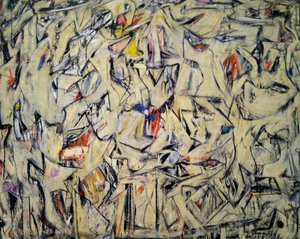
Willem de Kooning’s “Abstraction,” painted in 1950, stands as a cornerstone of Abstract Expressionism—a movement that irrevocably altered the landscape of twentieth-century art. More than just pigment on canvas; it's an embodiment of raw emotion, impulsive gesture, and a profound rejection of representational illusion.
Size & Composition: Measuring 46 x 37 cm, this relatively large piece commands attention immediately. The painting’s dynamism is palpable—a swirling vortex of figures and horses rendered in bold strokes. De Kooning eschewed traditional compositional rules, opting instead for a fragmented arrangement that prioritizes energy over visual harmony. Several individuals populate the scene, positioned in varying postures, creating an interplay of movement and interaction.
Color Palette & Technique: Dominating the canvas is a vibrant expanse of yellow—a hue chosen deliberately to infuse the artwork with warmth and luminosity. Thick impasto technique—applying paint thickly onto the surface—is central to De Kooning’s style, resulting in textured surfaces that capture the physicality of his brushstrokes. These marks aren't merely decorative; they convey an urgency and spontaneity that reflects the artist’s emotional state.
- Historical Context: “Abstraction” emerged during a pivotal moment in artistic history—the rise of Abstract Expressionism as a reaction against European Surrealism and Cubism. De Kooning's work aligned with the broader ethos of the movement, which championed individualism and explored subconscious impulses.
- Symbolism & Interpretation: While devoid of explicit narrative content, “Abstraction” invites contemplation about themes of struggle, transformation, and primal instinct. The horses symbolize power and untamed energy—mirroring De Kooning’s own artistic vision.
- Influence & Legacy: De Kooning's influence extended far beyond Abstract Expressionism, impacting subsequent movements like Pop Art and shaping the aesthetic sensibilities of artists across generations. “Abstraction” remains a testament to his pioneering spirit and its enduring appeal speaks to the universal desire for expressive art.
Further Exploration: For a deeper understanding of Willem de Kooning’s artistic journey, consider visiting MOMA and delving into “Woman I,” another iconic masterpiece showcasing his distinctive style.
Fragen & Antworten
In welchem Jahr wurde "Abstraction" geschaffen?
"Abstraction" von Willem de Kooning entstand im Jahr 1950.
Welchen Kontrast weist "Abstraction" von Willem de Kooning auf?
Der Hell-Dunkel-Kontrast von „Abstraction“ wird mit Ausgewogen angegeben. Der Kontrast beschreibt, wie stark sich helle und dunkle Bereiche voneinander unterscheiden.
Wie populär ist "Abstraction" innerhalb von Abstract Expressionism?
"Abstraction" wird im Katalog als Ikonisch unter den Werken der Abstract Expressionism geführt.
Wer ist der Künstler hinter "Abstraction"?
Der Künstler hinter „Abstraction“ ist Willem de Kooning. Das Werk ist unter dem Namen von Willem de Kooning katalogisiert.
Welche Technik und welcher Stil charakterisieren "Abstraction" von Willem de Kooning?
In "Abstraction" trifft die Acryl auf Leinwand-Technik auf die Abstract Expressionism-Strömung.
In welchem Alter schuf Willem de Kooning „Abstraction"?
Willem de Kooning war 46 Jahre alt, als Abstraction im Jahr 1950 geschaffen wurde. Das Alter berechnet sich aus dem Geburtsjahr des Künstlers, 1904.
Welche Farbidentität weist "Abstraction" von Willem de Kooning auf?
Die Farbidentität von "Abstraction" von Willem de Kooning: eine Erdig-Palette, dominiert von Bronze (#e0a63f).
Biografie des Künstlers
frühes Leben und Karriere
Willem de Kooning, ein renommierter niederländisch-amerikanischer abstrakter Expressionist, wurde am 24. April 1904 in Rotterdam, Niederlande, geboren. Seine Eltern, Leendert de Kooning und Cornelia Nobel, trennten sich 1907, und Willem de Kooning lebte zunächst mit seinem Vater, bevor er in die Obhut seiner Mutter überging. Er verließ die Schule 1916 und arbeitete als Lehrling in einer Werbeagentur.Künstlerische Entwicklung
De Kooning besuchte von 1916 bis 1924 Abendkurse an der Akademie für Bildende Künste und Technische Wissenschaften in Rotterdam. Im Jahr 1927 zog er nach New York City, wo er als Hausmaler arbeitete und seinen einzigartigen künstlerischen Stil entwickelte.Abstrakter Expressionismus
De Koonings Werk verschob sich in den späten 1950er Jahren hin zum abstrakten Expressionismus, der durch kräftige Pinselstriche und leuchtende Farben gekennzeichnet ist. Sein Gemälde Woman I (1950-1952) ist ein wegweisendes Werk dieser Bewegung, das Figuration mit Spontaneität und emotionaler Intensität verbindet.Bekannte Werke und Sammlungen
* The Glazier (137 x 112 cm, Öl auf Leinwand): Ein düsteres, erdtoniges Gemälde, inspiriert von den Fresken von Boscoreale. * Door to the River (Abstrakter Expressionismus): Ein breitschichtiges Gemälde, das an seine Tätigkeit als Hausmaler erinnert. * Standing Man (Abstrakter Expressionismus): Ein charakteristisches Beispiel für De Koonings abstrakten Expressionismus.Museen und Sammlungen
* Museum Boijmans van Beuningen, Rotterdam, Niederlande: Bietet eine beeindruckende Sammlung von über 151.000 Kunstwerken. * Universitätsbibliothek Leiden, Niederlande: Ein bedeutendes Kulturzentrum mit über 5.200.000 Büchern und 1.000.000 E-Books. Willem de Koonings Vermächtnis inspiriert weiterhin Künstler und Kunstliebhaber gleichermaßen und festigt seinen Platz als Pionier des abstrakten Expressionismus.
Willem de Kooning
1904 - 1997 , Niederlande
Eckdaten zum Künstler
- Beeinflusste Künstler: ['Arshile Gorky']
- Bemerkenswerte Werke:
- Frau I
- The Glazier
- Excavation
- Geburtsdatum: 24. April 1904
- Geburtsort: Rotterdam, Niederlande
- Künstlerische Bewegung: Abstrakter Expressionismus
- Nationalität: Niederländisch-Amerikanisch
- Todatum: 1997
- Vollständiger Name: Willem de Kooning
Verwandte Artikel

Willem de Kooning: Abstraktion, Geste und die Entwicklung der Nachkriegsamerikanischen Malerei
Entdecken Sie Willem de Koonings revolutionäre Kunst und die Entwicklung des Abstrakten Expressionismus. Expertenanalyse, Investitionspotenzial & Sammlerwert – erfahren Sie mehr auf OriginalUniqueArt.
Beyond Representation: Exploring the Emotional Landscape of Abstract Expressionism
Explore the profound emotional world of Abstract Expressionism with OriginalUniqueArt. Discover key artists like Pollock & Rothko, learn about collecting, and find museum-quality reproductions to inspire your space.

Abstrakter Expressionismus: Die 10 Meisterwerke, die eine Kunstbewegung prägten |
Entdecken Sie die 10 Meisterwerke des Abstrakten Expressionismus! Von Jackson Pollock bis Mark Rothko – erfahren Sie die Geschichten hinter ikonischen Gemälde und finden Sie hochwertige Reproduktionen für Ihr Zuhause. Jetzt bei entdecken!

Goya: Die 25 Meisterwerke des spanischen Genies – Kunst für Ihr Zuhause | OriginalUniqueArt
Entdecken Sie die 25 Meisterwerke von Francisco Goya! Tauchen Sie ein in die düstere Romantik spanischer Malerei, Porträts & Historienbilder. Hochwertige Kunstdrucke auf OriginalUniqueArt.com – für Kunstliebhaber und stilvolles Wohnen.

Kandinsky: Die 25 Meisterwerke des Abstrakten – Kunst für Ihr Zuhause | OriginalUniqueArt
Entdecken Sie die 25 bedeutendsten Gemälde von Wassily Kandinsky! Tauchen Sie ein in die Welt der abstrakten Kunst, des Expressionismus und der Farbkomposition. Hochwertige Kunstdrucke & Inspiration für Ihr Zuhause auf OriginalUniqueArt.com.