In echtem Maßstab anzeigen
 Versenden als Grußkarte
 Teilen
 Details anzeigen
 Leitfaden öffnen

 Herunterladen
 Ähnliche Objekte
 Röntgenaufnahme
 Diashow
 Besucherstatistiken
Monkey in the forest
 Etching
- Modernism
 1971
1971- Modern
 13.0 x 23.0 cm
 Museu de Valores do Banco Central
 Mehr anzeigen
Die auf dieser Seite dargestellten Kunstwerke sind urheberrechtlich geschützt, was bedeutet, dass wir keine identische Reproduktion rechtmäßig erstellen oder verkaufen dürfen. Dieser Schutz wird durch internationale Abkommen wie die Berner Übereinkunft und durch nationale Gesetze, einschließlich derer, die von den ... festgelegt wurden US-Urheberrecht – Titel 17.
Diese Methode entspricht vollumfänglich den Urheberrechtsbestimmungen, da sie keine Kopie oder Vervielfältigung des geschützten Kunstwerks darstellt. Stattdessen handelt es sich um eine kreative Neuinterpretation – ein neues Gemälde, das vom Original inspiriert, aber nicht identisch mit ihm ist.
Giclée / Kunstdruck
Giclée- oder Leinwanddruck in Museumsqualität mit schneller Produktion und flexiblen Veredelungsoptionen. ( Handgemalte Reproduktion kaufen Zum digitalen Bild wechseln)




P118B €10

P118H €10

P118W €10

P438Z €10

P508JH €12

P508YH €12

P805H €10

P805Z €10

P919BZ €10

P919G €10

P919XJ €10

P959ZH €10

P968JZ €12

W106C €8

W218G €10

W218JH €8

W218Y €10

W307PJ €10

W316G €10

W316PJ €8

W316Y €10

W398PJ €8

W4111J €10

W500HY €15

W500JH €15

W692G €12

W849H €8

W940BG €15

W953PJ €8




Wählen Sie aus unseren vordefinierten Formaten, die den ursprünglichen Proportionen des Kunstwerks entsprechen.

Sie können Ihre eigenen Maße eingeben, um ein bestimmtes Format oder einen speziellen Platz einzupassen. Wenn das von Ihnen gewählte Format nicht den Proportionen des Originalbildes entspricht, werden wir das Kunstwerk entweder beschneiden oder das Bild mit einem gespiegelten oder einfarbigen Rand erweitern. Ein digitaler Entwurf wird Ihnen zur Genehmigung zugesandt, bevor die Produktion beginnt.
Bitte beachten Sie, dass die Vorschau auf dem Bildschirm nicht den tatsächlichen Zuschnitt oder die Erweiterung widerspiegelt. Nur der Entwurf zeigt die endgültige Komposition präzise an.
Obwohl Sondermaße verfügbar sind, empfehlen wir die Auswahl eines Maßes aus der vordefinierten Liste, um die ursprünglichen Proportionen zu bewahren.
Weltweiter Versand () innerhalb von 2 Wochen statt der üblichen 4/5 Wochen. (13 Oktober)

Kostenloser weltweiter Expressversand

Hochwertige Leinenleinwand

Vollständiger Versicherungsschutz beim Versand

Zollgebühren-Rückerstattungsgarantie

Garantie für exakte Farbtreue

100-tägiges Rückgaberecht (nur bei Mängeln)

100% Geld-zurück-Garantie

Angebot für Mengenrabatt
 Die Glasoption ist nur für Größen unter 110 cm verfügbar.

Monkey in the forest
Giclée / Kunstdruck
Format der Reproduktion
-


Gesamtpreis
€ 69
A Whimsical Encounter in the Brazilian Wilds
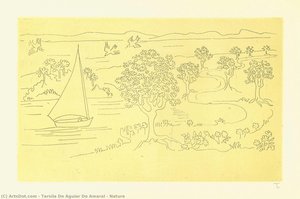
In the delicate interplay of line and imagination, Tarsila do Amaral invites us into a secluded, enchanted corner of the natural world. Her work, Monkey in the Forest, serves as a profound window into a dreamscape where the boundaries between reality and folklore dissolve. The composition centers on a singular, contemplative monkey perched atop a slender tree branch, a figure that seems both grounded in the earth and adrift in a moment of quiet introspection. Surrounding this central protagonist is a rhythmic dance of organic forms, including soft, heart-like shapes that infuse the scene with an unmistakable sense of tenderness and affection. This is not merely a depiction of fauna; it is a poetic meditation on the interconnectedness of life, where every element—from the watchful eyes of the surrounding cats to the intricate textures of the foliage—contributes to a larger narrative of harmony and peace.
The technical mastery displayed in this piece, particularly through its origins as an etching, lends the work a remarkable depth and tactile quality. Even when translated into a reproduction, the fine, intricate linework captures the essence of the artist's precision. The way the light seems to filter through the canopy is suggested by the meticulous detail of the strokes, creating a sense of atmosphere that feels both intimate and expansive. For the discerning collector or interior designer, this piece offers a unique textural richness; it possesses a graphic clarity that commands attention while maintaining a softness that allows it to integrate seamlessly into sophisticated, curated spaces. It is a work that rewards prolonged observation, revealing new layers of detail with every glance.
Modernist Roots and the Spirit of Antropofagia
To truly appreciate Monkey in the Forest, one must understand the revolutionary spirit of its creator. Tarsila do Amaral was not merely a painter; she was a visionary architect of Brazilian identity. Having been shaped by the avant-garde movements of Paris—absorbing the structural lessons of Cubism and the energy of Futurism—she returned to Brazil with a mission to "devour" foreign influences and transform them into something uniquely national. This concept, known as Antropofagia (Anthropophagy), is palpable in this work. While the technique may whisper of European modernism, the soul of the piece is undeniably Brazilian, celebrating the lush, untamed beauty of the local landscape and its inhabitants.
The emotional resonance of the artwork lies in its ability to evoke nostalgia and wonder simultaneously. There is a certain innocence in the composition, a return to a primal, untouched state of nature that speaks to the modern soul's longing for simplicity. For those looking to adorn a home or gallery, this reproduction offers more than just aesthetic beauty; it provides a conversation piece that bridges the gap between historical significance and contemporary decor. It brings into a room a sense of quiet movement and a storied past, making it an ideal selection for spaces designed to inspire thought, tranquility, and a deep appreciation for the enduring magic of the natural world.
Fragen & Antworten
Wie sehen die Reproduktionsrechte für „Monkey in the forest“ im Museu de Valores do Banco Central aus?
Der Urheberrechtsstatus von "Monkey in the forest" von Tarsila do Amaral ist eindeutig: Das Werk ist noch urheberrechtlich geschützt. Seine Präsenz in der Museu de Valores do Banco Central ändert nichts an diesem Status.
Wie viel Licht scheinen die Farben von "Monkey in the forest" zu reflektieren?
"Monkey in the forest" von Tarsila do Amaral weist eine Luminanz von Luminous auf. Die Luminanz beschreibt, wie viel Licht die Farben scheinbar reflektieren.
In welcher Beziehung stehen die Farben von "Monkey in the forest" von Tarsila do Amaral zu dessen emotionaler Wirkung?
In "Monkey in the forest" begleiten Monochrome-Farben ein Playful Gefühl.
Welche Druckgröße von "Monkey in the forest" von Tarsila do Amaral passt in den empfohlenen Raum?
Die ideale Kombination für "Monkey in the forest" von Tarsila do Amaral: ein Druck im Format Small für einen Children's Room.
Für welchen Raum wird "Monkey in the forest" von Tarsila do Amaral empfohlen?
"Monkey in the forest" von Tarsila do Amaral wird für ein Children's Room empfohlen. Dieser Vorschlag basiert auf dem Motiv, den Farben und der Stimmung des Werkes.
An welcher Stelle innerhalb des Gesamtwerks von Tarsila do Amaral lässt sich "Monkey in the forest" einordnen?
"Monkey in the forest" gehört zu Tarsila do Amarals Werk der Modernism-Epoche, dessen dokumentierte Themen unter anderem cubism and futurism influences, brazilian modernist identity, antropofagia movement themes, late career etching work umfassen.
Wo sollte eine Reproduktion von "Monkey in the forest" von Tarsila do Amaral aufgehängt werden?
Mit seiner Landscape-Form wird eine Reproduktion von „Monkey in the forest“ für ein Children's Room empfohlen.
Welche Stellung nimmt „Monkey in the forest“ unter den wiederkehrenden Motiven von Tarsila do Amaral ein?
"Monkey in the forest" stellt monkey, forest, nature, animals, etching, cats, hearts dar, während die dokumentierten Themen von Tarsila do Amaral cubism and futurism influences, brazilian modernist identity, antropofagia movement themes, late career etching work sind. Ein Vergleich der beiden zeigt, wie das Werk mit den üblichen Sujets des Künstlers in Verbindung steht.
Biografie des Künstlers
Frühe Jahre und Ausbildung
Tarsila do Amaral, geboren am 1. September 1886 in Fazenda São Bernardo, Capivari, Bundesstaat São Paulo, war eine brasilianische Malerin und Schlüsselfigur der Anthropophagie-Bewegung. Ihre vollständiger Name lautete Tarsila de Aguiar do Amaral. Sie stammte aus einer wohlhabenden Familie von Kaffeebauern und genoss eine privilegierte Erziehung. Bereits in ihrer Jugend zeigte sie künstlerisches Talent, das von ihrer Familie gefördert wurde. Sie besuchte das Colégio Sion in São Paulo und später das Colégio Sacré-Coeur in Barcelona. Nach ihrer Rückkehr nach Brasilien studierte sie ab 1918 Privatunterricht bei Pedro Alexandrino Borges (1864–1942). Von 1920 bis 1922 absolvierte sie Studien an der Académie Julian und der Académie Moderne in Paris, wo sie von Künstlern wie Fernand Léger, Albert Gleizes und André Lhôte beeinflusst wurde.Die Grupo dos Cinco und ihre Bedeutung für den brasilianischen Modernismus
Nach ihrer Rückkehr nach São Paulo im Juni 1922 lernte Tarsila do Amaral durch die befreundete Malerin Anita Malfatti, ebenfalls Schülerin von Georg Fischer-Elpons, den Schriftsteller Oswald de Andrade (den sie 1926 heiratete), seinen Freund und Autor Mário de Andrade sowie den Maler und Journalisten Menotti Del Picchia kennen. Diese Künstler bildeten die sogenannte „Grupo dos Cinco“ (Gruppe der Fünf). Die Gruppe spielte eine zentrale Rolle in der brasilianischen Moderne, insbesondere durch die Organisation der Semana de Arte Moderna („Woche der modernen Kunst“) im Februar 1922, die als Wegbereiter des Modernismus in Brasilien gilt. Tarsila do Amaral war somit maßgeblich an der Definition und Etablierung einer neuen brasilianischen künstlerischen Identität beteiligt.Anthropophagie: Eine radikale Bewegung
Eines ihrer bekanntesten Werke, Abaporu (1928), wurde zu einem Symbol der Anthropophagie-Bewegung. Der Begriff „Abaporu“ bedeutet in der Tupí-Sprache so viel wie „Menschenfresser“. Die Anthropophagie-Bewegung war eine künstlerische und intellektuelle Reaktion auf den Eurozentrismus und versuchte, die brasilianische Kultur durch die bewusste Aneignung und Umdeutung europäischer Einflüsse neu zu definieren. Tarsila do Amaral und ihre Kollegen griffen dabei Stereotypen und Zuschreibungen über indigene Kulturen auf, um diese zu dekonstruieren und eine neue Form der brasilianischen Identität zu schaffen. Das Gemälde Abaporu, das sich heute im Museu de Arte Latino-Americana in Buenos Aires (MALBA) befindet, wurde für 1,5 Millionen Dollar erworben und gilt als eines ihrer wichtigsten Werke.Künstlerischer Stil und Entwicklung
Tarsila do Amarals künstlerischer Stil entwickelte sich im Laufe ihrer Karriere stetig weiter. In ihren frühen Werken, wie A Negra (1923), zeigt sie bereits Einflüsse des Kubismus und des Futurismus. Später wandte sie sich verstärkt brasilianischen Themen zu, insbesondere der Darstellung von Landschaften und dem Alltag der Bevölkerung. Ihre Farbpalette war oft leuchtend und expressiv, was ihren Werken eine besondere Lebendigkeit verleiht. Neben Abaporu sind auch Werke wie Morro da Favela (Favela-Hügel) bemerkenswert, die ihre Auseinandersetzung mit sozialen Realitäten Brasiliens zeigen.Vermächtnis und Bedeutung
Tarsila do Amaral gilt als eine der bedeutendsten brasilianischen Künstlerinnen des 20. Jahrhunderts. Ihre Werke haben nicht nur die Entwicklung der brasilianischen Moderne maßgeblich beeinflusst, sondern auch dazu beigetragen, das Bild Brasiliens in der Welt zu prägen. Sie war eine Pionierin, die mit ihrem innovativen Stil und ihrer kritischen Auseinandersetzung mit kulturellen Stereotypen neue Wege für die brasilianische Kunst ebnete. Ihre Bedeutung wird heute international anerkannt, und ihre Werke sind in zahlreichen Museen und Sammlungen auf der ganzen Welt zu sehen.- Museu de Valores do Banco Central do Brasil (Brasília, Brazil): beherbergt mehrere ihrer Arbeiten, darunter Antropofagic Landscape with Ox und eine Studie einer nackten Figur.
- Museu de Arte do Rio Grande do Sul Ado Malagoli (Porto Alegre, Brazil): repräsentiert den breiteren Kontext der brasilianischen Kunst.

Tarsila do Amaral
1886 - 1973 , Brasilien
Eckdaten zum Künstler
- Beeinflusste Künstler:
- Fernand Léger
- Albert Gleizes
- André Lhôte
- Bemerkenswerte Werke:
- Abaporu (1928)
- A Negra (1923)
- Morro da Favela
- Geburtsdatum: 01. September 1886
- Geburtsort: Cachoeira do Sul, Brasilien
- Künstlerische Bewegung: Brasilianischer Modernismus
- Nationalität: Brasilianisch
- Todatum: 17. Januar 1973
- Vollständiger Name: Tarsila do Amaral
- Von Künstlern Beeinflusst: ['Pedro Alexandrino Borges']
Verwandte Artikel
Etching Unlocked: The Sharp, High-Impact Art of Line and Shadow for the Modern Collector
Master the high-impact world of etching. Explore the transformative power of line and shadow through the intaglio tradition, from its armor-making origins to modern collecting strategies for the sophisticated art enthusiast.

The Enchanted Canopy: Exploring Forests in Art History – From Romantic Idealization to Ecological Consciousness
Explore the rich history of forests in art! Discover Romantic masterpieces by Friedrich & Monet, Symbolist depths, and contemporary visions. Find inspiration & quality reproductions at OriginalUniqueArt.

The Intricate World of Etching: A Historical Survey of Technique, Aesthetic Evolution, and Enduring Artistic Impact
Explore the rich history of etching, from its origins to modern practice. Discover techniques, key artists like Rembrandt, and insights for collectors. A comprehensive guide by OriginalUniqueArt.
Die 10 legendärsten Radierungen: Meisterwerke, die Kunstgeschichte schrieben | OriginalUniqueArt
Entdecken Sie die 10 legendärsten Radierungen von Rembrandt, Dürer & Goya! Erfahren Sie die Geschichten hinter diesen Meisterwerken der Kunstgeschichte und lassen Sie sich für Ihre Wohnräume inspirieren. Hochwertige Kunstdrucke auf OriginalUniqueArt.com.

Etching: A Historical Survey of Technique, Aesthetic Qualities & Enduring Artistic Significance
Explore the rich history of etching, from its origins to Rembrandt's masterful innovations. Discover the technique, aesthetic qualities & enduring legacy of this captivating art form. Expert insights for collectors and enthusiasts.