In echtem Maßstab anzeigen
 Versenden als Grußkarte
 Teilen
 Details anzeigen
 Leitfaden öffnen

 Herunterladen
 Ähnliche Objekte
 Röntgenaufnahme
 Diashow
 Besucherstatistiken
Eight-Pointed Stars
 Druckgrafik
- Wandkunst
- Conceptual Minimalism
 137.0 x 137.0 cm
 Chrysler Museum of Art
 Mehr anzeigen
Die auf dieser Seite dargestellten Kunstwerke sind urheberrechtlich geschützt, was bedeutet, dass wir keine identische Reproduktion rechtmäßig erstellen oder verkaufen dürfen. Dieser Schutz wird durch internationale Abkommen wie die Berner Übereinkunft und durch nationale Gesetze, einschließlich derer, die von den ... festgelegt wurden US-Urheberrecht – Titel 17.
Diese Methode entspricht vollumfänglich den Urheberrechtsbestimmungen, da sie keine Kopie oder Vervielfältigung des geschützten Kunstwerks darstellt. Stattdessen handelt es sich um eine kreative Neuinterpretation – ein neues Gemälde, das vom Original inspiriert, aber nicht identisch mit ihm ist.
Giclée / Kunstdruck
Giclée- oder Leinwanddruck in Museumsqualität mit schneller Produktion und flexiblen Veredelungsoptionen. ( Handgemalte Reproduktion kaufen Zum digitalen Bild wechseln)




P118B €10

P118H €10

P118W €10

P438Z €10

P508JH €12

P508YH €12

P805H €10

P805Z €10

P919BZ €10

P919G €10

P919XJ €10

P959ZH €10

P968JZ €12

W106C €8

W218G €10

W218JH €8

W218Y €10

W307PJ €10

W316G €10

W316PJ €8

W316Y €10

W398PJ €8

W4111J €10

W500HY €15

W500JH €15

W692G €12

W849H €8

W940BG €15

W953PJ €8




Wählen Sie aus unseren vordefinierten Formaten, die den ursprünglichen Proportionen des Kunstwerks entsprechen.

Type the width and the height you need, to fit your frame or your wall. A print can only be cut, never made bigger than the picture, so a size with a different shape loses a part of the image. We send you a digital mockup to approve before we print anything. The picture shown on this page does not show the real cut — only the mockup does.
Weltweiter Versand () innerhalb von 2 Wochen statt der üblichen 4/5 Wochen. (14 Oktober)

Kostenloser weltweiter Expressversand

Hochwertige Leinenleinwand

Vollständiger Versicherungsschutz beim Versand

Zollgebühren-Rückerstattungsgarantie

Garantie für exakte Farbtreue

100-tägiges Rückgaberecht (nur bei Mängeln)

100% Geld-zurück-Garantie

Angebot für Mengenrabatt
 Die Glasoption ist nur für Größen unter 110 cm verfügbar.

Eight-Pointed Stars
Giclée / Kunstdruck
Format der Reproduktion
-


Gesamtpreis
€ 69
Sol LeWitt’s “Eight Pointed Stars”: A Geometric Meditation on Order and Chaos
Solomon Lewitt's "Eight Pointed Stars," created in 1996, isn’t merely a print; it’s an invitation into the meticulously ordered yet profoundly dynamic universe of one of Minimalism’s most influential figures. This work, part of a set of thirty-six embossed relief prints, embodies LeWitt’s core philosophy – that art resides not in the execution itself, but in the precise definition of its underlying concept. The piece unfolds as a grid of eight-and-a-half-inch squares, each filled with an infinite combination of colors: white, gray, black, red, yellow, and blue. These aren’t random splashes; they are governed by a strict set of instructions, meticulously documented by LeWitt himself, ensuring that the final outcome is entirely predictable yet endlessly fascinating.
LeWitt's approach to art was revolutionary. He famously stated, “The idea precedes the execution,” shifting the focus from the artist’s hand to the conceptual framework. This principle is vividly demonstrated in "Eight Pointed Stars." The work draws heavily on geometric principles – specifically, the combinatorial possibilities of two-part combinations. It's a testament to the beauty found within mathematical systems and their translation into visual form. The choice of colors isn’t arbitrary; it contributes to a subtle tension between order and chaos. The stark contrast of black and white, for instance, creates a powerful sense of definition against a backdrop of muted tones, while the vibrant reds and yellows inject moments of unexpected energy.
Craftsmanship and Process: A Collaborative Creation
The creation of "Eight Pointed Stars" was a complex undertaking, involving a dedicated team of artisans working under LeWitt’s precise guidance. The prints were executed on Twinrocker handmade paper, chosen for its tactile quality and ability to capture the subtle nuances of the embossed technique. David Lasry, a master printer at Two Palms Press in New York, played a crucial role in translating LeWitt's instructions into reality. Each panel was meticulously hand-dyed, then milled onto an aluminum plate before being carefully inked and pressed – a process demanding immense skill and attention to detail. The edition size of fifteen underscores the rarity and exclusivity of this work, highlighting the labor involved in its creation.
The collaborative nature of the project is significant. LeWitt’s conceptual framework was realized through the expertise of craftspeople, demonstrating his belief that art is a shared endeavor. This process mirrors his broader approach to creating structures – often involving multiple individuals working together to bring an idea to life. The sheer number of variations possible within the set of thirty-six panels speaks volumes about the complexity and depth of LeWitt’s vision.
Symbolism and Emotional Resonance
While seemingly simple in its geometric arrangement, “Eight Pointed Stars” resonates with deeper symbolic meanings. The star itself is a universal symbol of hope, guidance, and aspiration – an archetype found across countless cultures and throughout history. LeWitt’s use of color further amplifies this symbolism. White represents purity and clarity, while black can signify mystery or the unknown. The inclusion of red evokes passion and energy, and yellow suggests optimism and enlightenment. The repetition of these elements within a structured grid creates a sense of balance and harmony, suggesting an underlying order that transcends the apparent chaos of color combinations.
Beyond its symbolic weight, “Eight Pointed Stars” offers a profound meditation on the relationship between order and chaos. The meticulously defined rules governing the creation of each panel ultimately lead to an infinite number of possibilities – a visual representation of the inherent dynamism within seemingly static systems. It’s a work that invites contemplation, prompting viewers to consider the beauty found in both structure and spontaneity.
A Legacy of Conceptual Innovation
Sol LeWitt's "Eight Pointed Stars" stands as a pivotal example of Minimalist art and conceptual practice. Its enduring appeal lies not only in its aesthetic qualities but also in its intellectual rigor and profound exploration of artistic principles. The work’s influence can be seen in countless contemporary artists who continue to push the boundaries of creative expression by prioritizing ideas over traditional techniques. Owning a reproduction, or even experiencing this print firsthand, offers a tangible connection to one of the 20th century's most visionary and influential artists – a testament to the power of simplicity and the enduring fascination with geometric forms.
Fragen & Antworten
Ist "Eight-Pointed Stars" im Heimatland seines Künstlers verblieben?
Ja – das Kunstwerk befindet sich im Heimatland der Künstlerin / des Künstlers. "Eight-Pointed Stars" is held in Vereinigte Staaten von Amerika, while Sol Lewitt was born in Vereinigte Staaten von Amerika.
Wo kann ich eine digitale Abbildung von "Eight-Pointed Stars" von Sol Lewitt kaufen?
To get a digital file of "Eight-Pointed Stars" von Sol Lewitt, order ein hochauflösender digitaler Bild-Download on its Digital Image page.
Welche Farbharmonie weist "Eight-Pointed Stars" von Sol Lewitt auf?
Die Farben von "Eight-Pointed Stars" von Sol Lewitt zeigen eine Disharmonische Farbpalette Harmonie. Harmonie beschreibt, wie die Farben zueinander in Beziehung stehen.
Biografie des Künstlers
Der Architekt der Ideen: Das Leben und Vermächtnis von Sol LeWitt
In der weiten Landschaft der Moderne des zwanzigsten Jahrhunderts wirft nur wenige Gestalten einen so langen oder intellektuell tiefgründigen Schatten wie Solomon LeWitt. Geboren am 9. September 1928 in Hartford, Connecticut, in eine Familie jüdischer Einwanderer aus Russland, war LeWitts Weg durch das Streben nach reinem Denken über die bloße physische Ausführung definiert. Seine frühen Jahre waren geprägt von einer strengen analytischen Neugewissheit, eine Eigenschaft, die durch sein Studium an der Syracuse University zwischen 1945 und 1949 genährt wurde. Dieses akademische Fundament in Mathematik und Geometrie sollte später zum eigentlichen Herzschlag seiner künstlerischen Sprache werden und es ihm ermöglichen, die dekorativen Überflüsse traditioneller Kunst abzustreifen, um die skelettartige Schönheit von Logik und Struktur freizulegen.
LeWitts Entwicklung als Künstler war kein plötzlicher Bruch, sondern eine bewusste Migration vom Greifbaren zum Konzeptuellen. Während seine frühen Erkundungen die taktile Natur der Malerei und Zeichnung einbezogen, fühlte er sich bald zunehmend der Idee hinter dem Strich statt dem Strich selbst hingezogen. Dieser Wandel markierte die Geburtsstunde eines Pioniers, der die Lücke zwischen Minimalismus und Konzeptkunst überbrücken sollte. Er begann, den Künstler nicht als einen Handwerker zu sehen, der an die Hand gebunden ist, sondern als einen Architekten von Anweisungen. Indem er den geistigen Entwurf über das fertige Objekt stellte, forderte LeWitt die Definition der Urheberschaft selbst heraus und legte nahe, dass die physische Manifestation einer Idee, sobald sie einmal erdacht wurde, lediglich eine sekundäre Konsequenz ist.
Die Revolution der Wandzeichnung
Die späten 1960er Jahre wurden Zeuge einer der radikalsten Transformationen in der zeitgenössischen Kunst mit dem Aufkommen von LeWitts ikonischen Wandzeichnungen. Indem er die Beständigkeit und Kostbarkeit traditioneller Skulptur ablehnte, führte er „Strukturen“ ein – einen Begriff, den er gegenüber „Skulpturen“ bevorzugte, um deren mathematische Essenz zu betonen – sowie eine Reihe von Anweisungen, die von jedem ausgeführt werden konnten, der darin geschult war, ihnen zu folgen. Diese Werke waren nicht bloß Dekorationen, sondern gelebte Erfahrungen, oft bestehend aus präzisen geometrischen Mustern, Bögen und ineinandergreifenden Formen, die den architektonischen Räumen, in denen sie existierten, Leben einhauchten.
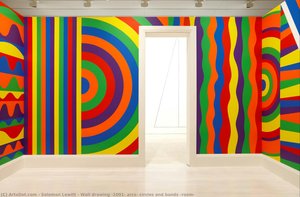
Eine Wandzeichnung von LeWitt zu erleben bedeutet, Logik in Poesie verwandelt zu sehen. Ob es die karge, rhythmische Wiederholung in Black with White Lines, Vertical Not Touching war oder die lebendige, überschäumende Energie von Wall Drawing #1091: arcs, circles and bands – seine Arbeit nutzte die Kraft der Linie, um den Raum zu beherrschen. Diese Stücke stützten sich oft auf ein System logischer, häufig mathematischer Anweisungen, die Assistenten oder Museumsmitarbeiter bei ihrer Produktion leiteten. Diese Methode demokratisierte den Akt des Erschaffens und erhob gleichzeitig die Bedeutung des Konzepts, wodurch sichergestellt wurde, dass das Kunstwerk im Kern als intellektueller Funke existierte, noch bevor es jemals eine Wand berührte.
Ein bleibender Eindruck der Moderne
In seiner produktiven Karriere, die Jahrzehnte umspannte und Meisterschaft in Druckgrafik, Fotografie und Installation beinhaltete, blieb LeWitt seiner Verpflichtung zu Klarheit und Präzision treu. Seine Fähigkeit, tiefgreifende Schönheit in den einfachsten Formen zu finden – wie etwa die markante weiße Pyramide oder die komplexen, farbenfrohen Rhythmen seiner auf Kreide basierenden Wandwerke – definierte die ästhetischen Grenzen des späten 20. Jahrhunderts neu. Er bewies, dass Kunst ihres Egos und ihres Ornaments beraubt werden kann und dennoch eine Seele behält, die tief mit dem menschlichen Verlangen nach Ordnung und Entdeckung resoniert.
Die historische Bedeutung von Sol LeWitt kann nicht hoch genug eingeschätzt werden. Er lieferte das Vokabular für Generationen von Künstlern, um die Grenzen zwischen Gedanken und Materie zu erforschen. Sein Vermächtnis lebt in jedem Museum und jeder Galerie weiter, in denen die Linie zwischen Schöpfer und Ausführendem verschwimmt und in denen die Stärke einer Idee als das ultimative Medium anerkannt wird. Wenn wir auf sein Leben zurückblicken, von seinen Anfängen in Hartford bis zu seinen letzten Tagen in New York City im Jahr 2007, sehen wir einen Mann, der nicht nur Kunst erschuf, sondern der uns lehrte, die tiefgreifende Architektur des Denkens selbst zu erkennen.

Sol Lewitt
1928 - 2007 , Vereinigte Staaten von Amerika
Eckdaten zum Künstler
- Artistic Movement Or Style: Minimalismus
- Artists Who Influenced This Artist: ['Frank Lloyd Wright']
- Date Of Birth: 9. September 1928
- Date Of Death: 8. April 2007
- Full Name: Solomon Lewitt
- Nationality: Amerikaner
- Notable Artworks:
- Distorzierte Kuben
- Kaldor Kunstprojekt 11: Sol Lewitt
- Place Of Birth: Hartford, Vereinigte Staaten
Verwandte Artikel

Echoes of Time: Exploring the Enduring Appeal & Historical Context of Vintage Art Prints
Explore the captivating world of vintage art prints! Discover their history, collecting tips & enduring appeal. Expert insights on chromolithography and building a legacy collection with OriginalUniqueArt.

Geometrische Abstraktion: Die 10 Meisterwerke, die Kunstgeschichte prägten | OriginalUniqueArt.com
Entdecken Sie die 10 Meisterwerke der geometrischen Abstraktion! Von Kandinsky bis Mondrian – erleben Sie die Geschichte, Farben & Formen dieser revolutionären Kunstrichtung. Hochwertige Kunstreproduktionen auf OriginalUniqueArt.com

The Enduring Legacy of Fine Art Prints: Technique, History & Aesthetic Impact
Explore the rich history & techniques of fine art prints. Discover investment potential, assess authenticity, and learn how to preserve your collection with expert guidance. Trusted insights for discerning collectors.

Giclée Prints: Archival Quality & Aesthetic Nuances for the Discerning Collector
Explore the world of giclée prints with OriginalUniqueArt. Learn about archival quality, aesthetic nuances & investment potential. Expert guidance for discerning art collectors seeking museum-quality reproductions and lasting value.

The Power of Less: A Definitive Guide to the Minimalism Movement and Geometric Abstraction
Explore the profound impact of Minimalism and Geometric Abstraction. From Mondrian to Malevich, discover how stripping art to its essential forms revolutionized modern aesthetics through our expert-led historical guide.