In echtem Maßstab anzeigen
 Versenden als Grußkarte
 Teilen
 Details anzeigen

 Herunterladen
 Ähnliche Objekte
 Röntgenaufnahme
 Diashow
 Besucherstatistiken
Dismal Swamp Canal


 Mehr anzeigen
Giclée / Kunstdruck
Giclée- oder Leinwanddruck in Museumsqualität mit schneller Produktion und flexiblen Veredelungsoptionen. ( Handgemalte Reproduktion kaufen Zum digitalen Bild wechseln)




P118B $10

P118H $10

P118W $10

P438Z $10

P508JH $12

P508YH $12

P805H $10

P805Z $10

P919BZ $10

P919G $10

P919XJ $10

P959ZH $10

P968JZ $12

W106C $8

W218G $10

W218JH $8

W218Y $10

W307PJ $10

W316G $10

W316PJ $8

W316Y $10

W398PJ $8

W4111J $10

W500HY $15

W500JH $15

W692G $12

W849H $8

W940BG $15

W953PJ $8




Wählen Sie aus unseren vordefinierten Formaten, die den ursprünglichen Proportionen des Kunstwerks entsprechen.

Sie können Ihre eigenen Maße eingeben, um ein bestimmtes Format oder einen speziellen Platz einzupassen. Wenn das von Ihnen gewählte Format nicht den Proportionen des Originalbildes entspricht, werden wir das Kunstwerk entweder beschneiden oder das Bild mit einem gespiegelten oder einfarbigen Rand erweitern. Ein digitaler Entwurf wird Ihnen zur Genehmigung zugesandt, bevor die Produktion beginnt.
Bitte beachten Sie, dass die Vorschau auf dem Bildschirm nicht den tatsächlichen Zuschnitt oder die Erweiterung widerspiegelt. Nur der Entwurf zeigt die endgültige Komposition präzise an.
Obwohl Sondermaße verfügbar sind, empfehlen wir die Auswahl eines Maßes aus der vordefinierten Liste, um die ursprünglichen Proportionen zu bewahren.
Weltweiter Versand () innerhalb von 2 Wochen statt der üblichen 4/5 Wochen. (18 September)

Kostenloser weltweiter Expressversand

Hochwertige Leinenleinwand

Vollständiger Versicherungsschutz beim Versand

Zollgebühren-Rückerstattungsgarantie

Garantie für exakte Farbtreue

100-tägiges Rückgaberecht (nur bei Mängeln)

100% Geld-zurück-Garantie

Angebot für Mengenrabatt
 Die Glasoption ist nur für Größen unter 110 cm verfügbar.

Dismal Swamp Canal
Giclée / Kunstdruck
Format der Reproduktion
-


Gesamtpreis
$ 80
A Window into the Early Republic: Robert W. Salmon’s “Dismal Swamp Canal”
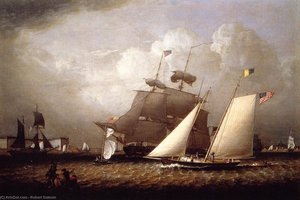
Robert W. Salmon's "Dismal Swamp Canal" isn’t merely a depiction of a waterway; it’s a vibrant snapshot of 19th-century America, brimming with ambition, industry, and the nascent spirit of westward expansion. Painted in 1830, this oil on canvas transports us to a pivotal moment in American history – the construction and early operation of the Dismal Swamp Canal, a bold engineering feat that connected the Chesapeake Bay and Albemarle Sound, fundamentally altering trade routes and shaping the landscape of the southeastern United States. Salmon masterfully captures the bustling activity surrounding this vital artery, showcasing not just the physical infrastructure but also the human element – the ships laden with goods, the laborers toiling alongside them, and the burgeoning settlements that sprung up along its banks.
- Historical Context: The painting reflects a period of intense national development. Following the American Revolution, there was a pressing need for improved transportation networks to facilitate trade and connect disparate regions. The Dismal Swamp Canal addressed this critical demand, offering an alternative to arduous overland routes through the swamp itself.
- Engineering Marvel: Salmon’s depiction highlights the scale of the undertaking – a complex system of locks and channels painstakingly carved through the dense, treacherous swamp. The canal's construction was a testament to human ingenuity and perseverance, requiring immense labor and logistical planning.
A Luminist Approach: Light, Detail, and Atmospheric Depth
Salmon’s artistic style is firmly rooted in the emerging movement of American Luminism, characterized by its emphasis on capturing natural light and atmospheric effects. Unlike the highly detailed, often theatrical scenes favored by earlier historical painters, Salmon employs a more subdued palette and a looser brushstroke to create a sense of realism and immediacy. The painting's composition is carefully balanced, utilizing horizontal lines to emphasize the expansive waterway while layering elements in the foreground, middle ground, and background to establish a convincing sense of depth. Notice how he skillfully uses light – diffused and soft – to illuminate key figures and structures, drawing the viewer’s eye through the scene.
Technique: Salmon's meticulous approach is evident in the layering of brushstrokes, particularly noticeable in the depiction of the sails of the ships. These are rendered with a remarkable sense of texture and movement, conveying both their strength and vulnerability to the elements. The artist’s use of color is restrained yet effective, relying on browns, blues, and reds to create a realistic and evocative atmosphere.Symbolism and the American Narrative
Beyond its depiction of a specific engineering project, “Dismal Swamp Canal” carries significant symbolic weight. The prominent American flag flying from one of the buildings represents national identity and the expansion of the United States westward. The bustling harbor scene speaks to the burgeoning commercial activity that fueled the nation’s growth – a testament to the spirit of innovation and entrepreneurialism. Even the “Dismal Swamp” itself, despite its name, becomes a symbol of opportunity and progress, transformed by human intervention into a vital artery for trade and transportation.
- The Canal as Progress: The canal represents more than just a physical connection; it symbolizes America’s drive to overcome geographical obstacles and forge ahead with its destiny.
- Labor and Industry: The inclusion of laborers highlights the human cost of this ambitious project, reminding us that progress often comes at a price.
A Legacy in Reproduction – Bringing History to Life
OriginalUniqueArt’s meticulously crafted reproductions of Robert W. Salmon's “Dismal Swamp Canal” offer a remarkable opportunity to bring this captivating historical scene into your home or office. Each reproduction is created using the same techniques and materials as the original painting, ensuring an authentic representation of Salmon’s artistic vision. Whether you are an art enthusiast, a collector, or simply seeking a stunning piece of American history, OriginalUniqueArt's reproductions provide a beautiful and enduring tribute to this remarkable work.
Biografie des Künstlers
Frühes Leben und künstlerische Ausbildung
- Ursprünge: Salmon wurde als Robert Salomon, Sohn von Francis Salomon, einem Juwelier, geboren. Der geschäftige Hafen von Whitehaven hatte einen frühen Einfluss auf seine künstlerische Entwicklung.
- Frühe Einflüsse: Seine Ausbildung ist nicht umfassend dokumentiert, aber es wird angenommen, dass er niederländische Marine-Maler des 17. Jahrhunderts, italienische Vedute-Künstler und Claude Lorrain studierte.
- Frühe Werke: Seine frühesten bekannten Werke, „Zwei bewaffnete Handelsschiffe verlassen den Hafen von Whitehaven“ (1800) und “Die ‘Estridge’ vor Dover”, demonstrieren seine frühen Fähigkeiten bei der Darstellung maritimer Szenen.
- Royal Academy Debut: Salmon stellte 1802 erstmals in der Royal Academy aus, was einen bedeutenden Schritt in seiner Karriere markierte.
Karrierentwicklung und Stil
- Umzug nach Liverpool (1806): Salmon ließ sich in Liverpool nieder und änderte seinen Namen in Salmon. In dieser Zeit schuf er zahlreiche Marinegemälde, die heute im National Maritime Museum in London zu sehen sind.
- Schiffsporträts: Seine Schiffsporträts zeugen von einer tiefen Vertrautheit mit Segelschiffen und deren Mechanik und zeigen oft dasselbe Schiff aus verschiedenen Blickwinkeln auf einer einzigen Leinwand.
- Popularität & Sammler: Salmons Werk erlangte Popularität bei namhaften Bostonern wie Samuel Cabot, Robert Bennett Forbes und John Newmarch Cushing, was seine wachsende Anerkennung in Amerika signalisierte.
- Luminismus-Pionier: Er gilt als eine Schlüsselfigur bei der Entwicklung des amerikanischen Luminismus und beeinflusste Künstler wie William Bradford und Fitz Henry Lane. Sein Fokus auf Licht und Atmosphäre schuf friedliche und ruhige Szenen.
Bemerkenswerte Werke und künstlerische Bedeutung
- Hauptwerke: Zu Salmons bekanntesten Werken gehören „Die Brigantine ‘Ariel’“, „Segelschiff ‘Trelawney’“ und “Blick auf Liverpool von Cheshire”. Diese Gemälde veranschaulichen seine Fähigkeit, die Schönheit und Komplexität von Segelschiffen einzufangen.
- Boston Harbor Serie: Er schuf eine bedeutende Anzahl von Werken, die den Bostoner Hafen darstellen und das maritime Leben und historisches Boston zeigen. "Boston Harbor von Castle Island (Schiff Charlotte)" ist ein bemerkenswertes Beispiel.
- Einfluss auf die amerikanische Kunst: Salmons Stil beeinflusste nachhaltig nachfolgende Generationen amerikanischer Meeresmaler und trug zur Entwicklung des Luminismus als wichtige künstlerische Bewegung bei.
Vermächtnis und Anerkennung
- Museumsbestände: Salmons Werke befinden sich in renommierten Institutionen, darunter die U.S. Naval Academy, das Museum of Fine Arts, Boston, und das National Maritime Museum, Greenwich.
- Nachhaltige Wirkung: Seine Gemälde inspirieren weiterhin Künstler bis heute und zeugen von seiner Fähigkeit und Kunstfertigkeit.
- Vater des amerikanischen Luminismus: Salmons Vermächtnis ist fest als Pionier des amerikanischen Luminismus etabliert und hat ihre bleibende Spur in der Kunstwelt hinterlassen.

Robert W. Salmon
1775 - 1845 , Vereinigtes Königreich
Eckdaten zum Künstler
- Beeinflusste Künstler:
- Dutch marine painters
- Claude Lorrain
- Bemerkenswerte Werke:
- Sailing Ship 'Trelawney'
- Boston Harbor von Castle Island
- A Frigate of the Baltic Fleet
- Geburtsdatum: 1775
- Geburtsort: Whitehaven, Vereinigtes Königreich
- Künstlerische Richtung: Amerikanischer Luminismus
- Nationalität: Britisch
- Sterbedatum: 1845
- Vollständiger Name: Robert W. Salmon
- Von Künstlern Beeinflusst:
- William Bradford
- Fitz Henry Lane
Verwandte Artikel

Robert Spencer: Luminism, Narrative & the American Landscape Tradition
Explore the captivating world of Luminism & the Hudson River School with our expert analysis. Discover the history, artists, and enduring beauty of 19th-century American landscape painting. Find museum-quality reproductions at OriginalUniqueArt.

Amerikanischer Realismus: Die 10 Meisterwerke, die eine Ära prägten | OriginalUniqueArt
Entdecken Sie die 10 Meisterwerke des Amerikanischen Realismus! Von Edward Hopper bis Winslow Homer – erleben Sie die Geschichten, Techniken & zeitlose Schönheit. Hochwertige Kunstdrucke auf OriginalUniqueArt.com.
Robert W. Salmon: Licht und Atmosphäre der amerikanischen Seemalerei – Eine Studie zum Ursprung des Luminismus
Entdecken Sie die faszinierende Welt des amerikanischen Luminismus! Erfahren Sie mehr über Robert W. Salmon und die Meister der Lichtmalerei. Kunstgeschichte, Museen & hochwertige Reproduktionen auf OriginalUniqueArt.

Grant Wood und der amerikanische Regionalismus: Identität, Mythos und die ländliche Landschaft
Entdecken Sie Grant Wood und den amerikanischen Regionalismus! Erfahren Sie mehr über 'American Gothic', Woods Leben, Einflüsse und sein Vermächtnis in der Kunstgeschichte. Expertenwissen & hochwertige Reproduktionen.

Meisterwerke des 19. Jahrhunderts: Kunst für Ihr Zuhause | OriginalUniqueArt
Entdecken Sie die 10 bedeutendsten Kunstwerke des 19. Jahrhunderts! Von Impressionismus bis Realismus – erleben Sie die Geschichten berühmter Maler und ihre Meisterwerke. Hochwertige Reproduktionen für Ihr Zuhause auf OriginalUniqueArt.com.