Vorschau anzeigen
 Versenden
 Teilen
 Details anzeigen
 Leitfaden

 Herunterladen
 Ähnliche Objekte
 Röntgenaufnahme
 Diashow
 Q&A
Q&A Statistiken
Under the Hammer

- 637.0 x 637.0 cm


 Weiterlesen
Giclée / Kunstdruck
Giclée- oder Leinwanddruck in Museumsqualität mit schneller Produktion und flexiblen Veredelungsoptionen. ( Handgemalte Reproduktion bestellen Zum digitalen Bild wechseln)




P118B €10

P118H €10

P118W €10

P438Z €10

P508JH €12

P508YH €12

P805H €10

P805Z €10

P919BZ €10

P919G €10

P919XJ €10

P959ZH €10

P968JZ €12

W106C €8

W218G €10

W218JH €8

W218Y €10

W307PJ €10

W316G €10

W316PJ €8

W316Y €10

W398PJ €8

W4111J €10

W500HY €15

W500JH €15

W692G €12

W849H €8

W940BG €15

W953PJ €8




Wählen Sie aus unseren vordefinierten Formaten, die den ursprünglichen Proportionen des Kunstwerks entsprechen.

Geben Sie die benötigte Breite und Höhe an, damit der Druck perfekt in Ihren Rahmen oder an Ihre Wand passt. Ein Druck kann nur beschnitten, aber niemals größer als das Originalbild angefertigt werden; daher verliert ein Format mit anderen Proportionen einen Teil des Bildes. Wir senden Ihnen ein digitales Mockup zur Freigabe, bevor wir den Druck ausführen. Das auf dieser Seite gezeigte Bild zeigt nicht den tatsächlichen Beschnitt – dies ist nur im Mockup ersichtlich.
Weltweiter Versand () innerhalb von 2 Wochen statt der üblichen 4/5 Wochen. (1 November)

Kostenloser weltweiter Expressversand

Hochwertige Leinenleinwand

Umfassender Versicherungsschutz beim Versand

Zollgebühren-Rückerstattungsgarantie

Garantie für exakte Farbtreue

100 Tage Rückgaberecht (nur bei Mängeln)

100% Geld-zurück-Garantie

Mengenrabatt verfügbar
 Die Glasoption ist nur für Größen unter 110 cm verfügbar.

Under the Hammer
Giclée / Kunstdruck
Format der Reproduktion
-


Endpreis
€ 71
Robert Polhill Bevan’s ‘Under the Hammer’: A Window into Early Modern British Art
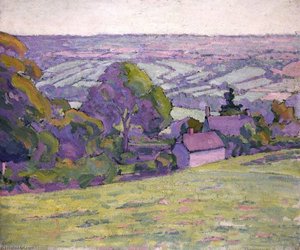
Under the Hammer, painted in 1914 by Robert Polhill Bevan, is more than just a depiction of a crowded room; it's a meticulously observed snapshot of a pivotal moment in British art history. Measuring an impressive 637 x 637 cm, this black and white composition captures a scene brimming with quiet intensity – a gathering seemingly centered around a horse, likely within the context of an auction or appraisal. Bevan’s work stands as a crucial bridge between the Impressionistic tendencies prevalent at the turn of the century and the burgeoning radicalism that would define British Modernism.
- Subject Matter: The central focus is undeniably the horse, positioned with deliberate prominence within the room's architecture. However, it’s the surrounding figures – a diverse group of men, many in formal attire suggesting an upper-class setting – that truly imbue the painting with its narrative weight.
- Style & Technique: Bevan employs a restrained yet remarkably detailed technique, characteristic of his time. The tonal range is carefully controlled, utilizing subtle gradations of gray to create depth and volume. His brushwork is precise, particularly evident in the rendering of clothing textures and the horse’s musculature, reflecting a commitment to observational accuracy rather than purely expressive color.
A Quaker Banker's Artistic Rebellion
Robert Polhill Bevan’s biography itself is fascinating. Born into a banking family – his parents were Richard Alexander Bevan and Laura Maria Polhill – he initially seemed destined for a life of finance, influenced by his Quaker upbringing. Yet, defying expectations, Bevan embraced an artistic path, fueled by a restless intellectual curiosity and a desire to push the boundaries of representation. His formative years in Paris at the Académie Julian proved transformative, exposing him to the innovative ideas circulating amongst artists like P.
This influence is palpable in ‘Under the Hammer’. The composition’s slightly awkward perspective, the deliberate lack of idealized beauty, and the focus on capturing a specific moment in time – rather than presenting an allegorical or romanticized scene – are hallmarks of Bevan's engagement with European modernism. He wasn't simply copying trends; he was actively participating in a dialogue about how art could represent the world around him.
Symbolic Layers and Emotional Resonance
While seemingly straightforward, ‘Under the Hammer’ is rich in symbolic potential. The horse itself can be interpreted as representing wealth, status, and perhaps even judgment – fitting for an auction setting. The figures surrounding it are equally significant; their expressions, postures, and interactions suggest a complex interplay of observation, speculation, and negotiation. The inclusion of details like books and cups adds layers of domesticity and intellectual engagement to the scene.
Bevan’s ability to evoke a sense of quiet contemplation is remarkable. Despite the bustling activity implied by the gathering, there's an underlying stillness that draws the viewer in. This emotional resonance, combined with the artist’s masterful technical skill, elevates ‘Under the Hammer’ beyond a mere depiction of a scene; it becomes a poignant meditation on observation, value, and the human condition.
A Legacy for Collectors & Interior Design
This hand-painted reproduction captures not only the visual elements of Bevan's original work but also its historical significance and artistic merit. Its size (637 x 637 cm) makes it a commanding presence, suitable for grand spaces or as a focal point within a sophisticated interior design scheme. The monochrome palette lends itself beautifully to a variety of styles – from classic British interiors to contemporary minimalist settings. ‘Under the Hammer’ is an investment in art history and a testament to Bevan's pioneering role in shaping modern British art.
Fragen & Antworten
In welcher Phase der Karriere von Robert Polhill Bevan lässt sich „Under the Hammer“ angesichts seines Entstehungsdatums einordnen?
Angesichts seiner Datierung auf 1914 fällt "Under the Hammer" in die Early Modernism von Robert Polhill Bevan.
Was stellt "Under the Hammer" von Robert Polhill Bevan dar?
Die Motive von "Under the Hammer" sind auction scene, horse gathering, british art, early 20th century, robert bevan, black and white, social portrait.
Für welche Verwendung und welchen Raum wird "Under the Hammer" von Robert Polhill Bevan empfohlen?
Empfohlene Verwendung (Reflective) und Raum (Reception) sind die zwei Empfehlungen für "Under the Hammer" von Robert Polhill Bevan.
Künstlerbiografie
Frühes Leben und künstlerische Ausbildung
- Geboren: Hove, Großbritannien (1865)
- Gestorben: 1925
- Familiärer Hintergrund: Robert Polhill Bevan wurde in einer quakerischen Familie mit Verbindungen zum Bankwesen geboren. Seine Eltern waren Richard Alexander Bevan und Laura Maria Polhill.
- Frühe Ausbildung: Er studierte an der Westminster School of Art unter Fred Brown. Später besuchte er die Académie Julian in Paris, wo er einflussreiche Künstler wie Paul Sérusier, Pierre Bonnard, Édouard Vuillard und Maurice Denis kennenlernte.
- Bretonischer Einfluss: Frühe Reisen nach Britanny (1890 & 1891) beeinflussten seine künstlerische Entwicklung maßgeblich, insbesondere durch die Auseinandersetzung mit dem Pont-Aven Stil.
Künstlerische Entwicklung und Einflüsse
- Früher Stil: Bevans frühe Arbeiten zeigten Einflüsse des Synthetismus, erkennbar in seinen Zeichnungen und Drucken aus seiner Zeit in Britanny.
- Fauvismus: Um 1904 experimentierte Bevan mit reiner Farbe und zeigte so einen frühen Ansatz des Fauvismus, der viele britische Künstler seiner Zeit voraus war. Sein Gemälde "Innenhof" gilt als frühes Beispiel für diesen Stil.
- Divisionismus/Pointillismus: Später übernahm er eine divisionistische oder pointillistische Technik, wie man sie in Werken wie "Auf dem Downs bei Lewes" und "Der Pflüge auf dem Feld" sehen kann.
- Wichtige Einflüsse: Bedeutende Einflüsse waren Paul Gauguin (erkennbar an seiner Farbgebung) sowie frühere Meister wie Velázquez und Goya. Er würdigte auch Renoirs Anleitung beim Zeichnen von Pferden.
Mitgliedschaften und Künstlerkreise
- Camden Town Group: Bevan war Gründungsmitglied der Camden Town Group, einer Gemeinschaft von Künstlern, die das moderne Stadtleben darstellen wollten.
- London Group: Er gehörte auch der London Group an, einer weiteren progressiven Kunstorganisation.
- Cumberland Market Group: Um seine Verpflichtung zu zeitgenössischen künstlerischen Bewegungen weiter zu demonstrieren, war Bevan Teil der Cumberland Market Group.
- Verbindung zu Walter Sickert: Im Jahr 1908 trat er der Gruppe von Walter Sickert in Fitzroy Street bei, wo er ermutigt wurde, sich auf alltägliche Themen zu konzentrieren.
- Allied Artists' Association: Er nahm an der ersten Ausstellung der Allied Artists’ Association im Jahr 1908 teil, die eine Plattform für progressive Künstler bot und ihn Wassily Kandinsky näherbrachte.
Hauptwerke und Themen
- Landschaften: Bevan ist am besten bekannt für seine Landschaften aus Sussex und Britanny, oft Darstellungen ländlicher Szenen mit lebendigen Farben und expressivem Pinselstrich. Beispiele sind "Auf dem Downs bei Lewes", "Die Kastanie" und "Landschaft in den Blackdown Hills, Devon".
- Porträts: Er schuf Porträts, darunter eine bemerkenswerte Darstellung seiner Frau, Stanislawa Bevan (geborene de Karłowska).
- Urbanische Szenen: Seine Arbeit umfasste auch Darstellungen des Stadtlebens, wie Gemälde, die den Niedergang der Kutscherei dokumentieren ("Die Kutscha").
- Bemerkenswerte Gemälde: Zu seinen weiteren bedeutenden Werken gehören "Queen's Grove, St John's Wood", "Das Bauernhaus" und “Rosemary la vallée”.
Vermächtnis und historische Bedeutung
- Pionier der modernen britischen Kunst: Robert Polhill Bevan gilt als Pionier der modernen britischen Kunst, insbesondere für seine frühe Übernahme fauvistischer Prinzipien.
- Einfluss auf die Farbgebung: Er war einer der ersten britischen Künstler, der reine Farbe in bedeutender Weise einsetzte und damit nachfolgende Generationen von Malern beeinflusste.
- Beitrag zur Camden Town Group: Seine Teilnahme an der Camden Town Group trug dazu bei, die Entwicklung der modernen Kunst in Großbritannien zu gestalten.
- Retrospektive Ausstellung: Eine Retrospektive-Ausstellung bei Colnaghi's im Jahr 1961 hob seine Beiträge hervor und festigte seinen Platz in der Kunstgeschichte.

Robert Polhill Bevan
1865 - 1925 , Vereinigtes Königreich
Kurzinfos
- Bemerkenswerte Werke:
- Rosemary la vallée
- Landscape in the Blackdown Hills
- Stanislawa Bevan, née de Karlowska
- In the Downs near Lewes
- Die Kastanie
- Queen's Grove, St John's Wood
- Das Farmhaus
- Geburtsdatum: 1865
- Geburtsort: Hove, Vereinigtes Königreich
- Künstlerische Bewegung:
- Camden Town Group
- Fauvismus
- Punktillismus
- Künstlerische Einflüsse:
- Paul Gauguin
- Renoir
- Velázquez
- Goya
- Nationalität: Britisch
- Sterbedatum: 1925
- Vollständiger Name: Robert Polhill Bevan
Ähnliche Artikel
Robert Bevan: Pioneering British Post-Impressionism & the Camden Town Group's Intimate Vision
Explore the life & work of Robert Bevan, a pioneer of British Post-Impressionism and founding member of the Camden Town Group. Discover his vibrant landscapes and lasting impact on early 20th-century art.

Monochrome Visions: Exploring the Aesthetic & Historical Significance of Black & White Photography
Explore the rich history & artistic power of black and white photography. From early techniques to iconic masters like Ansel Adams, discover why monochrome continues to captivate art lovers today. Expert insights for collectors.

Die Top 10 berühmter Gemälde im Reich der dunklen Töne |
Entdecken Sie die Top 10 berühmter Gemälde, beherrscht von dunklen Tönen! Von Caravaggio bis Manet – erfahren Sie die Geschichten hinter Meisterwerken der Kunstgeschichte. Finden Sie Ihre perfekte Reproduktion auf .

Weiße Meisterwerke: Die Top 10 berühmtesten Gemälde und ihre zeitlose Eleganz
Entdecken Sie die Top 10 berühmter Gemälde, dominiert von Weiß! Von Malewitsch bis Rothko – erfahren Sie Geschichten hinter ikonischen Kunstwerke und lassen Sie sich für Ihre Wohnraumgestaltung inspirieren. Kunstreproduktionen in Museumsqualiät auf

Giclée Prints: Archival Quality & Aesthetic Nuances for the Discerning Collector
Explore the world of giclée prints with OriginalUniqueArt. Learn about archival quality, aesthetic nuances & investment potential. Expert guidance for discerning art collectors seeking museum-quality reproductions and lasting value.