Post-Impressionism · 1924
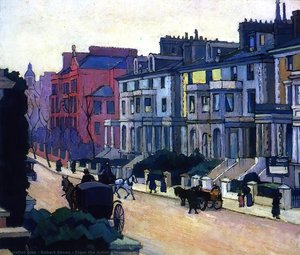
Mount Stephen, Devon (Robert Bevan, 1924)
Robert Bevan (1865–1925) schuf Mount Stephen, Devon. Es stammt aus dem Jahr 1924. Es gehört zur Post-Impressionism-Strömung. Es ist aus Oil On Canvas gefertigt. Die Maße sind 56 × 76 cm.
- 1924
- Oil On Canvas
- 56 × 76 cm

 Vorschau anzeigen

 Handgemaltes Ölgemälde
 Versenden
 Teilen
 Datenblatt


 Herunterladen
 Ähnliche Objekte
 Röntgenaufnahme
 Diashow
 Fragen & Antworten

 Statistiken
Mount Stephen, Devon im Überblick
- Titel
- Mount Stephen, Devon
- Künstler
- Robert Bevan (1865–1925)
- Geburtsjahr des Künstlers
- Hove, Vereinigtes Königreich
- Datum
- 1924
- Medium
- Oil On Canvas
- Maße
- 56 × 76 cm
- Bewegung
- Post-Impressionism
- Epoche
- Modern
- Motiv
- devon village, rural england, coastal scene, british art, village life, impressionism
Was stellt Mount Stephen, Devon dar?
Identification of Mount Stephen, Devon
Mount Stephen, Devon is an oil on canvas painting by the artist Robert Bevan. This work was created in 1924. The piece measures 56 x 76 cm. It depicts a scene in Devon, England, featuring a red brick building in the foreground and two figures standing outside the structure.
The subject matter focuses on a small village setting. The composition includes residential architecture, specifically houses with thatched roofs, chimneys, and windows. Two people are positioned on the sidewalk, engaged in conversation. The perspective is slightly elevated, looking down a sloping street toward the sea. The sky is covered by clouds, which creates diffused lighting across the scene. This lighting casts soft shadows and highlights the various colors present in the village architecture and the surrounding landscape.
The Composition and Visual Elements
The composition presents a balanced arrangement of clustered buildings situated under a cloudy sky. The perspective is slightly elevated, looking down a sloping street that leads toward the sea. In the foreground, a red brick building anchors the scene. Two people stand outside this structure, positioned on the sidewalk near the architecture. The subject matter focuses on residential architecture, including houses characterized by thatched roofs, chimneys, and windows.
The arrangement of the village in Devon, England, relies on a series of rectangular shapes and organic lines. The rooflines of the houses create a structured pattern against the sky. Lines define the edges of the buildings, while the sloping street provides a sense of depth through atmospheric perspective. Distant elements appear paler and less distinct, establishing a clear recession into the background. The lighting is diffused by the overcast sky, casting soft shadows across the surfaces of the buildings and the street.
Technique and Artistic Style
The style of this work is reminiscent of the Post-Impressionist movement. It utilizes bold colors and geometric shapes to define the architecture and the landscape. The composition relies on rectangular forms for the buildings and organic shapes for the roofs. Visible brushstrokes are used throughout the piece, creating a sense of texture. On the walls and roofs, the paint appears thick and impasto-like, suggesting a deliberate layering of the medium.
The lighting in the scene is diffused, a result of the overcast sky. This soft light avoids harsh shadows and instead highlights the various colors across the village. Depth is achieved through the use of atmospheric perspective, where distant elements appear paler and less distinct than those in the foreground. This technique establishes a sense of space between the red brick building in the front and the elements further back in the composition.
Related Works by Robert Bevan
The artist's engagement with the Devon landscape is evident in other compositions from different periods. Landscape in the Blackdown Hills, Devon was painted in 1917. This work focuses on the rolling topography and the relationship between the land and the sky. Other depictions of the region include Devonshire Valley, No. 2, which was painted in 1913. This piece features a sweeping vista of a verdant valley where a small stone cottage with a pink-hued roof sits among dark trees.
Earlier works also demonstrate the artist's interest in atmospheric conditions and specific technical approaches. Haze over the Valley was created in 1913. In different studies, the artist utilized a divisionist technique, as seen in The Turn-Rice Plough. These varied approaches to color and form reflect a career spent exploring the structural elements of the English countryside and the application of light across different terrains.
Hochauflösende Bilder von Mount Stephen, Devon

Gemeinfrei: Der Künstler verstarb im Jahr 1925.
Andere Formate, Ausschnitte und Zitierhinweise →Robert Bevan, Mount Stephen, Devon (1924).
Robert Bevan (1865–1925), Mount Stephen, Devon, 1924, oil on canvas. Gemeinfreiheit Bild: OriginalUniqueArt.com.
Fragen zu Mount Stephen, Devon, beantwortet
In welchem Jahr wurde "Mount Stephen, Devon" von Robert Bevan geschaffen?
"Mount Stephen, Devon" von Robert Bevan entstand im Jahr 1924.
Welche Technik wurde für "Mount Stephen, Devon" von Robert Bevan verwendet?
Das Medium von "Mount Stephen, Devon" von Robert Bevan ist Oil On Canvas. Die Reproduktionen zielen darauf ab, die Optik dieser Technik wiederzugeben.
Welche Maße hat "Mount Stephen, Devon" von Robert Bevan im Original?
Das Originalwerk "Mount Stephen, Devon" von Robert Bevan hat die Maße 56 x 76 cm.
Welche Motive sind in "Mount Stephen, Devon" von Robert Bevan zu sehen?
Die Themen in "Mount Stephen, Devon" von Robert Bevan umfassen devon village, rural england, coastal scene, british art, village life, impressionism, colorful painting und fassen gemeinsam den Gegenstand des Kunstwerks zusammen.
Ist die Abbildung von "Mount Stephen, Devon" von Robert Bevan gemeinfrei?
"Mount Stephen, Devon" von Robert Bevan ist gemeinfrei – das Urheberrecht ist abgelaufen. Dieser Status bestimmt, wie das Bild des Werkes vervielfältigt werden darf.
Wer hat "Mount Stephen, Devon" geschaffen?
Der Künstler hinter „Mount Stephen, Devon“ ist Robert Bevan. Das Werk ist unter dem Namen von Robert Bevan katalogisiert.
Welcher künstlerischen Strömung ist "Mount Stephen, Devon" von Robert Bevan zuzuordnen?
„Mount Stephen, Devon“ ist ein Werk der Post-Impressionism. Die Stilrichtung gibt die künstlerische Tradition an, der das Werk angehört.
Welcher Phase in der künstlerischen Entwicklung von Robert Bevan lässt sich "Mount Stephen, Devon" zuordnen?
„Mount Stephen, Devon“ entstammt der Mature Period von Robert Bevan. Diese Einordnung setzt das Werk in Bezug zur künstlerischen Entwicklung des Künstlers.
Wie alt war Robert Bevan, als „Mount Stephen, Devon“ im Jahr 1924 geschaffen wurde?
Robert Bevan war 59 Jahre alt, als Mount Stephen, Devon im Jahr 1924 geschaffen wurde. Das Alter berechnet sich aus dem Geburtsjahr des Künstlers, 1865.
Über den Künstler, Robert Bevan

1865–1925, Vereinigtes Königreich
Robert Bevan
Frühes Leben und künstlerische Ausbildung Geboren: Hove, Großbritannien (1865) Gestorben: 1925 Familiärer Hintergrund: Robert Polhill Bevan wurde in einer quakerischen Familie mit Verbindungen zum Bankwesen geboren. Seine Eltern waren Richard Alexander Bevan und Laura Maria Polhill. Frühe Ausbildung: Er studierte an der Westminster School of Art unter Fred Brown. Später besuchte er die Académie Julian in Paris, wo er einflussreiche Künstler wie Paul Sérusier, Pierre Bonnard, Édouard Vuillard und Maurice Denis kennenlernte.
Ebenfalls von Robert Bevan
 Aus dem Fenster des Künstlers1915
 Pferdehändler (Verkauf in Ward's Repository Nr. 1)1918
 Devonshire-Tal, Nr. 21913
 Landschaft in den Blackdown Hills, Devon1917

Essays zu Mount Stephen, Devon
 10 beeindruckende Gemälde von sanften Hügeln und weiten LandschaftenEntdecken Sie 10 Ikonen der Hügellandschaft von Renoir bis Munch. Finden Sie Museen-Qualität auf OriginalUniqueArt.com. Jetzt die Kollektio…
 25 Highlights von Pierre Puvis de Chavannes: Die wichtigsten Bilder des SymbolismusEntdecken Sie 25 ikonische Werke von Pierre Puvis de Chavannes. Erfahren Sie alles über den Symbolismus. Jetzt die Kollektion auf OriginalU…
 Bernardo Bellotto: Die 25 bedeutendsten Meisterwerke des VedutistenEntdecken Sie die 25 besten Werke von Bernardo Bellotto. Erleben Sie meisterhafte Veduten auf OriginalUniqueArt.com. Jetzt die Kollektion o…