

 Vorschau anzeigen
 Versenden
 Teilen
 Details anzeigen
 Leitfaden

 Herunterladen
 Ähnliche Objekte
 Röntgenaufnahme
 Diashow
 Statistiken
Plane/Figure Series (Double Panel) F


 Weiterlesen
Die auf dieser Seite dargestellten Kunstwerke sind urheberrechtlich geschützt, was bedeutet, dass wir keine identische Reproduktion rechtmäßig erstellen oder verkaufen dürfen. Dieser Schutz wird durch internationale Abkommen wie die Berner Übereinkunft und durch nationale Gesetze, einschließlich derer, die von den US-Urheberrecht – Titel 17.
Als respektvolle und rechtlich einwandfreie Alternative bieten wir individuelle, handgemalte Kunstwerke an, die vom Original inspiriert sind. Unsere geschickten und professionellen Künstler studieren sorgfältig den Stil, die Stimmung und das künstlerische Wesen des Originals, um ein neues, einzigartiges Werk zu schaffen, das dasselbe Gefühl hervorruft – während es zugleich eine eigenständige Originalschöpfung bleibt.
Diese Methode entspricht vollumfänglich den Urheberrechtsbestimmungen, da sie keine Kopie oder Vervielfältigung des geschützten Kunstwerks darstellt. Stattdessen handelt es sich um eine kreative Neuinterpretation – ein neues Gemälde, das vom Original inspiriert, aber nicht identisch mit ihm ist.
Handgefertigte Ölreproduktion
Handgemaltes Ölgemälde auf Leinwand in Ihrer Wunschgröße und mit Rahmen, auf Bestellung von unseren Künstlern angefertigt. ( Zum Druck wechseln Zum digitalen Bild wechseln)




P118B €10

P118H €10

P118W €10

P438Z €10

P508JH €12

P508YH €12

P805H €10

P805Z €10

P919BZ €10

P919G €10

P919XJ €10

P959ZH €10

P968JZ €12

W106C €8

W218G €10

W218JH €8

W218Y €10

W307PJ €10

W316G €10

W316PJ €8

W316Y €10

W398PJ €8

W4111J €10

W500HY €15

W500JH €15

W692G €12

W849H €8

W940BG €15

W953PJ €8




Wählen Sie aus unseren vordefinierten Formaten, die den ursprünglichen Proportionen des Kunstwerks entsprechen.

Geben Sie die Breite und die Höhe an, die Sie für Ihren Rahmen oder Ihre Wand benötigen. Da dieses Werk handgemalt ist, kann der Künstler bei einer anderen Form etwas mehr um das Bild herum malen oder etwas abschneiden – Sie entscheiden. Wir senden Ihnen ein digitales Mockup zur Freigabe, bevor mit dem Malen begonnen wird. Das auf dieser Seite gezeigte Bild stellt nicht das tatsächliche Ergebnis dar – dies tut nur das Mockup.
Nach der Bestellung wird das OriginalUniqueArt.com-Team dem Kunden Anweisungen per E-Mail zusenden und eine Mockup-Vorschau bereitstellen.
Weltweiter Versand () in nur 3 bis 4 Wochen statt der üblichen 5 Wochen. (26 Oktober). Keine Kompromisse bei der Qualität.

Kostenloser weltweiter Expressversand

Hochwertige Leinenleinwand

Umfassender Versicherungsschutz beim Versand

Zollgebühren-Rückerstattungsgarantie

Garantie für exakte Farbtreue

100 Tage Rückgaberecht (nur bei Mängeln)

100% Geld-zurück-Garantie

Mengenrabatt verfügbar
 Die Glasoption ist nur für Größen unter 110 cm verfügbar.

Plane/Figure Series (Double Panel) F
Art der Reproduktion
Format der Reproduktion
-


Endpreis
€ 263
A Quiet Revolution: Deconstructing Form in Robert Mangold’s ‘Plane/Figure Series’
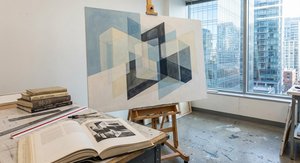
Robert Mangold's 'Plane/Figure Series (Double Panel) F,' a deceptively simple yet profoundly resonant work from 1993, represents a pivotal moment in the evolution of American painting. Emerging from the shadow of Abstract Expressionism and Minimalism, Mangold deliberately stripped away illusionistic depth and narrative complexity, focusing instead on the inherent qualities of paint itself – its materiality, its flatness, and its capacity to exist as an object in space. This piece isn’t about depicting a scene; it's about exploring the very essence of painting, a quiet revolution that challenged established conventions and paved the way for subsequent generations of artists.
The work immediately commands attention not through grand gestures or vibrant hues, but through its stark geometry and deliberate restraint. Two rectangular canvases, joined seamlessly to form an irregular quadrilateral, are presented against a neutral white wall – a strategic choice that amplifies their physical presence and emphasizes the materiality of the surfaces. The olive-green and brown-red colors, applied in broad, solid blocks with minimal blending or gradation, create a subtle tension between the two panels, suggesting a dialogue rather than a unified whole. This deliberate lack of integration speaks to Mangold’s core philosophy: painting is not about creating a seamless illusion but about presenting distinct elements within a carefully constructed composition.
The Language of Geometry and Space
Mangold's approach can be understood through the lens of Minimalism, yet his work transcends simple geometric abstraction. The canvases aren’t merely squares or rectangles; they possess an inherent dynamism due to their irregular shape and the oblique edges that hint at a vanishing point beyond the frame. Two ellipses, delicately placed within each panel, act as visual connectors, subtly suggesting spatial relationships and inviting the viewer to contemplate the interplay between figure and ground – a concept central to Renaissance art but deliberately deconstructed here. The layering of paint itself contributes to this sense of depth, creating a subtle illusion of recession that contrasts sharply with the flat surfaces.
The deliberate positioning of the upper and lower edges parallel while the oblique sides indicate a vanishing point outside the canvas is a key element in Mangold’s design. This creates an intriguing visual paradox – a sense of depth and perspective achieved through purely formal means, without relying on traditional representational techniques. It's as if the painting is actively resisting our ingrained expectations of how space should be depicted.
Materiality and Process: A Meditation on Paint
‘Plane/Figure Series (Double Panel) F’ is a testament to Mangold’s meticulous approach to painting. Executed in oil paint on canvas, the work showcases a straightforward yet sophisticated technique. The broad blocks of color are applied directly to the surface with a matte finish, suggesting a deliberate avoidance of glossy effects and emphasizing the tactile quality of the paint itself. The use of acrylic and colored pencil adds another layer of complexity, grounding the composition in a tangible reality while simultaneously exploring the possibilities of mixed media.
Considering Mangold’s broader body of work, this piece exemplifies his ongoing investigation into the properties of painting – its surface, its texture, its color, and its relationship to space. It's not simply about creating an image; it’s about revealing the inherent qualities of the medium itself, a quiet meditation on the fundamental elements that constitute a painting.
A Legacy of Quiet Innovation
Robert Mangold’s ‘Plane/Figure Series (Double Panel) F’ stands as a significant contribution to American art history. It represents a shift away from grand narratives and emotional expression towards a more conceptual and material-driven approach to painting. His work continues to resonate with contemporary artists and collectors alike, offering a compelling example of how simplicity can be profoundly powerful. The piece invites contemplation on the nature of perception, representation, and the enduring fascination with the fundamental elements that define the art of painting.
Fragen & Antworten
Verwendet "Plane/Figure Series (Double Panel) F" von Robert Mangold starke Kontraste oder sanfte Harmonien?
Die Farbanalyse von "Plane/Figure Series (Double Panel) F" von Robert Mangold offenbart einen Statement Kontrast und eine Balanced Harmony Harmonie.
Ist "Plane/Figure Series (Double Panel) F" von Robert Mangold gemeinfrei?
Die urheberrechtliche Situation für "Plane/Figure Series (Double Panel) F" von Robert Mangold: Das Werk ist noch urheberrechtlich geschützt. Dies bestimmt, ob Reproduktionen des Bildes frei erstellt werden dürfen.
Welche Stimmung und welche Emotionen vereinen sich in "Plane/Figure Series (Double Panel) F"?
In "Plane/Figure Series (Double Panel) F" verleiht eine Calm-Stimmung der Reflective Emotion Ausdruck.
Künstlerbiografie
Robert Mangold: Ein Pionier des Minimalismus
Robert Mangold (geboren 1937) ist ein hoch einflussreicher amerikanischer minimalistischer Maler, der für seinen innovativen Ansatz in Bezug auf Form und Farbe bekannt ist. Seine Arbeit stellt traditionelle Malergrenzen in Frage und betont konzeptuelle Ideen gegenüber materieller Ausführung.
Frühes Leben und Ausbildung
Geboren in North Tonawanda, New York, verfolgte Robert Mangold zunächst ein Studium der Ingenieurwissenschaften, bevor er sich auf die Kunst konzentrierte. Er erhielt einen Bachelor of Fine Arts-Abschluss von der University of Buffalo im Jahr 1959 und einen Master of Fine Arts-Abschluss von der Yale University School of Art im Jahr 1961.
Künstlerische Entwicklung & Einflüsse
Mangolds künstlerischer Weg begann mit abstrakter Expressionismus, aber er entwickelte sich in den frühen 1960er Jahren zum Minimalismus. Er war stark von Künstlern wie Kazimir Malevich, Piet Mondrian und Barnett Newman beeinflusst, die reine Abstraktion und reduzierte Formen erforschten. Seine Arbeit spiegelt auch eine Reaktion auf die gestische Intensität der abstrakten Expressionismus wider und bevorzugt stattdessen einen restriktiveren und intellektuelleren Ansatz.
Wichtige Merkmale & Stil
Mangold ist bekannt für seine geformten Leinwände – Gemälde, die nicht rechteckig sind, sondern ungewöhnliche oder geometrische Formen annehmen. Dieser Abgang von traditionellen Trägerstrukturen wurde zu einer Markenzeichen seines Stils. Seine Gemälde zeigen typischerweise:
- Geometrische Abstraktion: Vereinfachte Formen und Linien dominieren seine Kompositionen.
- Subtile Farbflächen: Er verwendet gedämpfte, pastelfarbene Töne, um atmosphärische Effekte zu erzeugen.
- Minimalistischer Ästhetik: Konzentration auf essentielle Formen und die Eliminierung unnötiger Details.
- Keinen traditionellen Rahmen: Seine Leinwände erscheinen oft ungerahmt, was ihre einzigartigen Formen weiter hervorhebt.
Wichtige Werke & Serien
Im Laufe seiner Karriere hat Mangold mehrere bedeutende Serien produziert:
- Plane/Figure-Serie: Erforscht die Beziehung zwischen Form und Farbe durch geteilte Leinwandkompositionen.
- Wandmalereien: Großformatige Werke, die für architektonische Räume konzipiert sind.
- Ring-Serie: Bietet kreisförmige oder ringförmige Formen innerhalb rechteckiger Felder.
- Säulenstruktur-Serie: Untersucht Vertikalität und räumliche Beziehungen.
Leistungen & Anerkennung
Robert Mangolds Werk wurde weltweit in Museen und Galerien ausgestellt. Er hat zahlreiche Auszeichnungen und Anerkennungen erhalten, die seine Position als eine führende Figur der zeitgenössischen Kunst festigen. Seine Werke befinden sich in bedeutenden Sammlungen wie:
- Das Museum of Modern Art, New York
- Das Metropolitan Museum of Art, New York
- Das Tate Modern, London
Historische Bedeutung & Vermächtnis
Robert Mangold spielte eine entscheidende Rolle bei der Gestaltung der Entwicklung des Minimalismus. Seine Erforschung geformter Leinwände und subtiler Farbflächen erweiterte die Möglichkeiten der abstrakten Kunst und stellte konventionelle Vorstellungen von Darstellung in Frage. Zusammen mit Künstlern wie Robert Ryman stellt er das Kernstück des Minimalismus dar, wobei der Schwerpunkt auf konzeptueller Strenge und formaler Reduktion liegt. Sein Einfluss wird weiterhin von zeitgenössischen Künstlern spürbar sein, die mit Abstraktion und geometrischen Formen arbeiten.

Robert Mangold
1937 - , Vereinigte Staaten von Amerika
Kurzinfos
- Beeinflusste Künstler:
- Kazimir Malevich
- Piet Mondrian
- Barnett Newman
- Bemerkenswerte Werke:
- Plane/Figure Serie
- Ring Serie
- Untitled (Skowhegan Suite)
- Geburtsdatum: 1937
- Geburtsort: North Tonawanda, USA
- Künstlerische Bewegung: Minimalismus
- Nationalität: Amerikanisch
- Vollständiger Name: Robert Mangold
- Von Künstlern Beeinflusst: ['Robert Ryman']
Ähnliche Artikel

Geometrische Abstraktion: Die 10 Meisterwerke, die Kunstgeschichte prägten | OriginalUniqueArt.com
Entdecken Sie die 10 Meisterwerke der geometrischen Abstraktion! Von Kandinsky bis Mondrian – erleben Sie die Geschichte, Farben & Formen dieser revolutionären Kunstrichtung. Hochwertige Kunstreproduktionen auf OriginalUniqueArt.com
Beyond Form & Color: Geometric Abstraction's Enduring Legacy in Art History
Explore the captivating world of geometric abstraction! Discover its origins, key artists like Malevich & Mondrian, and why this movement remains highly valued by art collectors today. Expert insights at OriginalUniqueArt.

Beyond Form & Color: Geometric Abstraction's Evolution in 20th/21st Century Art
Explore the evolution of geometric abstraction from Cubism to contemporary art. Discover key artists like Malevich & Mondrian, investment insights, and expert collecting advice at OriginalUniqueArt.

Neo-Abstract Art: The High-Impact Evolution of Modern Visual Energy and Geometric Sophistication
Discover the power of Neo-Abstract art. Explore how bold geometric forms and high-impact visual energy are redefining modern design. Learn to curate sophisticated, high-energy spaces with the latest trends in contemporary abstraction and structural color.

Kandinsky: Die 25 Meisterwerke des Abstrakten – Kunst für Ihr Zuhause | OriginalUniqueArt
Entdecken Sie die 25 bedeutendsten Gemälde von Wassily Kandinsky! Tauchen Sie ein in die Welt der abstrakten Kunst, des Expressionismus und der Farbkomposition. Hochwertige Kunstdrucke & Inspiration für Ihr Zuhause auf OriginalUniqueArt.com.