Vorschau anzeigen
 Versenden
 Teilen
 Details anzeigen
 Leitfaden

 Herunterladen
 Ähnliche Objekte
 Röntgenaufnahme
 Diashow
 Q&A
Q&A Statistiken
Snow in New York


 Weiterlesen
Giclée / Kunstdruck
Giclée- oder Leinwanddruck in Museumsqualität mit schneller Produktion und flexiblen Veredelungsoptionen. ( Handgemalte Reproduktion bestellen Zum digitalen Bild wechseln)




P118B €10

P118H €10

P118W €10

P438Z €10

P508JH €12

P508YH €12

P805H €10

P805Z €10

P919BZ €10

P919G €10

P919XJ €10

P959ZH €10

P968JZ €12

W106C €8

W218G €10

W218JH €8

W218Y €10

W307PJ €10

W316G €10

W316PJ €8

W316Y €10

W398PJ €8

W4111J €10

W500HY €15

W500JH €15

W692G €12

W849H €8

W940BG €15

W953PJ €8




Wählen Sie aus unseren vordefinierten Formaten, die den ursprünglichen Proportionen des Kunstwerks entsprechen.

Geben Sie die benötigte Breite und Höhe an, damit der Druck perfekt in Ihren Rahmen oder an Ihre Wand passt. Ein Druck kann nur beschnitten, aber niemals größer als das Originalbild angefertigt werden; daher verliert ein Format mit anderen Proportionen einen Teil des Bildes. Wir senden Ihnen ein digitales Mockup zur Freigabe, bevor wir den Druck ausführen. Das auf dieser Seite gezeigte Bild zeigt nicht den tatsächlichen Beschnitt – dies ist nur im Mockup ersichtlich.
Weltweiter Versand () innerhalb von 2 Wochen statt der üblichen 4/5 Wochen. (2 November)

Kostenloser weltweiter Expressversand

Hochwertige Leinenleinwand

Umfassender Versicherungsschutz beim Versand

Zollgebühren-Rückerstattungsgarantie

Garantie für exakte Farbtreue

100 Tage Rückgaberecht (nur bei Mängeln)

100% Geld-zurück-Garantie

Mengenrabatt verfügbar
 Die Glasoption ist nur für Größen unter 110 cm verfügbar.

Snow in New York
Giclée / Kunstdruck
Format der Reproduktion
-


Endpreis
€ 71
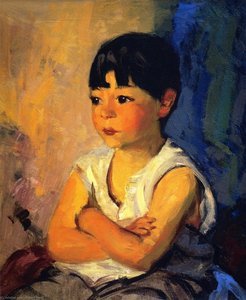
A Winter’s Gaze: Robert Henri's "Snow in New York"
Robert Henri’s “Snow in New York,” painted in 1902, isn’t merely a depiction of a snowy street; it’s a raw, almost brutal, distillation of urban life captured with an unprecedented honesty for its time. Far removed from the idealized landscapes favored by many of his contemporaries, Henri plunges headfirst into the gritty reality of New York City, presenting a scene both familiar and profoundly unsettling. The painting immediately commands attention not through picturesque beauty, but through its stark simplicity and the palpable sense of unease it evokes – a feeling that speaks volumes about the burgeoning anxieties of a rapidly changing America.
Henri’s style firmly places “Snow in New York” within the Ashcan School movement. Rejecting the academic traditions of the National Academy of Design, the Ashcan painters sought to portray everyday life—often the less glamorous aspects—with unflinching realism. This isn't a romanticized view; instead, we encounter a common side street, devoid of grand avenues or iconic landmarks. The composition is deliberately straightforward, utilizing a single-point perspective that draws the eye directly into the scene, emphasizing its immediacy and lack of embellishment. Thick impasto—a technique where paint is applied thickly to create texture—dominates the canvas, lending a tactile quality to the buildings, the snowdrifts, and even the figures traversing the street. The muted palette – browns, grays, and whites – further contributes to the painting’s somber mood, creating an atmosphere of quiet desperation.
The Painter's Perspective: Henri and the Ashcan School
Understanding Robert Henri requires acknowledging his pivotal role in shaping the Ashcan School. Born Robert Henry Cozad in Cincinnati in 1865, Henri’s early life was marked by instability following a fatal shooting involving his father. This event profoundly shaped his artistic vision, leading him to embrace a radical approach to painting—one that prioritized direct observation and honest representation over idealized beauty. Henri's time in Paris exposed him to the Impressionists, but he quickly moved beyond their focus on light and color, seeking instead to capture the essence of American life with unflinching detail. He famously declared that art should be “akin to journalism,” mirroring the straightforwardness and social commentary found in contemporary newspapers.
Henri’s studio became a hub for a group of like-minded artists—including George Luks, Everett Shinn, and William Glackens—collectively known as the "Philadelphia Four." They gathered regularly to discuss art, literature, and philosophy, fostering a spirit of experimentation and challenging established artistic conventions. This collaborative environment fueled their shared desire to depict the realities of urban America, often focusing on marginalized communities and the struggles faced by ordinary people.
Symbolism in the Streetscape
While seemingly simple, “Snow in New York” is rich with symbolic meaning. The absence of grand buildings or recognizable landmarks suggests a sense of anonymity and isolation within the vastness of the city. The figures walking along the street—carrying handbags, bundled in coats—represent the everyday lives of New Yorkers, their faces obscured by the gloom, lost in their own thoughts. The snow itself acts as a metaphor for both hardship and resilience – covering the streets but also creating a temporary sense of stillness. The presence of a wagon suggests commerce and the relentless cycle of urban activity, highlighting the constant struggle for survival.
Notably, Henri’s choice to depict a common street rather than a major avenue is significant. It reflects his deliberate rejection of romanticized views of New York and his focus on the overlooked corners of the city—the places where life unfolded with quiet intensity. The painting isn't about spectacle; it’s about capturing the essence of an ordinary day in an extraordinary place.
A Legacy of Realism
“Snow in New York” remains a powerful testament to Robert Henri’s artistic vision and his pioneering role in American art. It stands as a crucial example of the Ashcan School, demonstrating a commitment to realism, social commentary, and an honest portrayal of urban life. Reproductions of this evocative painting continue to resonate with viewers today, offering a glimpse into the heart of early 20th-century New York—a city grappling with rapid change, industrialization, and the challenges of modernity. Its enduring appeal lies in its ability to capture not just a scene, but also the complex emotions and experiences of those who lived within it.
Fragen & Antworten
Wo kann man handgemalte Reproduktionen von "Snow in New York" von Robert Henri kaufen?
"Snow in New York" ist als eine handgemalte Ölreproduktion auf Leinenleinwand erhältlich. Die Bestellung kann auf der Seite Handgemalte Ölreproduktion in verschiedenen Größen vorgenommen werden.
Befindet sich "Snow in New York" im Land seines Schöpfers?
Nein – das Kunstwerk wird im Ausland aufbewahrt. „Snow in New York“ befindet sich in USA, während Robert Henri in Vereinigte Staaten von Amerika geboren wurde.
Wofür wird eine Reproduktion von "Snow in New York" von Robert Henri empfohlen?
Eine Reproduktion von "Snow in New York" von Robert Henri wird für Statement empfohlen. Dieser Vorschlag ergibt sich aus dem Motiv, der Stimmung und den Farben des Werkes.
Künstlerbiografie
Turbulente Anfänge
Robert Henri, geboren als Robert Henry Cozad am 24. Juni 1865 in Cincinnati, Ohio, erlebte eine Kindheit geprägt von den schwierigen Beziehungen zwischen seinen Eltern, John Jackson Cozad, einem Glücksspieler und Immobilienentwickler, und seiner Mutter, Theresa Gatewood Cozad. Ein bedeutendes Ereignis im Jahr 1882 sollte das Leben der Familie verändern.Die Ashcan School und „The Eight“
Robert Henri entwickelte sich zu einer führenden Figur der Ashcan School des amerikanischen Realismus und war maßgeblich an der Gründung von „The Eight“ beteiligt, einem lockeren Zusammenschluss von Künstlern, die gegen die restriktiven Ausstellungsrichtlinien der mächtigen und konservativen National Academy of Design protestierten. Zu dieser Gruppe gehörten William Glackens, George Luks, Everett Shinn und John Sloan.Künstlerische Entwicklung
Henris künstlerischer Weg begann 1886 an der Pennsylvania Academy of the Fine Arts in Philadelphia unter der Leitung von Thomas Anshutz. Später reiste er 1888 nach Paris, um an der Académie Julian zu studieren, wo er von William-Adolphe Bouguereau und François Millet beeinflusst wurde und schließlich den Impressionismus annahm.Lehre und Einfluss
Ab 1892 unterrichtete Henri an der Philadelphia School of Design for Women. Zu seinen Schülern gehörten Joseph Stella, Edward Hopper, Rockwell Kent, George Bellows, Norman Raeben, Louis D. Fancher und Stuart Davis. Seine Lehrtätigkeit trug maßgeblich zur Verbreitung seines künstlerischen Ansatzes bei.Persönliches Leben und späte Jahre
Im Jahr 1898 heiratete Henri Linda Craige, eine Schülerin aus seinem privaten Kunstkurs. Nach ihrem Tod im Jahr 1905 heiratete er 1908 Marjorie Organ. Seine späteren Jahre waren geprägt von seinem anhaltenden Einfluss auf den amerikanischen Realismus und seiner Rolle als Mentor für kommende Generationen von Künstlern.- Wichtige Werke: „Woman in Manteau“ (1899) und „La Neige“ („The Snow“), die von der französischen Regierung erworben wurden und im Musée du Luxembourg ausgestellt werden.
- Bekannte Schüler: Joseph Stella, Edward Hopper, Rockwell Kent, George Bellows, Norman Raeben, Louis D. Fancher und Stuart Davis.
- Künstlerische Bewegung: Ashcan School des amerikanischen Realismus.
Vermächtnis
Robert Henris Einfluss auf die amerikanische Kunst ist unbestreitbar. Sein Engagement für den Realismus und sein Einfluss auf die nächste Generation von Künstlern haben ein bleibendes Vermächtnis hinterlassen. Seine Betonung der Darstellung des Alltagslebens, seiner Beobachtungsgabe und seines Engagements für seine Schüler machten ihn zu einer Schlüsselfigur in der Entwicklung der amerikanischen Kunst im frühen 20. Jahrhundert.
Robert Henri
1865 - 1929 , Vereinigte Staaten von Amerika
Kurzinfos
- Beeinflusste Künstler: ['William-Adolphe Bouguereau']
- Bemerkenswerte Werke:
- Frau in Mantel
- La Neige
- Geburtsdatum: 24. Juni 1865
- Geburtsort: Cincinnati, USA
- Künstlerische Bewegung: Ashcan-Schule
- Nationalität: Amerikanisch
- Todatum: 12. Juli 1929
- Vollständiger Name: Robert Henri
- Von Ihm Beeinflusste Künstler:
- Edward Hopper
- Rockwell Kent
Ähnliche Artikel
Robert Henri und der Geist des amerikanischen Realismus: Eine Ära urbaner Lebensbilder
Entdecken Sie den Amerikanischen Realismus und Robert Henri! Erfahren Sie mehr über die 'Ashcan School', urbane Lebensbilder, Einflüsse & das Vermächtnis dieser bedeutenden Kunstbewegung. Jetzt lesen!
William Glackens und die Erfassung des modernen amerikanischen Lebens im Stil des Ashcan-Realismus
Entdecken Sie William Glackens und den Ashcan Realismus! Erfahren Sie mehr über die revolutionäre amerikanische Kunstbewegung, ihre Künstler und die Darstellung des modernen Lebens in New York. Expertenwissen auf OriginalUniqueArt.

Farben voller Leben: Die 25 besten Meisterwerke von Henri Matisse
Entdecken Sie die 25 besten Werke von Henri Matisse und den Fauvismus. Erleben Sie Meisterwerke auf OriginalUniqueArt.com.
The Ashcan School: Realism, Urban Life & the Democratization of American Art
Explore the revolutionary Ashcan School! Discover how artists like Henri & Sloan challenged tradition with gritty realism, capturing urban life in early 20th-century America. Learn about their impact on American art history.

The Ashcan School: Capturing the Raw Spirit and Urban Realism of New York City Life
Explore the raw, evocative beauty of the Ashcan School. Discover how masters like Bellows and Glackens captured New York's urban soul through American Realism, and learn to bring this gritty, historical elegance into your modern art collection.