Vorschau anzeigen
 Versenden
 Teilen
 Details anzeigen
 Leitfaden

 Herunterladen
 Ähnliche Objekte
 Röntgenaufnahme
 Diashow
 Fragen & Antworten
 Statistiken
Rhythm Color

 Weiterlesen
Giclée / Kunstdruck
Giclée- oder Leinwanddruck in Museumsqualität mit schneller Produktion und flexiblen Veredelungsoptionen. ( Handgemalte Reproduktion bestellen Zum digitalen Bild wechseln)




P118B €10

P118H €10

P118W €10

P438Z €10

P508JH €12

P508YH €12

P805H €10

P805Z €10

P919BZ €10

P919G €10

P919XJ €10

P959ZH €10

P968JZ €12

W106C €8

W218G €10

W218JH €8

W218Y €10

W307PJ €10

W316G €10

W316PJ €8

W316Y €10

W398PJ €8

W4111J €10

W500HY €15

W500JH €15

W692G €12

W849H €8

W940BG €15

W953PJ €8




Wählen Sie aus unseren vordefinierten Formaten, die den ursprünglichen Proportionen des Kunstwerks entsprechen.

Geben Sie die benötigte Breite und Höhe an, damit der Druck perfekt in Ihren Rahmen oder an Ihre Wand passt. Ein Druck kann nur beschnitten, aber niemals größer als das Originalbild angefertigt werden; daher verliert ein Format mit anderen Proportionen einen Teil des Bildes. Wir senden Ihnen ein digitales Mockup zur Freigabe, bevor wir den Druck ausführen. Das auf dieser Seite gezeigte Bild zeigt nicht den tatsächlichen Beschnitt – dies ist nur im Mockup ersichtlich.
Weltweiter Versand () innerhalb von 2 Wochen statt der üblichen 4/5 Wochen. (11 November)

Kostenloser weltweiter Expressversand

Hochwertige Leinenleinwand

Umfassender Versicherungsschutz beim Versand

Zollgebühren-Rückerstattungsgarantie

Garantie für exakte Farbtreue

100 Tage Rückgaberecht (nur bei Mängeln)

100% Geld-zurück-Garantie

Mengenrabatt verfügbar
 Die Glasoption ist nur für Größen unter 110 cm verfügbar.

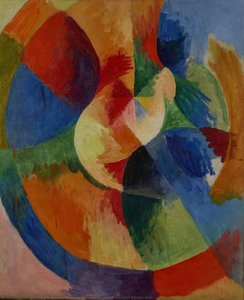
Rhythm Color
Giclée / Kunstdruck
Format der Reproduktion
-


Endpreis
€ 72
Robert Delaunay’s “Rhythm Color”: A Symphony of Geometric Light
The artwork "Rhythm Color," executed by Robert Delaunay in 1913, stands as an emblem of Orphism—a movement that irrevocably altered the trajectory of modern art. More than just a visual spectacle, it embodies a profound philosophical inquiry into the nature of perception and artistic expression itself. Delaunay’s ambition wasn't to depict reality; rather, he sought to distill its essence into pure color and form, mirroring the burgeoning fascination with scientific discoveries concerning light and vibration during this transformative period.- Style & Context: Orphism emerged from Cubism, rejecting its fragmentation of perspective in favor of a more holistic approach. Influenced by Nietzsche’s concept of Dionysian ecstasy—a primal surge of emotion and instinct—the movement aimed to liberate art from representational constraints and tap into the subconscious realm. The canvas pulsates with an energy that transcends mere visual observation.
- Technique: Delaunay employed oil on canvas, utilizing a technique characterized by layering translucent washes of color—primarily reds, yellows, and blues—over textured surfaces achieved through impasto. This method allowed for the creation of luminous effects and palpable materiality, capturing the dynamism inherent in the artist’s vision.
Decoding Geometric Harmony: Composition & Color Palette
The composition is dominated by a rectangular frame enclosing overlapping circles and geometric shapes—primarily squares and rectangles—arranged in a seemingly random yet meticulously balanced configuration. However, beneath this surface lies an underlying order rooted in mathematical principles. Delaunay’s color palette eschews traditional hues, opting instead for vibrant shades that vibrate with luminosity. The interplay of complementary colors—red against blue, yellow against violet—creates visual tension and reinforces the sense of movement throughout the artwork. Each shape contributes to a larger harmonic whole, reflecting the artist's belief in the interconnectedness of form and color.Symbolism Beyond Representation: Light & Vibration
Beyond its formal qualities, “Rhythm Color” carries symbolic weight rooted in Delaunay’s fascination with scientific theories concerning light and vibration. He believed that color possessed a vibrational energy—akin to sound—that could influence human consciousness. The luminous circles represent this radiant force, conveying an aspiration toward transcendence and spiritual illumination. They symbolize the artist's desire to capture not just what is seen but what is felt—a profound communion with the underlying rhythms of existence.Emotional Resonance: Capturing the Dionysian Spirit
Ultimately, “Rhythm Color” succeeds in evoking a powerful emotional response. Its chaotic yet harmonious arrangement mirrors the exhilaration and disorientation experienced during moments of ecstatic inspiration—a core tenet of Orphism’s philosophical underpinning. The artwork invites contemplation on themes of beauty, dynamism, and spiritual awakening, resonating with viewers who appreciate art that transcends mere visual gratification.A reproduction of “Rhythm Color” offers an exceptional opportunity to experience the brilliance of Delaunay's vision—a testament to his pioneering role in shaping the landscape of modern art.
Fragen & Antworten
Welches Motiv und welche Atmosphäre vereint "Rhythm Color" von Robert Delaunay?
"Rhythm Color" zeigt abstract composition, geometric forms, color field art, dynamic rhythm, circular design, modern abstraction, vibrant palette, und die eingefangene Stimmung ist Elegant.
Wie schafft "Rhythm Color" das Gleichgewicht zwischen Hell und Dunkel?
Die aufgezeichneten Werte für "Rhythm Color" von Robert Delaunay sind: balanced Helligkeit, Gentle Luminance Luminanz.
Welche Emotion vermittelt "Rhythm Color" von Robert Delaunay?
"Rhythm Color" von Robert Delaunay vermittelt eine Reflective emotionale Stimmung.
Künstlerbiografie
Frühe Jahre und künstlerliche Anfänge
Robert Delaunay, ein französischer Künstler, wurde am 12. April 1885 in Paris geboren. Er ist vor allem bekannt dafür, dass er zusammen mit seiner Frau Sonia Delaunay die Orphismus-Kunstbewegung begründete. Diese Bewegung, die durch ihre Verwendung von kräftigen Farben und geometrischen Formen gekennzeichnet ist, zielte darauf ab, das moderne Leben durch abstrakte Formen auszudrücken.Künstlerischer Stil und Einflüsse
Delaunays künstlerischer Stil zeichnete sich durch eine kühne Farbgebung und eine deutliche Liebe zur Experimentierfreude mit Tiefe und Ton aus. Seine späteren Werke waren abstrakter und erinnerten an Paul Klee. Der Künstler wurde maßgeblich von der Verwendung von Farbe als Ausdrucksmittel und strukturelles Element beeinflusst.- Die Eiffelturm-Serie, die das Wesen dieses ikonischen Pariser Wahrzeichens in einer einzigartigen und abstrakten Form einfängt.
- Gleichzeitige Kontraste: Sonne und Mond, ein Gemälde, das Delaunays Kunst und sein theoretisches Engagement für Farbe zeigt.
- Fenster öffnen sich gleichzeitig, 1. Teil, 3. Motiv, ein Gemälde, das Delaunays Verwendung von Farbblöcken demonstriert, um Tiefe und Bewegung zu erzeugen.
Wichtige Werke und Vermächtnis
Zu Delaunays wichtigsten Werken gehören:- Der Eiffelturm (126 x 93 cm, Solomon R. Guggenheim Museum, New York, Vereinigte Staaten)
- Gleichzeitige Kontraste: Sonne und Mond (Orphismus)
- Fenster öffnen sich gleichzeitig, 1. Teil, 3. Motiv (Orphismus)
Schlussfolgerung
Robert Delaunay, ein Pionier des Orphismus, hat mit seiner kühnen Farbgebung und abstrakten Formen eine bleibende Spur in der Kunstwelt hinterlassen. Sein Vermächtnis inspiriert weiterhin Künstler und Kunstliebhaber gleichermaßen und macht ihn zu einer bedeutenden Figur in der Geschichte der modernen Kunst. Weitere Werke von Robert Delaunay finden Sie auf OriginalUniqueArt Die Geschichte der Malerei - Wikipedia Die Orphismus-Kunstbewegung - OriginalUniqueArt
Robert Delaunay
1885 - 1941 , Frankreich
Kurzinfos
- Beeinflusste Künstler: ['Paul Klee']
- Bemerkenswerte Werke:
- Eiffelturm (Serie)
- Gleichzeitige Kontraste: Sonne und Mond
- Fenêtres simultanées
- Geburtsdatum: 12. April 1885
- Geburtsort: Paris, Frankreich
- Künstlerische Bewegung: Orphismus, Kubismus
- Nationalität: Französisch
- Sterbedatum: 25. Oktober 1941
- Vollständiger Name: Robert Delaunay
- Von Ihm Beeinflusste Künstler:
- Stanton Macdonald-Wright
- Morgan Russell
- Patrick Henry Bruce
- Der Blaue Reiter
- August Macke
- Franz Marc
- Lyonel Feininger
Ähnliche Artikel
Sonia Delaunay: A Life in Color – Exploring the Rhythms of Abstraction and Synesthesia
Explore the vibrant world of Sonia Delaunay, a pioneer of abstract art and co-founder of Orphism. Discover her revolutionary use of color, geometric forms, and influence on modern design. A deep dive into her life & legacy.
Orphism: A Symphony of Color and Form – Exploring the Abstract Roots of Modern Art
Explore Orphism, the vibrant abstract art movement pioneered by Robert & Sonia Delaunay. Discover its unique color theory, lasting influence on modern art, and how to bring this 'symphony of color' into your home with OriginalUniqueArt.

Orphism Unlocked: The High-Energy Color Revolution That Defined Abstract Art
Dive into the high-energy world of Orphism. Discover how this color revolution broke Cubism's rules to define modern abstraction through light, motion, and pure visual impact. Explore the legacy of the Delaunays and bring bold, vibrant energy to your contemporary space.
Orphism Unveiled: The Radiant Dance of Color and Light in the Evolution of Abstract Art
Discover the luminous world of Orphism. Explore how masters like Robert and Sonia Delaunay revolutionized art through a radiant dance of color, light, and geometric abstraction in this deep dive into modern art history.

Geometrische Abstraktion: Die 10 Meisterwerke, die Kunstgeschichte prägten | OriginalUniqueArt.com
Entdecken Sie die 10 Meisterwerke der geometrischen Abstraktion! Von Kandinsky bis Mondrian – erleben Sie die Geschichte, Farben & Formen dieser revolutionären Kunstrichtung. Hochwertige Kunstreproduktionen auf OriginalUniqueArt.com