In echtem Maßstab anzeigen
 Versenden als Grußkarte
 Teilen
 Details anzeigen
 Leitfaden öffnen

 Herunterladen
 Ähnliche Objekte
 Röntgenaufnahme
 Diashow
 Besucherstatistiken
Rhythm


 Mehr anzeigen
Giclée / Kunstdruck
Giclée- oder Leinwanddruck in Museumsqualität mit schneller Produktion und flexiblen Veredelungsoptionen. ( Handgemalte Reproduktion kaufen Zum digitalen Bild wechseln)




P118B €10

P118H €10

P118W €10

P438Z €10

P508JH €12

P508YH €12

P805H €10

P805Z €10

P919BZ €10

P919G €10

P919XJ €10

P959ZH €10

P968JZ €12

W106C €8

W218G €10

W218JH €8

W218Y €10

W307PJ €10

W316G €10

W316PJ €8

W316Y €10

W398PJ €8

W4111J €10

W500HY €15

W500JH €15

W692G €12

W849H €8

W940BG €15

W953PJ €8




Wählen Sie aus unseren vordefinierten Formaten, die den ursprünglichen Proportionen des Kunstwerks entsprechen.

Geben Sie die Breite und die Höhe an, die Sie benötigen, damit der Druck perfekt in Ihren Rahmen oder an Ihre Wand passt. Ein Druck kann nur beschnitten werden und niemals größer als das Originalbild gemacht werden; daher verliert ein Format mit einer anderen Proportion einen Teil des Bildes. Wir senden Ihnen ein digitales Mockup zur Freigabe, bevor wir den Druck ausführen. Das auf dieser Seite gezeigte Bild zeigt nicht den tatsächlichen Beschnitt – dies ist nur im Mockup ersichtlich.
Weltweiter Versand () innerhalb von 2 Wochen statt der üblichen 4/5 Wochen. (21 Oktober)

Kostenloser weltweiter Expressversand

Hochwertige Leinenleinwand

Vollständiger Versicherungsschutz beim Versand

Zollgebühren-Rückerstattungsgarantie

Garantie für exakte Farbtreue

100-tägiges Rückgaberecht (nur bei Mängeln)

100% Geld-zurück-Garantie

Angebot für Mengenrabatt
 Die Glasoption ist nur für Größen unter 110 cm verfügbar.

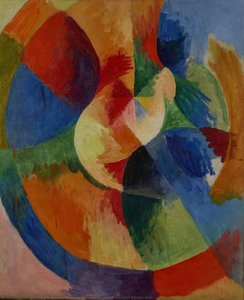
Rhythm
Giclée / Kunstdruck
Format der Reproduktion
-


Gesamtpreis
€ 70
A Symphony of Pure Light and Motion
In the early twentieth century, as the world accelerated into the modern age, Robert Delaunay captured its frantic, beautiful pulse in his 1912 masterpiece, Rhythm. This striking duo of panels serves as a cornerstone of early modernist abstraction, immediately captivating the viewer with a dynamic interplay of color and geometric precision. Rather than depicting a tangible landscape or a human figure, Delaunay invites us into a realm of pure sensation. Large, luminous circles are interwoven with squares and intersecting lines, creating an unmistakable impression of pulsating energy. It is a visual dance where form and color do not merely sit upon the canvas but seem to vibrate against one another, mimicking the very heartbeat of urban life and scientific discovery.
The artwork stands as a profound testament to the Orphism movement, a style Delaunay pioneered alongside his wife, Sonia Delaunay. Moving beyond the fragmented, monochromatic constraints of traditional Cubism, Rhythm embraces a bold, chromatic palette that celebrates the autonomy of color. The technique is nothing short of masterful; executed in oil on canvas, the painting showcases visible, intentional brushstrokes that lend a rich, tactile texture to the surface. Through the skillful use of color gradients and overlapping planes, Delaunay generates an extraordinary sense of depth and luminosity. This layering of pigment allows light to appear as if it is trapped within the circles themselves, creating a glowing effect that breathes life into the abstract composition.
The Dawn of Abstract Expression
To understand Rhythm is to understand a pivotal moment in art history when the boundaries of representation were being irrevocably shattered. Painted during the formative years of the avant-garde, this work reflects the broader European currents that sought to move past Impressionism toward a more distilled visual experience. Delaunay’s vision was not to replicate reality, but to capture its fundamental essence—movement, vibration, and harmony. By rejecting traditional spatial cues and embracing a flattened, asymmetrical perspective, he anticipated the revolutionary shifts of later movements like Surrealism and Expressionism. The painting acts as a bridge between the recognizable world and the limitless possibilities of non-figurative art.
For the discerning collector or interior designer, Rhythm offers more than just aesthetic beauty; it provides an emotional anchor of energy and playfulness. The bright, energetic tones and the rhythmic arrangement of shapes make it a commanding presence in any sophisticated space, capable of injecting vitality into a contemporary setting. It is a piece that speaks to the soul through its lack of literal subject matter, instead communicating through the universal language of light and geometry. Owning a high-quality reproduction of this work means bringing a fragment of the historical avant-garde into the home—a permanent celebration of the moment when art learned to sing in color.
Fragen & Antworten
Aus welcher Epoche stammt "Rhythm"?
"Rhythm" von Robert Delaunay stammt aus der Epoche der Modern. Diese Zeitspanne liefert den historischen Kontext des Werkes.
Wie wird die Farbpalette von "Rhythm" von Robert Delaunay beschrieben?
Die Farbpalette von "Rhythm" von Robert Delaunay wird als Dark beschrieben. Es handelt sich um eine kompakte Beschreibung der Farben des Werkes.
Aus welcher Schaffensperiode von Robert Delaunay stammt "Rhythm"?
Innerhalb der Schaffensperiode von Robert Delaunay lässt sich „Rhythm“ der Early Modern zuordnen. Diese Phase ermöglicht einen Vergleich mit anderen Werken des Künstlers.
Biografie des Künstlers
Frühe Jahre und künstlerliche Anfänge
Robert Delaunay, ein französischer Künstler, wurde am 12. April 1885 in Paris geboren. Er ist vor allem bekannt dafür, dass er zusammen mit seiner Frau Sonia Delaunay die Orphismus-Kunstbewegung begründete. Diese Bewegung, die durch ihre Verwendung von kräftigen Farben und geometrischen Formen gekennzeichnet ist, zielte darauf ab, das moderne Leben durch abstrakte Formen auszudrücken.Künstlerischer Stil und Einflüsse
Delaunays künstlerischer Stil zeichnete sich durch eine kühne Farbgebung und eine deutliche Liebe zur Experimentierfreude mit Tiefe und Ton aus. Seine späteren Werke waren abstrakter und erinnerten an Paul Klee. Der Künstler wurde maßgeblich von der Verwendung von Farbe als Ausdrucksmittel und strukturelles Element beeinflusst.- Die Eiffelturm-Serie, die das Wesen dieses ikonischen Pariser Wahrzeichens in einer einzigartigen und abstrakten Form einfängt.
- Gleichzeitige Kontraste: Sonne und Mond, ein Gemälde, das Delaunays Kunst und sein theoretisches Engagement für Farbe zeigt.
- Fenster öffnen sich gleichzeitig, 1. Teil, 3. Motiv, ein Gemälde, das Delaunays Verwendung von Farbblöcken demonstriert, um Tiefe und Bewegung zu erzeugen.
Wichtige Werke und Vermächtnis
Zu Delaunays wichtigsten Werken gehören:- Der Eiffelturm (126 x 93 cm, Solomon R. Guggenheim Museum, New York, Vereinigte Staaten)
- Gleichzeitige Kontraste: Sonne und Mond (Orphismus)
- Fenster öffnen sich gleichzeitig, 1. Teil, 3. Motiv (Orphismus)
Schlussfolgerung
Robert Delaunay, ein Pionier des Orphismus, hat mit seiner kühnen Farbgebung und abstrakten Formen eine bleibende Spur in der Kunstwelt hinterlassen. Sein Vermächtnis inspiriert weiterhin Künstler und Kunstliebhaber gleichermaßen und macht ihn zu einer bedeutenden Figur in der Geschichte der modernen Kunst. Weitere Werke von Robert Delaunay finden Sie auf OriginalUniqueArt Die Geschichte der Malerei - Wikipedia Die Orphismus-Kunstbewegung - OriginalUniqueArt
Robert Delaunay
1885 - 1941 , Frankreich
Eckdaten zum Künstler
- Beeinflusste Künstler: ['Paul Klee']
- Bemerkenswerte Werke:
- Eiffelturm (Serie)
- Gleichzeitige Kontraste: Sonne und Mond
- Fenêtres simultanées
- Geburtsdatum: 12. April 1885
- Geburtsort: Paris, Frankreich
- Künstlerische Bewegung: Orphismus, Kubismus
- Nationalität: Französisch
- Sterbedatum: 25. Oktober 1941
- Vollständiger Name: Robert Delaunay
- Von Ihm Beeinflusste Künstler:
- Stanton Macdonald-Wright
- Morgan Russell
- Patrick Henry Bruce
- Der Blaue Reiter
- August Macke
- Franz Marc
- Lyonel Feininger
Verwandte Artikel

Geometrische Abstraktion: Die 10 Meisterwerke, die Kunstgeschichte prägten | OriginalUniqueArt.com
Entdecken Sie die 10 Meisterwerke der geometrischen Abstraktion! Von Kandinsky bis Mondrian – erleben Sie die Geschichte, Farben & Formen dieser revolutionären Kunstrichtung. Hochwertige Kunstreproduktionen auf OriginalUniqueArt.com
Sonia Delaunay: A Life in Color – Exploring the Rhythms of Abstraction and Synesthesia
Explore the vibrant world of Sonia Delaunay, a pioneer of abstract art and co-founder of Orphism. Discover her revolutionary use of color, geometric forms, and influence on modern design. A deep dive into her life & legacy.
Orphism Unveiled: The Radiant Dance of Color and Light in the Evolution of Abstract Art
Discover the luminous world of Orphism. Explore how masters like Robert and Sonia Delaunay revolutionized art through a radiant dance of color, light, and geometric abstraction in this deep dive into modern art history.
Fernand Léger: Die 25 Meisterwerke des Kubismus für Ihr Zuhause | OriginalUniqueArt
Entdecken Sie die 25 Meisterwerke von Fernand Léger! Tauchen Sie ein in die Welt des Kubismus, Tubismus & der Avantgarde. Hochwertige Kunstreproduktionen für Ihr Zuhause – jetzt auf OriginalUniqueArt.com!

Kandinsky: Die 25 Meisterwerke des Abstrakten – Kunst für Ihr Zuhause | OriginalUniqueArt
Entdecken Sie die 25 bedeutendsten Gemälde von Wassily Kandinsky! Tauchen Sie ein in die Welt der abstrakten Kunst, des Expressionismus und der Farbkomposition. Hochwertige Kunstdrucke & Inspiration für Ihr Zuhause auf OriginalUniqueArt.com.