Expressionism
Aragon (Rafael Barradas)
Rafael Barradas (1890–1929) schuf Aragon. Es gehört zur Expressionism-Strömung. Es ist aus Oil On Canvas gefertigt.
- Oil On Canvas

 Vorschau anzeigen

 Handgemaltes Ölgemälde
 Versenden
 Teilen
 Datenblatt


 Herunterladen
 Ähnliche Objekte
 Röntgenaufnahme
 Diashow
 Fragen & Antworten

 Statistiken
Aragon im Überblick
- Titel
- Aragon
- Künstler
- Rafael Barradas (1890–1929)
- Geburtsjahr des Künstlers
- Montevideo, Uruguay
- Medium
- Oil On Canvas
- Bewegung
- Expressionism
- Epoche
- Modern
- Motiv
- portrait, religious figures, expressionism, geometric forms, shadows, texture
Was stellt Aragon dar?
The Subject and Artist of Aragon
Aragon is a work by Rafael Barradas, an Uruguayan modernist painter and graphic artist. The piece presents a group portrait of three figures, rendered in a distinctly Expressionistic style. These subjects, appearing as clergymen or religious officials, are defined by bold, angular lines and simplified forms. Their attire, including collars and hats, suggests a position of religious authority.
Barradas, born in Montevideo, Uruguay, in 1890, developed a unique visual language through his immersion in European avant-garde movements. His approach often synthesized the dynamism of Futurism and the structural deconstruction of Cubism. In this work, the artist prioritizes emotional impact over accurate representation, utilizing sharp edges to construct the faces and torsos of the subjects.
The composition focuses entirely on the heads and upper bodies of the three men against a dark, textured background. This tight cropping, combined with the severe and detached expressions of the figures, creates a sense of solemnity. The artist’s method emphasizes the physical presence of the subjects through heavy, layered application of paint.
Composition and Visual Elements
The composition is tightly cropped, focusing exclusively on the heads and upper torsos of the three figures. This close framing eliminates environmental context, pushing the subjects toward the viewer. Bold, angular lines define the faces, utilizing sharp edges to construct the features. The arrangement relies on a geometric vocabulary; squares, rectangles, and triangles are used to build the forms of the figures rather than following naturalistic contours.
A single, unseen light source casts heavy shadows across the subjects. These shadows accentuate the structural planes of the faces, heightening the dramatic tension. The perspective is intentionally flattened, rejecting any sense of receding space or depth. Against this lack of spatial dimension, the background remains dark and heavily textured, providing a stark contrast to the geometric subjects.
Technique and Artistic Materials
The work is executed in oil paints on canvas. The application of pigment is heavy, utilizing a thick impasto that creates a palpable, rough surface. This layered approach builds a physical texture across the pictorial plane, emphasizing the material presence of the paint itself.
Visible brushwork defines the forms, rejecting smooth transitions in favor of direct, gestural marks. These strokes contribute to the structural clarity of the figures, using sharp edges and angularity to construct the subjects. The interplay of light and shadow is achieved through this deliberate, uneven application, which accentuates the planes of the faces and adds a sense of weight to the composition.
Hochauflösende Bilder von Aragon
Gemeinfrei: Der Künstler verstarb im Jahr 1929.
Rafael Barradas, Aragon. Gemeinfreiheit
Fragen zu Aragon, beantwortet
In welcher Technik wurde "Aragon" von Rafael Barradas ausgeführt?
Das Medium von "Aragon" von Rafael Barradas ist Oil On Canvas. Die Reproduktionen zielen darauf ab, die Optik dieser Technik wiederzugeben.
Welche Motive sind in "Aragon" von Rafael Barradas zu sehen?
Die Motive von "Aragon" sind portrait, religious figures, expressionism, geometric forms, shadows, texture, clergy, angular.
Ist die Abbildung von "Aragon" von Rafael Barradas gemeinfrei?
Was das Urheberrecht betrifft, so ist "Aragon" gemeinfrei – das Urheberrecht ist abgelaufen.
Wer ist der Künstler hinter "Aragon"?
"Aragon" wurde von Rafael Barradas geschaffen. Die Informationen auf dieser Seite beschreiben das Originalwerk von Rafael Barradas.
Zu welcher Stilrichtung gehört "Aragon"?
„Aragon“ ist ein Werk der Expressionism. Die Stilrichtung gibt die künstlerische Tradition an, der das Werk angehört.
In welche Phase von Rafael Barradass Schaffen lässt sich "Aragon" einordnen?
„Aragon“ entstammt der Mature Period von Rafael Barradas. Diese Einordnung setzt das Werk in Bezug zur künstlerischen Entwicklung des Künstlers.
Ist "Aragon" von Rafael Barradas gemeinfrei, und warum?
"Aragon" von Rafael Barradas ist gemeinfrei – das Urheberrecht ist abgelaufen. Die Urheberrechtsfristen werden ab dem Todesjahr des Künstlers berechnet, und Rafael Barradas verstarb im Jahr 1929.
Welche Gemeinsamkeiten weist "Aragon" mit dem restlichen Werk von Rafael Barradas auf?
Innerhalb des Gesamtwerks von Rafael Barradas steht „Aragon“ im Stil der Expressionism und greift die Themen futurist & cubist echoes, uruguayan religious themes, spanish exile reflections, aragon – a stark portrait, barradas' intense vision, early expressionistic style, short career, bold impact auf.
Ist "Aragon" typisch für das Werk von Rafael Barradas?
Zu den wiederkehrenden Themen von Rafael Barradas gehören futurist & cubist echoes, uruguayan religious themes, spanish exile reflections, aragon – a stark portrait, barradas' intense vision, early expressionistic style, short career, bold impact; „Aragon“ konzentriert sich auf portrait, religious figures, expressionism, geometric forms, shadows, texture, clergy, angular.
Über den Künstler, Rafael Barradas

1890–1929, Uruguay
Rafael Barradas
Ein Leben im Schwingen: Die künstlerische Reise Rafael Barradas Rafael Pérez Giménez Barradas, geboren 1890 in Montevideo, Uruguay, erblühte als eine Schlüsselfigur der aufkommenden Modernen Bewegung des frühen 20. Jahrhunderts. Seine Geschichte ist geprägt von rastloser künstlerischer Erkundung, einer lebendigen Verschmelzung uruguayischer Wurzeln und europäischer Avantgarde-Sensibilitäten. Umgeben von einer Familie, die tief in künstlerischem Ausdruck verwurzelt war – eine Pianistin Schwester, ein Dichter Bruder und ein Maler Vater – absorbierte Barradas frühzeitig eine ästhetische Sensibilität, die sein Lebenswerk definieren sollte.
Über Rafael Barradas Bemerkenswerte Werke von Rafael Barradas
Ebenfalls von Rafael Barradas
 Barcelonastraße um 13 Uhr1918
 Der Tango1913
 Playa Ramirez (auf der Terrasse)
 Hospitalet de Llobregat
Essays zu Aragon
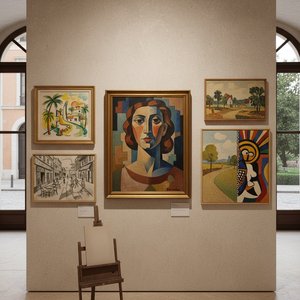 Rafael Barradas: Die Synthese europäischer Avantgarde und uruguayischer Moderne – Eine künstlerische AnnäherungEntdecken Sie Rafael Barradas und seine Synthese aus europäischer Avantgarde und uruguayischer Moderne. Expertenanalyse, Sammlerperspektive…
 Argentinische Maler des 20. JahrhundertsEntdecken Sie argentinische Meister wie Lucio Fontana und Antonio Berni. Erleben Sie Ikonen der Moderne auf OriginalUniqueArt.com.
 Spontaneität und Materie: Die Abgrenzung von CoBrA vom Art InformelErfahren Sie den Unterschied zwischen CoBrA und Art Informel durch Expertenwissen. Jetzt die Kunstgeschichte verstehen!