

 Vorschau anzeigen
 Versenden
 Teilen
 Details anzeigen

 Herunterladen
 Ähnliche Objekte
 Röntgenaufnahme
 Diashow
Composition. Unfinished


 Weiterlesen
Giclée / Kunstdruck
Giclée- oder Leinwanddruck in Museumsqualität mit schneller Produktion und flexiblen Veredelungsoptionen. ( Handgemalte Reproduktion bestellen Bild kaufen)




P118B $10

P118H $10

P118W $10

P438Z $10

P508JH $12

P508YH $12

P805H $10

P805Z $10

P919BZ $10

P919G $10

P919XJ $10

P959ZH $10

P968JZ $12

W106C $8

W218G $10

W218JH $8

W218Y $10

W307PJ $10

W316G $10

W316PJ $8

W316Y $10

W398PJ $8

W4111J $10

W500HY $15

W500JH $15

W692G $12

W849H $8

W940BG $15

W953PJ $8




Wählen Sie aus unseren vordefinierten Formaten, die den ursprünglichen Proportionen des Kunstwerks entsprechen.

Sie können Ihre eigenen Maße eingeben, um ein bestimmtes Format oder einen speziellen Platz einzupassen. Wenn das von Ihnen gewählte Format nicht den Proportionen des Originalbildes entspricht, werden wir das Kunstwerk entweder beschneiden oder das Bild mit einem gespiegelten oder einfarbigen Rand erweitern. Ein digitaler Entwurf wird Ihnen zur Genehmigung zugesandt, bevor die Produktion beginnt.
Bitte beachten Sie, dass die Vorschau auf dem Bildschirm nicht den tatsächlichen Zuschnitt oder die Erweiterung widerspiegelt. Nur der Entwurf zeigt die endgültige Komposition präzise an.
Obwohl Sondermaße verfügbar sind, empfehlen wir die Auswahl eines Maßes aus der vordefinierten Liste, um die ursprünglichen Proportionen zu bewahren.
Weltweiter Versand () innerhalb von 2 Wochen statt der üblichen 4/5 Wochen. (21 August)

Kostenloser weltweiter Expressversand

Hochwertige Leinenleinwand

Umfassender Versicherungsschutz beim Versand

Zollgebühren-Rückerstattungsgarantie

Garantie für exakte Farbtreue

60 Tage Rückgaberecht (nur bei Mängeln)

100% Geld-zurück-Garantie

Mengenrabatt verfügbar
 Die Glasoption ist nur für Größen unter 110 cm verfügbar.

Composition. Unfinished
Giclée / Kunstdruck
Format der Reproduktion
-


Gesamtpreis
$ 80
Sammlerstück-Beschreibung
A Study in Restrained Harmony: Exploring Mondrian’s ‘Composition. Unfinished’
Piet Mondrian's Composition. Unfinished is more than just a painting; it’s an embodiment of a radical artistic philosophy, a visual distillation of the artist’s lifelong pursuit of universal harmony. Executed in his signature style, this work exemplifies the core tenets of Neo-Plasticism – a movement that sought to strip away all superfluous elements from art and reality, revealing only essential lines and primary colors. The painting's stark simplicity immediately commands attention, inviting the viewer into a carefully constructed space where balance and order reign supreme.
- Subject Matter: The subject itself is deliberately reductive. Mondrian eschews traditional depictions of landscapes or figures, instead focusing on geometric forms – squares and rectangles – arranged in a rigorously controlled composition.
- Color Palette: The restrained palette—a vibrant red square anchored by surrounding white rectangles punctuated with black lines—is profoundly significant. Red, often associated with passion and energy, is tempered by the cool neutrality of white, creating a dynamic tension that speaks to the artist’s desire for equilibrium. The black squares provide crucial grounding, preventing the composition from dissolving into pure abstraction.
The Roots of Neo-Plasticism: A Reaction Against Impressionism
Understanding Composition. Unfinished requires acknowledging its historical context. Mondrian's artistic journey began within the vibrant currents of Dutch Impressionism and Post-Impressionism, a period marked by experimentation with color and light. However, he ultimately rejected these approaches, finding them too subjective and reliant on fleeting perceptions. Influenced by Theosophy, a spiritual movement that emphasized universal harmony and interconnectedness, Mondrian sought to create art that reflected this underlying order – a belief that the visible world was merely a superficial manifestation of a deeper, geometric reality.
- Early Influences: His early landscapes, such as *The Red Mill*, demonstrate his initial mastery of traditional techniques. Yet, even in these works, there’s an underlying tension, a desire to move beyond mere representation and capture something more fundamental.
- Theoretical Framework: Mondrian's philosophy extended beyond the canvas; he believed that art should be a reflection of universal principles, much like music or mathematics. This conviction shaped his entire artistic practice.
Technique and Composition: A Masterclass in Reduction
Mondrian’s technique is characterized by its meticulous precision and unwavering control. Each element – the square, the rectangle, the line – is rendered with a deliberate hand, reflecting the artist's commitment to order and clarity. The painting’s composition isn’t accidental; it’s the result of countless calculations and adjustments, guided by Mondrian’s theoretical framework. The ‘unfinished’ aspect adds another layer of intrigue, suggesting a perpetual state of refinement, an ongoing exploration of balance and harmony. It's a testament to his belief that perfection is unattainable but the pursuit itself is profoundly meaningful.
- Linear Perspective: The painting utilizes a modified linear perspective, creating a sense of depth within its two-dimensional space.
- Grid System: A subtle grid system underlies the composition, further reinforcing the idea of order and structure.
Symbolism and Emotional Impact
While seemingly austere, Composition. Unfinished is profoundly rich in symbolism. The squares represent the fundamental building blocks of reality – horizontal and vertical lines symbolizing stability and dynamism respectively. The painting evokes a sense of calm contemplation, inviting viewers to engage with its inherent order and discover their own interpretations. It’s a powerful reminder that beauty can be found in simplicity, and that true harmony lies in the careful balance of opposing forces.
Über den Künstler
**frühes Leben und Karriere in den Niederlanden (1872–1911)**
pieter cornelis mondriaan, bekannt ab 1911 als piet mondrian, war ein niederländischer Maler und Kunsttheoretiker, geboren am 7. März 1872 in Amersfoort, Niederlande. Er begann seine Karriere als Lehrer an der Grundschule und betrieb gleichzeitig Malerei, zunächst im Stil der Haag School des niederländischen Impressionismus.- Sein frühes Werk, das von naturalistischen Landschaften geprägt ist, kann in Gemälden wie the red mill und trees in moonrise zu sehen ist, die im kunstmuseum den haag ausgestellt wurden.
- Mondrians Suche nach einem persönlichen Stil führte ihn dazu, verschiedene künstlerische Bewegungen zu erkunden, darunter Pointillismus und Fauvismus.
- Seine erste Ausstellung im Jahr 1893 markierte den Beginn seiner produktiven Karriere.
**Die Entwicklung des Stils von Mondrian**
Von figurativ zu abstrakt Mondrians künstlerische Richtung verschob sich hin zu einem zunehmend abstrakten Stil, der in eine nicht-repräsentative Form mündete, die er Neoplasticismus nannte. Diese „reine plastische Kunst“ zielte darauf ab, „universelle Schönheit“ zu schaffen und seinen formalen Wortschatz auf Primärfarben (Rot, Blau und Gelb), Werte (Schwarz, Weiß und Grau) und Richtungen (horizontal und vertikal) zu beschränken.- Beispiele für diesen Stil lassen sich in Gemälden wie composition with yellow patch (46 x 46 cm, Neoplasticismus, Öl auf Leinwand) zu sehen sein.
- Mondrians Werk hatte einen enormen Einfluss auf die Kunst des 20. Jahrhunderts und beeinflusste nicht nur die abstrakte Malerei, sondern auch Design, Architektur und Mode.
**Vermächtnis und Einfluss**
Mondrians Vermächtnis erstreckt sich über sein eigenes Werk hinaus und beeinflusst wichtige Stile und Bewegungen wie Farbflächenmalerei, abstrakten Expressionismus und Minimalismus. Kunsthistoriker stephen bayley stellte fest, dass Mondrian zum Totem für alles geworden ist, was der Modernismus zu sein versuchte.- Entdecken Sie mehr von Mondrians Werk unter OriginalUniqueArt.com.
- Erfahren Sie mehr über die De Stijl-Bewegung und ihren Einfluss auf die moderne Kunst auf wikipedia.
- Entdecken Sie andere einflussreiche Künstler wie vincent van gogh und ihre Auswirkungen auf die Kunstwelt.
**Wichtige Werke und Ausstellungen**
* piet mondrian: apple blossom (Cubismus) (ansicht auf OriginalUniqueArt.com) * piet mondrian: still life with vase of spices ii (Cubismus) (ansicht auf OriginalUniqueArt.com) * piet mondrian: passionflower (73 x 48 cm, Kunstmuseum Den Haag, Postimpressionismus, Aquarell) (ansicht auf OriginalUniqueArt.com)
Piët Mondrian
1872 - 1944 , Niederlande
Kurzinfos
- Beeinflusste Künstler:
- Hague School
- Pointillismus
- Fauvismus
- Kubismus
- Bemerkenswerte Werke:
- Komposition mit Rot, Gelb und Blau
- Broadway Boogie Woogie
- Tableau Nr. 2 Komposition V
- Rhythmus der schwarzen Linien
- Geburtsdatum: 7. März 1872
- Geburtsort: Amersfoort, Niederlande
- Künstlerische Bewegung: De Stijl, Neoplasticismus
- Nationalität: Niederländisch
- Sterbedatum: 1944
- Vollständiger Name: Piët Mondriaan
- Von Künstlern Beeinflusst:
- Farbfeldmalerei
- Abstrakter Expressionismus
- Minimalismus
Ähnliche Artikel

Geometrische Abstraktion: Die 10 Meisterwerke, die Kunstgeschichte prägten | OriginalUniqueArt.com
Entdecken Sie die 10 Meisterwerke der geometrischen Abstraktion! Von Kandinsky bis Mondrian – erleben Sie die Geschichte, Farben & Formen dieser revolutionären Kunstrichtung. Hochwertige Kunstreproduktionen auf OriginalUniqueArt.com

Kandinsky: Die 25 Meisterwerke des Abstrakten – Kunst für Ihr Zuhause | OriginalUniqueArt
Entdecken Sie die 25 bedeutendsten Gemälde von Wassily Kandinsky! Tauchen Sie ein in die Welt der abstrakten Kunst, des Expressionismus und der Farbkomposition. Hochwertige Kunstdrucke & Inspiration für Ihr Zuhause auf OriginalUniqueArt.com.
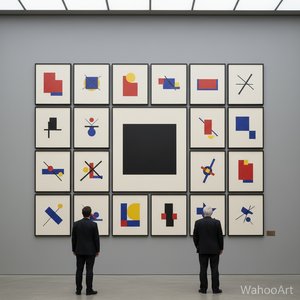
Kazimir Malevich: Die 25 Meisterwerke des Suprematismus für Ihr Zuhause | OriginalUniqueArt
Entdecken Sie die 25 Meisterwerke von Kazimir Malevich! Tauchen Sie ein in die Welt des Suprematismus, abstrakter Kunst & geometrischer Formen. Hochwertige Kunstdrucke und Reproduktionen auf OriginalUniqueArt.com – für Ihr Zuhause.

Neo-Abstract Art: The High-Impact Evolution of Modern Visual Energy and Geometric Sophistication
Discover the power of Neo-Abstract art. Explore how bold geometric forms and high-impact visual energy are redefining modern design. Learn to curate sophisticated, high-energy spaces with the latest trends in contemporary abstraction and structural color.

Beyond Form & Color: Geometric Abstraction's Evolution in 20th/21st Century Art
Explore the evolution of geometric abstraction from Cubism to contemporary art. Discover key artists like Malevich & Mondrian, investment insights, and expert collecting advice at OriginalUniqueArt.



