Expressionism
Self-portrait (Paula Modersohn-Becker)
Paula Modersohn-Becker (1876–1907) schuf Self-portrait. Es gehört zur Expressionism-Strömung. Es ist aus Oil On Canvas gefertigt.
- Oil On Canvas

 Vorschau anzeigen

 Handgemaltes Ölgemälde
 Versenden
 Teilen
 Datenblatt


 Herunterladen
 Ähnliche Objekte
 Röntgenaufnahme
 Diashow
 Fragen & Antworten

 Statistiken
Self-portrait im Überblick
- Titel
- Self-portrait
- Künstler
- Paula Modersohn-Becker (1876–1907)
- Geburtsjahr des Künstlers
- Dresden, Deutschland
- Medium
- Oil On Canvas
- Bewegung
- Expressionism
- Epoche
- Modern
- Motiv
- woman, red hair, green shirt, face, eyes, wall
Was stellt Self-portrait dar?
Identification of the Self-portrait
Self-portrait is a creation by the German Expressionist painter and draftswoman Paula Modersohn-Becker. This specific piece belongs to a vast body of work produced during her active life. The artist was born on 8 February 1876 in Dresden, Germany, and passed away on 30 November 1907 in Worpswede.
In this work, Paula Modersohn-Becker turns her gaze toward the viewer. The image captures a moment of quiet intensity through the artist's own likeness. It remains a direct encounter with her presence.
The Composition and Visual Details
The subject is positioned in front of a plain wall, seated in a manner that brings her face into sharp prominence. She wears a green shirt that contrasts with her red hair. Her hair is styled in an unconventional manner, contributing to the singular presence of the figure. The composition focuses heavily on the facial features, emphasizing a directness of gaze. Her eyes are open wide, looking straight ahead to meet the viewer's eyes with quiet intensity.
The arrangement of the figure against the background creates a sense of immediate, unmediated encounter. There is a notable focus on the psychological weight of the stare. The simplicity of the setting ensures that the viewer's attention remains fixed on the subject's expression and the specific arrangement of her features. This directness removes any sense of artifice from the encounter.
Technique and Artistic Medium
Executed in oil on canvas, this work exemplifies the principles of Expressionism. The medium allows for a directness of form that prioritizes the psychological state over mere physical likeness. Through the application of pigment, the artist achieves a sense of quiet intensity, focusing on the essential features of the face and the gaze to facilitate a moment of introspection.
The application of paint emphasizes a recognizable simplicity of form. This approach moves away from the atmospheric concerns of Impressionism, opting instead for a more structured and subjective visual language. The surface carries the weight of the artist's presence, using color and composition to explore the nuances of identity.
Where to See This Artwork Today
This work is held at the Paula Modersohn-Becker Museum in Bremen, Germany. The institution serves as a primary repository for the artist's output, housing a significant portion of her creative legacy.
Founded in 1927, the museum holds a unique position in art history as the first museum in the world devoted solely to a female artist. Its collection provides a comprehensive view of her development from her early training to her final years in Paris.
Related Works by the Artist
The artist's exploration of the self continued through several distinct phases of her career. In 1906, she produced Self-Portrait Looking Slightly Left, a work that shares a similar searching quality with her other studies of identity. During that same year, she completed Self-Portrait at 6th Wedding Anniversary, a piece that captures a specific moment of transition. This work is also known as Self-portrait on the sixth anniversary of marriage.
Earlier compositions reveal a different focus on objects and the female form. Around 1904, she created Self-Portrait with a bowl and a glass. Her interest in the intersection of the female form and the natural world is further evidenced in Self-Portrait with Two Flowers, where she cradles blossoms with a deliberate, steady intention.
Hochauflösende Bilder von Self-portrait
Gemeinfrei: Der Künstler verstarb im Jahr 1907.
Paula Modersohn-Becker, Self-portrait. Gemeinfreiheit
Fragen zu Self-portrait, beantwortet
In welcher Technik wurde "Self-portrait" von Paula Modersohn-Becker ausgeführt?
"Self-portrait" wurde in Oil On Canvas ausgeführt.
Was stellt "Self-portrait" von Paula Modersohn-Becker dar?
Die Motive von "Self-portrait" sind woman, red hair, green shirt, face, eyes, wall.
Ist "Self-portrait" von Paula Modersohn-Becker gemeinfrei?
Die urheberrechtliche Situation für "Self-portrait" von Paula Modersohn-Becker: Das Werk ist gemeinfrei – das Urheberrecht ist abgelaufen. Dies bestimmt, ob Reproduktionen des Bildes frei erstellt werden dürfen.
Wer hat "Self-portrait" geschaffen?
Der Künstler hinter „Self-portrait“ ist Paula Modersohn-Becker. Das Werk ist unter dem Namen von Paula Modersohn-Becker katalogisiert.
Welcher Kunstrichtung lässt sich "Self-portrait" von Paula Modersohn-Becker zuordnen?
Die mit "Self-portrait" von Paula Modersohn-Becker verbundene Stilrichtung ist Expressionism. Diese Klassifizierung ordnet das Werk in den Kontext verwandter Künstler und Kunstwerke ein.
Warum ist der Urheberrechtsstatus von "Self-portrait" so, wie er ist?
Der Urheberrechtsstatus von "Self-portrait" – gemeinfrei – das Urheberrecht ist abgelaufen – ergibt sich aus dem Todesjahr des Künstlers im Jahr 1907.
Welche Gemeinsamkeiten weist "Self-portrait" mit dem restlichen Werk von Paula Modersohn-Becker auf?
"Self-portrait" gehört zu Paula Modersohn-Beckers Werk der Expressionism-Epoche, dessen dokumentierte Themen unter anderem cézanne, gauguin, van gogh, identity and femininity, self-exploration and agency, pioneer of expressionism umfassen.
Inwiefern steht das Sujet von „Self-portrait“ in Beziehung zu den üblichen Themen von Paula Modersohn-Becker?
Unter den dokumentierten Themen von Paula Modersohn-Becker – cézanne, gauguin, van gogh, identity and femininity, self-exploration and agency, pioneer of expressionism – setzt „Self-portrait“ einen ganz eigenen Fokus auf woman, red hair, green shirt, face, eyes, wall.
Über den Künstler, Paula Modersohn-Becker

1876–1907, Deutschland
Paula Modersohn-Becker
Eine Pionierin des inneren Sehens: Das Leben und Werk von Paula Modersohn-Becker Paula Modersohn-Becker, ein Name, der in den Annalen der frühen modernen Kunst mit stiller Kraft widerhallt, war eine Künstlerin, die es wagte, nach innen zu blicken. Geboren am 8. Februar 1876 als Minna Hermine Paula Becker in Dresden, Deutschland, war ihr Leben tragisch kurz – sie verstarb am 30. November 1907 in Worpswede – doch innerhalb dieser drei Jahrzehnte bahnte sie einen Weg von bemerkenswerter künstlerischer Innovation und persönlichem Mut.
Über Paula Modersohn-Becker Bemerkenswerte Werke von Paula Modersohn-Becker
Ebenfalls von Paula Modersohn-Becker
 Porträt einer jungen Frau mit rotem Hut1900
 Halbporträt eines alten Bauern1903
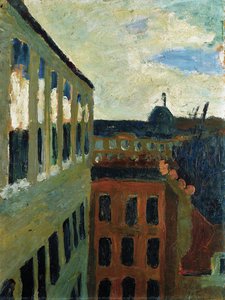 Blick aus dem Atelierfenster der Künstlerin in Paris1900
 Stillleben mit Pflanze, Zitrone und Orange1906
Essays zu Self-portrait
 Polnische Kunstwerke der 1900er JahreErleben Sie polnische Meisterwerke von Malczewski bis Boznańska. Entdecken Sie Ikonen der Young Poland Bewegung auf OriginalUniqueArt.com.
 Deutsche Kunstwerke der 1900er JahreErleben Sie deutsche Kunst der 1900er von Marc bis Kirchner. Entdecken Sie Meisterwerke auf OriginalUniqueArt.com.
 Egon Schiele: Die 25 bedeutendsten Meisterwerke des ExpressionismusEntdecken Sie die 25 besten Werke von Egon Schiele. Erleben Sie den österreichischen Expressionismus auf OriginalUniqueArt.com. Jetzt Kolle…