In echtem Maßstab anzeigen
 Versenden als Grußkarte
 Teilen
 Details anzeigen
 Leitfaden öffnen

 Herunterladen
 Ähnliche Objekte
 Röntgenaufnahme
 Diashow
 Besucherstatistiken
Snake-Eaters
 Oil On Canvas
- WallArt
- Symbolism
 19th Century
 161.0 x 127.0 cm
 Warschau Nationalmuseum
 Mehr anzeigen
Giclée / Kunstdruck
Giclée- oder Leinwanddruck in Museumsqualität mit schneller Produktion und flexiblen Veredelungsoptionen. ( Handgemalte Reproduktion kaufen Zum digitalen Bild wechseln)




P118B €10

P118H €10

P118W €10

P438Z €10

P508JH €12

P508YH €12

P805H €10

P805Z €10

P919BZ €10

P919G €10

P919XJ €10

P959ZH €10

P968JZ €12

W106C €8

W218G €10

W218JH €8

W218Y €10

W307PJ €10

W316G €10

W316PJ €8

W316Y €10

W398PJ €8

W4111J €10

W500HY €15

W500JH €15

W692G €12

W849H €8

W940BG €15

W953PJ €8




Wählen Sie aus unseren vordefinierten Formaten, die den ursprünglichen Proportionen des Kunstwerks entsprechen.

Geben Sie die Breite und die Höhe an, die Sie benötigen, damit der Druck perfekt in Ihren Rahmen oder an Ihre Wand passt. Ein Druck kann nur beschnitten werden und niemals größer als das Originalbild gemacht werden; daher verliert ein Format mit einer anderen Proportion einen Teil des Bildes. Wir senden Ihnen ein digitales Mockup zur Freigabe, bevor wir den Druck ausführen. Das auf dieser Seite gezeigte Bild zeigt nicht den tatsächlichen Beschnitt – dies ist nur im Mockup ersichtlich.
Weltweiter Versand () innerhalb von 2 Wochen statt der üblichen 4/5 Wochen. (24 Oktober)

Kostenloser weltweiter Expressversand

Hochwertige Leinenleinwand

Vollständiger Versicherungsschutz beim Versand

Zollgebühren-Rückerstattungsgarantie

Garantie für exakte Farbtreue

100-tägiges Rückgaberecht (nur bei Mängeln)

100% Geld-zurück-Garantie

Angebot für Mengenrabatt
 Die Glasoption ist nur für Größen unter 110 cm verfügbar.

Snake-Eaters
Giclée / Kunstdruck
Format der Reproduktion
-


Gesamtpreis
€ 70
A Mystical Encounter in the Breton Woods
In the heart of the dense, dappled forests of Brittany, Paul Sérusier’s “Snake-Eaters” unfolds as a profound invocation of ancient folklore and spiritual mystery. Painted in 1896, this masterpiece transcends mere landscape painting to become a window into the soul of Breton mysticism. The canvas captures four figures caught in the midst of a ritualistic dance, their forms emerging from the shadows of a primordial woodland. There is an undeniable sense of communal connection present in the scene, yet it is draped in an aura of the unknown. As sunlight filters through the thick canopy, it illuminates not just the physical space, but the spiritual weight of the ceremony taking place. For the discerning collector or interior designer, this work offers more than visual beauty; it provides a gateway into a world where the boundaries between the human and the divine are beautifully blurred.
The technique employed by Sérusier is a masterclass in Cloisonnism, a style that would later become a cornerstone of modern abstraction. Rather than relying on the fleeting optical realism of the Impressionists, Sérus and his contemporaries sought a deeper, more permanent truth. He utilizes flat planes of color, bounded by thin, dark contours that resemble the stained glass of a cathedral. This method strips away unnecessary naturalistic detail, allowing the viewer to focus on the rhythmic harmony of the composition. The texture of the foliage and the deliberate arrangement of the figures create a sense of depth that does not rely on traditional perspective, but rather on the emotional weight of color and shape. It is a technique that demands attention, making it a striking focal point for any sophisticated gallery or curated living space.
Symbolism and the Spirit of the Nabis
To understand “Snake-Eaters,” one must look toward the historical currents of the late 19th century. Emerging from the influential Pont-Aven colony under the mentorship of Paul Gauguin, Sérusier was a pioneer of the Nabis movement. This group of artists sought to express inner emotions and spiritual truths through symbolic imagery, rejecting the objective observation of the world in favor of subjective experience. The painting’s palette—a somber yet mesmerizing arrangement of deep browns, earthy reds, and heavy blacks—is meticulously chosen to evoke feelings of reverence, apprehension, and mystery. Every element, from the posture of the dancing figures to the subtle presence of nature around them, serves as a symbol for the unseen forces that shape human existence.
For those looking to integrate art into a refined interior, “Snake-Eaters” offers an unparalleled emotional resonance. It is a piece that invites contemplation and conversation, bringing a sense of historical gravity and avant-garde intellect to a room. Whether displayed as a high-quality reproduction in a study or as a centerpiece in a contemporary lounge, the painting’s ability to evoke the "aura of the unknown" remains potent. It stands as a testament to a period of intense artistic experimentation, offering a timeless connection to the legends and shadows of the past.
Fragen & Antworten
Wie wurde "Snake-Eaters" hergestellt und welche Maße hat es?
Das Originalwerk "Snake-Eaters" von Paul Sérusier ist ein Oil On Canvas mit den Maßen 161 x 127 cm. Technik und Größe beziehen sich auf das Originalobjekt.
Welcher Kunstrichtung lässt sich "Snake-Eaters" von Paul Sérusier zuordnen?
„Snake-Eaters“ ist ein Werk der Symbolism. Die Stilrichtung gibt die künstlerische Tradition an, der das Werk angehört.
Welche Farbharmonie weist "Snake-Eaters" von Paul Sérusier auf?
Die Farbharmonie von „Snake-Eaters“ wird als Unified Palette beschrieben.
Biografie des Künstlers
Frühes Leben und Ausbildung
Paul Sérusier, geboren als Louis-Paul-Henri Sérusier, erblickte am 9. November 1864 in Paris das Licht der Welt. Er studierte an der Académie Julian, wo er sich in den mittleren 1880er Jahren eine Stelle als Aufseher sicherte. Dies markierte den Beginn seiner künstlerischen Reise, die ihn schließlich dazu führte, abstrakte Kunst zu begründen und die avantgardistische Nabi-Bewegung, Synthetismus und Cloisonnismus zu inspirieren.Künstlerische Karriere
Im Sommer 1888 reiste Sérusier nach Pont-Aven, wo er einer kleinen Künstlergruppe beigetreten ist, die sich um Paul Gauguin sammelte. Unter Gauguins enger Anleitung malte Sérusier "Der Talisman", eine extreme Übung im Cloisonnismus, die der reinen Abstraktion nahe kam. Dieses Werk demonstrierte seinen innovativen Stil und seine Bereitschaft, mit neuen Techniken zu experimentieren. Als postimpressionistischer Maler war Sérusier Teil der Gruppe Les Nabis, zusammen mit Pierre Bonnard, Édouard Vuillard und Maurice Denis. Obwohl er nicht so bekannt ist wie einige seiner Kollegen, sind Sérusiers Beiträge zur Entwicklung abstrakter Kunst unbestreitbar.Wichtige Werke und Vermächtnis
Zu Sérusiers bemerkenswertesten Werken gehören:- L'Averse (1893), Musée d’Orsay, Paris
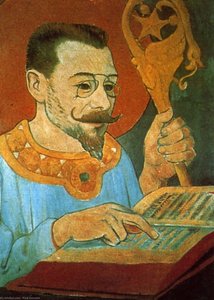
- Porträt von Paul Ranson (1890), Musée d’Orsay, Paris
- Melancholie (1890)
- Die Schlangenfresser (1894), Muzeum Narodowe, Warschau
Künstlerische Bewegung und Einfluss
Sérusiers Werk wurde von Cloisonnismus beeinflusst, einem Stil, der durch kühne und flache Formen gekennzeichnet ist, die durch dunkle Konturen getrennt sind. Diese Bewegung, die im späten 19. Jahrhundert entstand, spielte eine bedeutende Rolle bei der Gestaltung der Entwicklung moderner Kunst.- Erfahre mehr über Cloisonnismus: Die Cloisonnism-Kunstbewegung
- Entdecke Sérusiers Werk: Paul Sérusier | OriginalUniqueArt.com
- Erfahre mehr über die Nabi-Bewegung: Die Nabi-Kunstbewegung
- Paul Sérusier war ein französischer Maler, der abstrakte Kunst begründete und die Nabi-Bewegung inspirierte.
- Er studierte an der Académie Julian und unterrichtete später an der Académie Ranson.
- Sérusiers Werk wurde von Cloisonnismus beeinflusst, einem Stil, der durch kühne und flache Formen gekennzeichnet ist.

Paul Sérusier
1864 - 1927 , Frankreich
Eckdaten zum Künstler
- Beeinflusste Künstler:
- Paul Gauguin
- Maurice Denis
- Pierre Bonnard
- Édouard Vuillard
- Bekannte Werke:
- L'Averse (1893)
- Portrait von Paul Ranson
- Melancholie (1890)
- Die Schlangenfresser (1894)
- Geburtsdatum: 9. November 1864
- Geburtsort: Paris, Frankreich
- Künstlerische Bewegung: Postimpressionismus, Nabis
- Nationalität: Französisch
- Todatum: 7. Oktober 1927
- Vollständiger Name: Paul Sérusier
- Von Künstlern Beeinflusst: ['Cloisonnismus']
Verwandte Artikel

Paul Cézanne: Die 25 Meisterwerke des Impressionismus | OriginalUniqueArt
Entdecken Sie die 25 Meisterwerke von Paul Cézanne! Tauchen Sie ein in die Welt des Impressionismus und Postimpressionismus. Erfahren Sie mehr über seine Stillleben, Landschaften & berühmten Gemälde – jetzt hochwertige Kunstdrucke auf OriginalUniqueArt.com.

Romantische Landschaften: Die 10 Meisterwerke, die eine Epoche prägten | OriginalUniqueArt
Entdecken Sie die 10 Meisterwerke der Romantischen Landschaftsmalerei! Von Caspar David Friedrich bis Turner – erleben Sie die Kunst, Emotion & Natur. Hochwertige Reproduktionen auf OriginalUniqueArt.com

Evocations of Place: A Historical Journey Through Landscape Art
Explore the rich history of landscape art with OriginalUniqueArt. Discover renowned artists, movements like Impressionism & Romanticism, and expert guidance for collecting timeless pieces. Find your perfect serene escape today!
Paul Sérusier: Pionier des Synthetismus und die symbolische Revolution der Nabis
Entdecken Sie Paul Sérusier, den Pionier des Synthetismus und Schlüsselfigur der Nabis-Bewegung! Erfahren Sie mehr über seinen Cloisonnism-Stil, Einflüsse & sein Vermächtnis in der Kunstgeschichte. Jetzt lesen!
Paul Klee: Die 25 Meisterwerke des Abstrakten – Kunst für Ihr Zuhause | OriginalUniqueArt
Entdecken Sie die 25 Meisterwerke von Paul Klee! Tauchen Sie ein in seine abstrakte Welt, voller Expressionismus und Bauhaus-Einflüsse. Hochwertige Kunst für Ihr Zuhause – jetzt bei OriginalUniqueArt entdecken!