In echtem Maßstab anzeigen
 Versenden als Grußkarte
 Teilen
 Details anzeigen
 Leitfaden öffnen

 Herunterladen
 Ähnliche Objekte
 Röntgenaufnahme
 Diashow
 Besucherstatistiken
Landscape at Le Pouldu


 Mehr anzeigen
Giclée / Kunstdruck
Giclée- oder Leinwanddruck in Museumsqualität mit schneller Produktion und flexiblen Veredelungsoptionen. ( Handgemalte Reproduktion kaufen Zum digitalen Bild wechseln)




P118B $10

P118H $10

P118W $10

P438Z $10

P508JH $12

P508YH $12

P805H $10

P805Z $10

P919BZ $10

P919G $10

P919XJ $10

P959ZH $10

P968JZ $12

W106C $8

W218G $10

W218JH $8

W218Y $10

W307PJ $10

W316G $10

W316PJ $8

W316Y $10

W398PJ $8

W4111J $10

W500HY $15

W500JH $15

W692G $12

W849H $8

W940BG $15

W953PJ $8




Wählen Sie aus unseren vordefinierten Formaten, die den ursprünglichen Proportionen des Kunstwerks entsprechen.

Sie können Ihre eigenen Maße eingeben, um ein bestimmtes Format oder einen speziellen Platz einzupassen. Wenn das von Ihnen gewählte Format nicht den Proportionen des Originalbildes entspricht, werden wir das Kunstwerk entweder beschneiden oder das Bild mit einem gespiegelten oder einfarbigen Rand erweitern. Ein digitaler Entwurf wird Ihnen zur Genehmigung zugesandt, bevor die Produktion beginnt.
Bitte beachten Sie, dass die Vorschau auf dem Bildschirm nicht den tatsächlichen Zuschnitt oder die Erweiterung widerspiegelt. Nur der Entwurf zeigt die endgültige Komposition präzise an.
Obwohl Sondermaße verfügbar sind, empfehlen wir die Auswahl eines Maßes aus der vordefinierten Liste, um die ursprünglichen Proportionen zu bewahren.
Weltweiter Versand () innerhalb von 2 Wochen statt der üblichen 4/5 Wochen. (26 September)

Kostenloser weltweiter Expressversand

Hochwertige Leinenleinwand

Vollständiger Versicherungsschutz beim Versand

Zollgebühren-Rückerstattungsgarantie

Garantie für exakte Farbtreue

100-tägiges Rückgaberecht (nur bei Mängeln)

100% Geld-zurück-Garantie

Angebot für Mengenrabatt
 Die Glasoption ist nur für Größen unter 110 cm verfügbar.

Landscape at Le Pouldu
Giclée / Kunstdruck
Format der Reproduktion
-


Gesamtpreis
$ 80
Landscape at Le Pouldu: A Breton Reverie Embodied in Synthetism
The Landscape at Le Pouldu by Paul Sérusier stands as a cornerstone of Post-Impressionist art and a testament to the burgeoning Symbolist movement’s fascination with capturing inner emotion through visual representation. Painted in 1890, this deceptively simple canvas—now housed within the Museum of Fine Arts Houston—offers far more than meets the eye; it's an invitation into a realm of quiet contemplation and profound connection with nature. Sérusier’s artistic vision was profoundly influenced by his time spent at Pont-Aven, Brittany, alongside fellow artist Paul Gauguin, where he actively participated in the formation of Les Nabis – a group dedicated to exploring expressive abstraction rooted in traditional landscape painting techniques.The Style of Synthetism: Simplifying Reality for Emotional Resonance
Sérusier’s stylistic approach aligns perfectly with Synthetism, championed by Gauguin and Cézanne. Rejecting Impressionistic optical realism, Synthetists sought to distill the essence of a scene into its fundamental forms and colors—a deliberate simplification designed to evoke feeling rather than precise observation. “The Talisman,” Sérusier’s groundbreaking exploration of this style, exemplifies this ambition. Like Le Pouldu, it abandons detailed depiction in favor of bold brushstrokes and flattened planes of color, prioritizing the conveyance of mood and atmosphere above photographic accuracy. The resulting image possesses a dreamlike quality—a palpable stillness that encourages viewers to linger on its surface and contemplate its hidden depths.A Composition Steeped in Breton Symbolism
The painting depicts a woman standing before a solitary tree, her back turned towards the viewer. This posture isn’t merely compositional; it symbolizes introspection and detachment – themes prevalent within Breton folklore and Symbolist thought. The surrounding trees are rendered with muted greens and browns, creating a harmonious backdrop that emphasizes the central figure's solitude. Notably, two birds perch near the upper left corner and lower right side of the canvas—symbols of freedom and aspiration, subtly interwoven into the landscape’s serene tableau. These avian elements contribute to the painting’s overall sense of optimism and spiritual yearning.Technique: Bold Brushstrokes and Color Harmony
Sérusier's masterful technique utilizes thick impasto – applying paint in textured layers – to imbue the canvas with palpable physicality. The vibrant hues—primarily shades of green and ochre—are applied with confident strokes, capturing the diffused light characteristic of Breton summers. Careful consideration is given to color harmony; complementary colors are juxtaposed to heighten visual impact without overwhelming the viewer’s senses. This deliberate restraint underscores Sérusier's commitment to conveying emotion through subtle nuances of tone and hue – a hallmark of Post-Impressionist artistry.Emotional Impact: Finding Beauty in Quiet Contemplation
“Landscape at Le Pouldu” transcends mere visual representation; it invites viewers into a meditative state. The painting’s tranquil atmosphere speaks to the enduring human desire for connection with nature and introspection—themes that resonate powerfully across generations. Its understated beauty lies precisely in its ability to capture a fleeting moment of serenity, prompting contemplation on themes of solitude, spirituality, and the sublime. Owning a high-quality reproduction allows you to experience this timeless masterpiece and bring its evocative spirit into your home. Explore similar works by Gauguin and Cézanne at OriginalUniqueArt for inspiration.Biografie des Künstlers
Frühes Leben und Ausbildung
Paul Sérusier, geboren als Louis-Paul-Henri Sérusier, erblickte am 9. November 1864 in Paris das Licht der Welt. Er studierte an der Académie Julian, wo er sich in den mittleren 1880er Jahren eine Stelle als Aufseher sicherte. Dies markierte den Beginn seiner künstlerischen Reise, die ihn schließlich dazu führte, abstrakte Kunst zu begründen und die avantgardistische Nabi-Bewegung, Synthetismus und Cloisonnismus zu inspirieren.Künstlerische Karriere
Im Sommer 1888 reiste Sérusier nach Pont-Aven, wo er einer kleinen Künstlergruppe beigetreten ist, die sich um Paul Gauguin sammelte. Unter Gauguins enger Anleitung malte Sérusier "Der Talisman", eine extreme Übung im Cloisonnismus, die der reinen Abstraktion nahe kam. Dieses Werk demonstrierte seinen innovativen Stil und seine Bereitschaft, mit neuen Techniken zu experimentieren. Als postimpressionistischer Maler war Sérusier Teil der Gruppe Les Nabis, zusammen mit Pierre Bonnard, Édouard Vuillard und Maurice Denis. Obwohl er nicht so bekannt ist wie einige seiner Kollegen, sind Sérusiers Beiträge zur Entwicklung abstrakter Kunst unbestreitbar.Wichtige Werke und Vermächtnis
Zu Sérusiers bemerkenswertesten Werken gehören:- L'Averse (1893), Musée d’Orsay, Paris
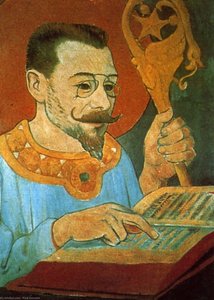
- Porträt von Paul Ranson (1890), Musée d’Orsay, Paris
- Melancholie (1890)
- Die Schlangenfresser (1894), Muzeum Narodowe, Warschau
Künstlerische Bewegung und Einfluss
Sérusiers Werk wurde von Cloisonnismus beeinflusst, einem Stil, der durch kühne und flache Formen gekennzeichnet ist, die durch dunkle Konturen getrennt sind. Diese Bewegung, die im späten 19. Jahrhundert entstand, spielte eine bedeutende Rolle bei der Gestaltung der Entwicklung moderner Kunst.- Erfahre mehr über Cloisonnismus: Die Cloisonnism-Kunstbewegung
- Entdecke Sérusiers Werk: Paul Sérusier | OriginalUniqueArt.com
- Erfahre mehr über die Nabi-Bewegung: Die Nabi-Kunstbewegung
- Paul Sérusier war ein französischer Maler, der abstrakte Kunst begründete und die Nabi-Bewegung inspirierte.
- Er studierte an der Académie Julian und unterrichtete später an der Académie Ranson.
- Sérusiers Werk wurde von Cloisonnismus beeinflusst, einem Stil, der durch kühne und flache Formen gekennzeichnet ist.

Paul Sérusier
1864 - 1927 , Frankreich
Eckdaten zum Künstler
- Beeinflusste Künstler:
- Paul Gauguin
- Maurice Denis
- Pierre Bonnard
- Édouard Vuillard
- Bekannte Werke:
- L'Averse (1893)
- Portrait von Paul Ranson
- Melancholie (1890)
- Die Schlangenfresser (1894)
- Geburtsdatum: 9. November 1864
- Geburtsort: Paris, Frankreich
- Künstlerische Bewegung: Postimpressionismus, Nabis
- Nationalität: Französisch
- Todatum: 7. Oktober 1927
- Vollständiger Name: Paul Sérusier
- Von Künstlern Beeinflusst: ['Cloisonnismus']
Verwandte Artikel

Meister der Form: Die 25 ikonischsten Kunstwerke von Paul Cézanne
Entdecken Sie die 25 bedeutendsten Meisterwerke von Paul Cézanne. Von Postimpressionismus bis Kubismus – erleben Sie die revolutionäre Kraft seiner Form und Farbe. Finden Sie museale Kunstreproduktionen für Ihr Zuhause auf OriginalUniqueArt.com. Jetzt die gesamte Kollektion online erkunden!
25 Masterpieces by Paul Gauguin: The Bold Colors of a Post-Impressionist Icon
Immerse yourself in the vibrant world of Paul Gauguin. Explore 25 iconic Post-Impressionist masterpieces, from Tahitian landscapes to bold symbolic works. Find inspiration for museum-quality art reproductions and decor. Discover all masterpieces on OriginalUniqueArt.com.

25 Masterpieces by Paul Gauguin: The Bold Colors of a Post-Impressionist Legend
Embark on a journey through Paul Gauguin's most iconic Post-Impressionist masterpieces. From Tahitian landscapes to bold symbolic colors, explore the stories behind 25 legendary works and find museum-quality art reproductions for your decor. Discover all masterpieces on OriginalUniqueArt.com.

Meisterwerke der Farbe: Die 25 wichtigsten Kunstwerke von Paul Gauguin
Entdecken Sie die 25 bedeutendsten Meisterwerke von Paul Gauguin. Von Tahiti bis Bretagne – erleben Sie den Postimpressionismus in intensiven Farben. Finden Sie museale Ölgemälde-Reproduktionen für Ihr Interieur auf OriginalUniqueArt.com. Jetzt die gesamte Kollektion online erkunden!
25 Masterpieces by Paul Gauguin: The Bold Colors of a Post-Impressionist Legend
Immerse yourself in the vibrant world of Paul Gauguin. Explore 25 iconic Post-Impressionist masterpieces, from Tahitian landscapes to bold symbolic works. Find inspiration and museum-quality art reproductions for your decor. Discover all masterpieces on OriginalUniqueArt.com.