In echtem Maßstab anzeigen
 Versenden als Grußkarte
 Teilen
 Details anzeigen
 Leitfaden öffnen

 Herunterladen
 Ähnliche Objekte
 Röntgenaufnahme
 Diashow
 Besucherstatistiken
Landscape


 Mehr anzeigen
Handgefertigte Ölreproduktion
Handgemaltes Ölgemälde auf Leinwand in Ihrer Wunschgröße und mit Rahmen, auf Bestellung von unseren Künstlern angefertigt. ( Zum Druck wechseln Zum digitalen Bild wechseln)




P118B €10

P118H €10

P118W €10

P438Z €10

P508JH €12

P508YH €12

P805H €10

P805Z €10

P919BZ €10

P919G €10

P919XJ €10

P959ZH €10

P968JZ €12

W106C €8

W218G €10

W218JH €8

W218Y €10

W307PJ €10

W316G €10

W316PJ €8

W316Y €10

W398PJ €8

W4111J €10

W500HY €15

W500JH €15

W692G €12

W849H €8

W940BG €15

W953PJ €8




Wählen Sie aus unseren vordefinierten Formaten, die den ursprünglichen Proportionen des Kunstwerks entsprechen.

Geben Sie die Breite und die Höhe an, die Sie für Ihren Rahmen oder Ihre Wand benötigen. Da dieses Werk handgemalt ist, kann der Künstler bei einer anderen Form etwas mehr um das Bild herum malen oder etwas abschneiden – Sie entscheiden. Wir senden Ihnen ein digitales Mockup zur Freigabe, bevor mit dem Malen begonnen wird. Das auf dieser Seite gezeigte Bild stellt nicht das tatsächliche Ergebnis dar – dies tut nur das Mockup.
Nach der Bestellung wird das OriginalUniqueArt.com-Team dem Kunden Anweisungen per E-Mail zusenden und eine Mockup-Vorschau bereitstellen.
Weltweiter Versand () in nur 3 bis 4 Wochen statt der üblichen 5 Wochen. (22 Oktober). Keine Kompromisse bei der Qualität.

Kostenloser weltweiter Expressversand

Hochwertige Leinenleinwand

Vollständiger Versicherungsschutz beim Versand

Zollgebühren-Rückerstattungsgarantie

Garantie für exakte Farbtreue

100-tägiges Rückgaberecht (nur bei Mängeln)

100% Geld-zurück-Garantie

Angebot für Mengenrabatt
 Die Glasoption ist nur für Größen unter 110 cm verfügbar.

Landscape
Reproduktionsmedium
Format der Reproduktion
-


Gesamtpreis
€ 263
Paul Sérusier’s “Landscape”: A Pioneer of Color and Light
Paul Sérusier's "Landscape," painted in 1912, isn’t merely a depiction of a green field; it’s a pivotal moment in the history of modern art. Born in Paris in 1864, Sérusier was a key figure in the Nabis movement – a group of Symbolist painters who sought to move beyond traditional academic styles and explore the expressive potential of color and form. This particular work embodies the core tenets of that revolutionary approach, representing a radical departure from representational accuracy and a profound embrace of subjective experience.
The painting immediately captivates with its vibrant palette – not a realistic rendering of nature, but an orchestration of pure hues. Deep greens dominate, punctuated by flashes of ochre, cerulean blue, and the warm tones of tree trunks. Sérusier eschewed meticulous detail, opting instead for broad, gestural brushstrokes that suggest movement and atmosphere rather than precise form. The trees themselves are simplified into blocks of color, their outlines blurred and indistinct, contributing to a sense of dreamlike abstraction. This technique, heavily influenced by the theories of Paul Gauguin, who had mentored Sérusier during his time at Pont-Aven in Brittany, was known as “cloisonnism,” where forms were defined by flat planes of color rather than shading or modeling.
The Influence of Breton Symbolism
Sérusier’s journey to this style began with a transformative summer spent in the coastal village of Pont-Aven. There, he encountered a community of artists deeply influenced by Breton folklore and spirituality. The landscape of Brittany, with its rugged coastline, ancient forests, and mystical traditions, provided fertile ground for artistic exploration. Gauguin encouraged Sérusier to “paint what you see, not what you think you should see,” urging him to capture the essence of the scene through color and emotion rather than strict adherence to photographic realism. This instruction proved crucial in shaping Sérusier’s distinctive style – a bold move towards abstraction that would profoundly impact subsequent generations of artists.
The painting's composition subtly evokes Breton legends, with the central tree acting as a focal point, reminiscent of ancient standing stones or sacred groves. The distant figures, barely discernible against the horizon, hint at human presence within this wild and untamed landscape, suggesting a connection between humanity and nature. The cat perched atop one of the trees adds an element of whimsical charm, perhaps symbolizing intuition or a primal connection to the natural world – a recurring motif in Symbolist art.
A Bridge Between Impressionism and Abstraction
"Landscape" stands as a crucial bridge between Impressionism and the nascent movements of abstraction. While rooted in the vibrant color palettes and atmospheric effects of Impressionism, Sérusier’s work transcends mere optical representation. He deliberately simplifies forms, reduces space, and prioritizes emotional expression over objective accuracy – characteristics that would become increasingly prominent in early 20th-century abstract art. It's a testament to his willingness to experiment and push the boundaries of artistic convention.
Emotional Resonance and Artistic Legacy
More than just a beautiful landscape, “Landscape” is an invitation to contemplate the relationship between nature, spirituality, and human perception. The painting’s luminous colors and fluid brushstrokes evoke a sense of tranquility and wonder, inviting the viewer to lose themselves in its dreamlike atmosphere. Sérusier's pioneering work paved the way for artists like Kandinsky and Mondrian, demonstrating that art could be more than just a mirror reflecting reality; it could be a powerful vehicle for expressing inner experience and exploring the depths of human consciousness. Reproductions of this piece offer a captivating glimpse into the heart of early modernism, inviting viewers to appreciate the enduring power of color and form.
Fragen & Antworten
Kann ich "Landscape" als Vollbild-Diashow ansehen?
Eine Diashow ist verfügbar: die Seite Diashow von "Landscape" von Paul Sérusier.
Welche Technik und welcher Stil charakterisieren "Landscape" von Paul Sérusier?
"Landscape" von Paul Sérusier verbindet die Technik der Acrylic On Canvas mit dem Stil der Nabis Movement. Technik und Stil beschreiben die Herstellung sowie die künstlerische Ausrichtung des Werkes.
Welches Gefühl vermittelt "Landscape" von Paul Sérusier?
"Landscape" von Paul Sérusier vermittelt ein Tranquil Gefühl innerhalb einer insgesamt Calm Stimmung.
Biografie des Künstlers
Frühes Leben und Ausbildung
Paul Sérusier, geboren als Louis-Paul-Henri Sérusier, erblickte am 9. November 1864 in Paris das Licht der Welt. Er studierte an der Académie Julian, wo er sich in den mittleren 1880er Jahren eine Stelle als Aufseher sicherte. Dies markierte den Beginn seiner künstlerischen Reise, die ihn schließlich dazu führte, abstrakte Kunst zu begründen und die avantgardistische Nabi-Bewegung, Synthetismus und Cloisonnismus zu inspirieren.Künstlerische Karriere
Im Sommer 1888 reiste Sérusier nach Pont-Aven, wo er einer kleinen Künstlergruppe beigetreten ist, die sich um Paul Gauguin sammelte. Unter Gauguins enger Anleitung malte Sérusier "Der Talisman", eine extreme Übung im Cloisonnismus, die der reinen Abstraktion nahe kam. Dieses Werk demonstrierte seinen innovativen Stil und seine Bereitschaft, mit neuen Techniken zu experimentieren. Als postimpressionistischer Maler war Sérusier Teil der Gruppe Les Nabis, zusammen mit Pierre Bonnard, Édouard Vuillard und Maurice Denis. Obwohl er nicht so bekannt ist wie einige seiner Kollegen, sind Sérusiers Beiträge zur Entwicklung abstrakter Kunst unbestreitbar.Wichtige Werke und Vermächtnis
Zu Sérusiers bemerkenswertesten Werken gehören:- L'Averse (1893), Musée d’Orsay, Paris
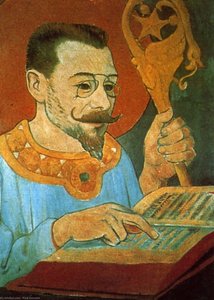
- Porträt von Paul Ranson (1890), Musée d’Orsay, Paris
- Melancholie (1890)
- Die Schlangenfresser (1894), Muzeum Narodowe, Warschau
Künstlerische Bewegung und Einfluss
Sérusiers Werk wurde von Cloisonnismus beeinflusst, einem Stil, der durch kühne und flache Formen gekennzeichnet ist, die durch dunkle Konturen getrennt sind. Diese Bewegung, die im späten 19. Jahrhundert entstand, spielte eine bedeutende Rolle bei der Gestaltung der Entwicklung moderner Kunst.- Erfahre mehr über Cloisonnismus: Die Cloisonnism-Kunstbewegung
- Entdecke Sérusiers Werk: Paul Sérusier | OriginalUniqueArt.com
- Erfahre mehr über die Nabi-Bewegung: Die Nabi-Kunstbewegung
- Paul Sérusier war ein französischer Maler, der abstrakte Kunst begründete und die Nabi-Bewegung inspirierte.
- Er studierte an der Académie Julian und unterrichtete später an der Académie Ranson.
- Sérusiers Werk wurde von Cloisonnismus beeinflusst, einem Stil, der durch kühne und flache Formen gekennzeichnet ist.

Paul Sérusier
1864 - 1927 , Frankreich
Eckdaten zum Künstler
- Beeinflusste Künstler:
- Paul Gauguin
- Maurice Denis
- Pierre Bonnard
- Édouard Vuillard
- Bekannte Werke:
- L'Averse (1893)
- Portrait von Paul Ranson
- Melancholie (1890)
- Die Schlangenfresser (1894)
- Geburtsdatum: 9. November 1864
- Geburtsort: Paris, Frankreich
- Künstlerische Bewegung: Postimpressionismus, Nabis
- Nationalität: Französisch
- Todatum: 7. Oktober 1927
- Vollständiger Name: Paul Sérusier
- Von Künstlern Beeinflusst: ['Cloisonnismus']
Verwandte Artikel

Paul Klee: Die 25 Meisterwerke des Abstrakten – Kunst für Ihr Zuhause | OriginalUniqueArt
Entdecken Sie die 25 Meisterwerke von Paul Klee! Tauchen Sie ein in seine abstrakte Welt, voller Expressionismus und Bauhaus-Einflüsse. Hochwertige Kunst für Ihr Zuhause – jetzt bei OriginalUniqueArt entdecken!

Impressionistische Landschaften: Die 10 Meisterwerke, die eine Epoche prägten | OriginalUniqueArt
Entdecken Sie die 10 Meisterwerke des Impressionismus! Von Monet bis Renoir – erleben Sie die Geschichte, Technik und zeitlose Schönheit ikonischer Landschaftsbilder. Hochwertige Kunstdrucke auf OriginalUniqueArt.com. Jetzt entdecken!

Paul Cézanne: Die 25 Meisterwerke des Impressionismus | OriginalUniqueArt
Entdecken Sie die 25 Meisterwerke von Paul Cézanne! Tauchen Sie ein in die Welt des Impressionismus und Postimpressionismus. Erfahren Sie mehr über seine Stillleben, Landschaften & berühmten Gemälde – jetzt hochwertige Kunstdrucke auf OriginalUniqueArt.com.
Paul Sérusier: Pionier des Synthetismus und die symbolische Revolution der Nabis
Entdecken Sie Paul Sérusier, den Pionier des Synthetismus und Schlüsselfigur der Nabis-Bewegung! Erfahren Sie mehr über seinen Cloisonnism-Stil, Einflüsse & sein Vermächtnis in der Kunstgeschichte. Jetzt lesen!

Evocations of Place: A Historical Journey Through Landscape Art
Explore the rich history of landscape art with OriginalUniqueArt. Discover renowned artists, movements like Impressionism & Romanticism, and expert guidance for collecting timeless pieces. Find your perfect serene escape today!