In echtem Maßstab anzeigen
 Versenden als Grußkarte
 Teilen
 Details anzeigen

 Herunterladen
 Ähnliche Objekte
 Röntgenaufnahme
 Diashow
 Besucherstatistiken
La lutte bretonne


 Mehr anzeigen
Giclée / Kunstdruck
Giclée- oder Leinwanddruck in Museumsqualität mit schneller Produktion und flexiblen Veredelungsoptionen. ( Handgemalte Reproduktion kaufen Zum digitalen Bild wechseln)




P118B $10

P118H $10

P118W $10

P438Z $10

P508JH $12

P508YH $12

P805H $10

P805Z $10

P919BZ $10

P919G $10

P919XJ $10

P959ZH $10

P968JZ $12

W106C $8

W218G $10

W218JH $8

W218Y $10

W307PJ $10

W316G $10

W316PJ $8

W316Y $10

W398PJ $8

W4111J $10

W500HY $15

W500JH $15

W692G $12

W849H $8

W940BG $15

W953PJ $8




Wählen Sie aus unseren vordefinierten Formaten, die den ursprünglichen Proportionen des Kunstwerks entsprechen.

Sie können Ihre eigenen Maße eingeben, um ein bestimmtes Format oder einen speziellen Platz einzupassen. Wenn das von Ihnen gewählte Format nicht den Proportionen des Originalbildes entspricht, werden wir das Kunstwerk entweder beschneiden oder das Bild mit einem gespiegelten oder einfarbigen Rand erweitern. Ein digitaler Entwurf wird Ihnen zur Genehmigung zugesandt, bevor die Produktion beginnt.
Bitte beachten Sie, dass die Vorschau auf dem Bildschirm nicht den tatsächlichen Zuschnitt oder die Erweiterung widerspiegelt. Nur der Entwurf zeigt die endgültige Komposition präzise an.
Obwohl Sondermaße verfügbar sind, empfehlen wir die Auswahl eines Maßes aus der vordefinierten Liste, um die ursprünglichen Proportionen zu bewahren.
Weltweiter Versand () innerhalb von 2 Wochen statt der üblichen 4/5 Wochen. (16 September)

Kostenloser weltweiter Expressversand

Hochwertige Leinenleinwand

Vollständiger Versicherungsschutz beim Versand

Zollgebühren-Rückerstattungsgarantie

Garantie für exakte Farbtreue

100-tägiges Rückgaberecht (nur bei Mängeln)

100% Geld-zurück-Garantie

Angebot für Mengenrabatt
 Die Glasoption ist nur für Größen unter 110 cm verfügbar.

La lutte bretonne
Giclée / Kunstdruck
Format der Reproduktion
-


Gesamtpreis
$ 80
A Primal Encounter in Breton Color
In the vibrant tapestry of late nineteenth-century French art, few works capture the raw, unbridled energy of folk tradition quite like Paul Sérusier's La Lutte bretonne. Completed in 1890, this masterpiece serves as a profound window into the soul of Brittany, moving far beyond a mere depiction of a wrestling match to become an evocative exploration of human struggle and cultural identity. The scene unfolds with an immediate, visceral intensity, placing the viewer directly within a circle of onlookers gathered to witness a physical altercation between two men. As they grapple in the center of the frame, the surrounding crowd—composed largely of women adorned in the iconic, intricate white coifs of Breton tradition—stands as a silent, watchful collective, their presence grounding the chaotic movement of the fighters in a sense of communal ritual.
The painting is a triumph of Cloisonnism, a bold stylistic departure from the soft, atmospheric nuances of traditional Impressionism. Heavily influenced by the mentorship of Paul Gauguin, Sérusier utilized thick, dark outlines to encase patches of saturated color, much like the leaded glass of a cathedral window. This technique strips away unnecessary anatomical detail in favor of a powerful, flattened graphic impact. The artist’s palette is particularly striking; he employs energetic bursts of reds and yellows that seem to pulse against the canvas, mirroring the heat and exertion of the wrestling match itself. For the discerning collector or interior designer, this use of pigment offers a dynamic focal point, capable of injecting a sense of rhythmic vitality and warmth into any sophisticated space.
Symbolism and the Spirit of the Nabis
Beyond its surface-level action, La Lutte bretonne is steeped in the symbolic preoccupations of the Nabis movement. During this era, artists sought to reject the polished, artificial perfection of the Parisian salons, turning instead toward what they perceived as the "primitive" and authentic beauty of rural life. The wrestling match serves as a potent metaphor for opposing forces—the tension between strength and vulnerability, or perhaps the struggle of tradition against the encroaching modernity of the Belle Époque. Every brushstroke is an intentional step away from realism and toward Synthetism, where the goal is to synthesize the external observation of nature with the internal emotional response of the artist.
To possess a reproduction of this work is to invite a piece of art history into one's home that celebrates the beauty of the unadorned and the profound depth of folk heritage. The painting does not merely decorate a wall; it commands attention through its structural boldness and its ability to evoke a sense of timelessness. Whether placed in a contemporary gallery setting or a classic study, Sérusier’s work continues to resonate with anyone moved by the intersection of raw human emotion and the deliberate, masterful application of color and form.
Biografie des Künstlers
Frühes Leben und Ausbildung
Paul Sérusier, geboren als Louis-Paul-Henri Sérusier, erblickte am 9. November 1864 in Paris das Licht der Welt. Er studierte an der Académie Julian, wo er sich in den mittleren 1880er Jahren eine Stelle als Aufseher sicherte. Dies markierte den Beginn seiner künstlerischen Reise, die ihn schließlich dazu führte, abstrakte Kunst zu begründen und die avantgardistische Nabi-Bewegung, Synthetismus und Cloisonnismus zu inspirieren.Künstlerische Karriere
Im Sommer 1888 reiste Sérusier nach Pont-Aven, wo er einer kleinen Künstlergruppe beigetreten ist, die sich um Paul Gauguin sammelte. Unter Gauguins enger Anleitung malte Sérusier "Der Talisman", eine extreme Übung im Cloisonnismus, die der reinen Abstraktion nahe kam. Dieses Werk demonstrierte seinen innovativen Stil und seine Bereitschaft, mit neuen Techniken zu experimentieren. Als postimpressionistischer Maler war Sérusier Teil der Gruppe Les Nabis, zusammen mit Pierre Bonnard, Édouard Vuillard und Maurice Denis. Obwohl er nicht so bekannt ist wie einige seiner Kollegen, sind Sérusiers Beiträge zur Entwicklung abstrakter Kunst unbestreitbar.Wichtige Werke und Vermächtnis
Zu Sérusiers bemerkenswertesten Werken gehören:- L'Averse (1893), Musée d’Orsay, Paris
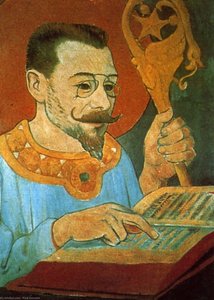
- Porträt von Paul Ranson (1890), Musée d’Orsay, Paris
- Melancholie (1890)
- Die Schlangenfresser (1894), Muzeum Narodowe, Warschau
Künstlerische Bewegung und Einfluss
Sérusiers Werk wurde von Cloisonnismus beeinflusst, einem Stil, der durch kühne und flache Formen gekennzeichnet ist, die durch dunkle Konturen getrennt sind. Diese Bewegung, die im späten 19. Jahrhundert entstand, spielte eine bedeutende Rolle bei der Gestaltung der Entwicklung moderner Kunst.- Erfahre mehr über Cloisonnismus: Die Cloisonnism-Kunstbewegung
- Entdecke Sérusiers Werk: Paul Sérusier | OriginalUniqueArt.com
- Erfahre mehr über die Nabi-Bewegung: Die Nabi-Kunstbewegung
- Paul Sérusier war ein französischer Maler, der abstrakte Kunst begründete und die Nabi-Bewegung inspirierte.
- Er studierte an der Académie Julian und unterrichtete später an der Académie Ranson.
- Sérusiers Werk wurde von Cloisonnismus beeinflusst, einem Stil, der durch kühne und flache Formen gekennzeichnet ist.

Paul Sérusier
1864 - 1927 , Frankreich
Eckdaten zum Künstler
- Beeinflusste Künstler:
- Paul Gauguin
- Maurice Denis
- Pierre Bonnard
- Édouard Vuillard
- Bekannte Werke:
- L'Averse (1893)
- Portrait von Paul Ranson
- Melancholie (1890)
- Die Schlangenfresser (1894)
- Geburtsdatum: 9. November 1864
- Geburtsort: Paris, Frankreich
- Künstlerische Bewegung: Postimpressionismus, Nabis
- Nationalität: Französisch
- Todatum: 7. Oktober 1927
- Vollständiger Name: Paul Sérusier
- Von Künstlern Beeinflusst: ['Cloisonnismus']
Verwandte Artikel
Roger de la Fresnaye: Cubism, Tradition & the Search for Order in Early 20th-Century French Painting
Explore the captivating world of Roger de la Fresnaye, a pivotal French Cubist painter. Discover his unique blend of tradition & modernity, influences, and lasting legacy with OriginalUniqueArt.

Paul Cézanne: Die 25 Meisterwerke des Impressionismus | OriginalUniqueArt
Entdecken Sie die 25 Meisterwerke von Paul Cézanne! Tauchen Sie ein in die Welt des Impressionismus und Postimpressionismus. Erfahren Sie mehr über seine Stillleben, Landschaften & berühmten Gemälde – jetzt hochwertige Kunstdrucke auf OriginalUniqueArt.com.
Top 25 Kunstwerke der Biennale Venedig: Meisterwerke für Ihr Zuhause | OriginalUniqueArt
Entdecken Sie die 25 bedeutendsten Kunstwerke der Biennale Venedig! Erfahren Sie die Geschichten hinter berühmten Gemälden, Künstlern und Stilen. Hochwertige Kunstdrucke & Reproduktionen für Ihr Zuhause – jetzt auf OriginalUniqueArt.com!
Paul Sérusier: Pionier des Synthetismus und die symbolische Revolution der Nabis
Entdecken Sie Paul Sérusier, den Pionier des Synthetismus und Schlüsselfigur der Nabis-Bewegung! Erfahren Sie mehr über seinen Cloisonnism-Stil, Einflüsse & sein Vermächtnis in der Kunstgeschichte. Jetzt lesen!

Paul Klee: Die 25 Meisterwerke des Abstrakten – Kunst für Ihr Zuhause | OriginalUniqueArt
Entdecken Sie die 25 Meisterwerke von Paul Klee! Tauchen Sie ein in seine abstrakte Welt, voller Expressionismus und Bauhaus-Einflüsse. Hochwertige Kunst für Ihr Zuhause – jetzt bei OriginalUniqueArt entdecken!