Text size

() ·

A painting made for you, by hand

Muse with Lyre

Handgefertigte Ölreproduktion

Handgemaltes Ölgemälde auf Leinwand in Ihrer Wunschgröße und mit Rahmen, auf Bestellung von unseren Künstlern angefertigt. ( Zum Druck wechseln Zum digitalen Bild wechseln)

Beschreibung des Sammlerstücks

Explore the vibrant world of Paolo Veronese, a Renaissance master renowned for his opulent compositions, masterful use of color, and dramatic Venetian scenes. Discover key artworks & legacy.

Künstlerbiografie

"meta_description": "Paolo Veronese (1528-1588): Venezischer Renaissance-Meister berühmt für prachtvolle Festtafeln und architektonische Inszenierungen. Seine opulenten Gemälde zeugen von der Kunst des 16. Jahrhunderts."

from ·

Chapter 1

How large should it be?

Slide to change the size; the picture on the left shows the frame at its real width. The proportions of the original are kept.

Standardformat
individuell anpassbar
CM
INCH

Wählen Sie aus unseren vordefinierten Formaten, die den ursprünglichen Proportionen des Kunstwerks entsprechen.

Breite
Höhe

Geben Sie die Breite und die Höhe an, die Sie für Ihren Rahmen oder Ihre Wand benötigen. Da dieses Werk handgemalt ist, kann der Künstler bei einer anderen Form etwas mehr um das Bild herum malen oder etwas abschneiden – Sie entscheiden. Wir senden Ihnen ein digitales Mockup zur Freigabe, bevor mit dem Malen begonnen wird. Das auf dieser Seite gezeigte Bild stellt nicht das tatsächliche Ergebnis dar – dies tut nur das Mockup.

Chapter 2

How should it arrive?

Choose the edges of the stretched canvas

Choose your frame

Corner sample of the WhiteWrap canvas edge finish, stretched on Massivholz bars
White €1
Corner sample of the BlurSideWrap canvas edge finish, stretched on Massivholz bars
Blurside €1
Corner sample of the ExtendedWrap canvas edge finish, stretched on Massivholz bars
Extended €1
Corner sample of the P118B picture frame: formgepresstes Polystyrol, 5 cm wide and 3 cm thick
P118B €10
Corner sample of the P118H picture frame: formgepresstes Polystyrol, 5 cm wide and 3 cm thick
P118H €10
Corner sample of the P118W picture frame: formgepresstes Polystyrol, 5 cm wide and 3 cm thick
P118W €10
Corner sample of the P438Z picture frame: formgepresstes Polystyrol, 5.5 cm wide and 3.5 cm thick
P438Z €10
Corner sample of the P508JH picture frame: formgepresstes Polystyrol, 7 cm wide and 3.5 cm thick
P508JH €12
Corner sample of the P508YH picture frame: formgepresstes Polystyrol, 7 cm wide and 3.5 cm thick
P508YH €12
Corner sample of the P805H picture frame: formgepresstes Polystyrol, 5 cm wide and 3.5 cm thick
P805H €10
Corner sample of the P805Z picture frame: formgepresstes Polystyrol, 5 cm wide and 3.5 cm thick
P805Z €10
Corner sample of the P919BZ picture frame: formgepresstes Polystyrol, 7 cm wide and 3.5 cm thick
P919BZ €10
Corner sample of the P919G picture frame: formgepresstes Polystyrol, 7 cm wide and 3.5 cm thick
P919G €10
Corner sample of the P919XJ picture frame: formgepresstes Polystyrol, 7 cm wide and 3.5 cm thick
P919XJ €10
Corner sample of the P959ZH picture frame: formgepresstes Polystyrol, 5 cm wide and 3 cm thick
P959ZH €10
Corner sample of the P968JZ picture frame: formgepresstes Polystyrol, 6 cm wide and 4 cm thick
P968JZ €12
Corner sample of the W106C picture frame: Massivholz, 5 cm wide and 3 cm thick
W106C €8
Corner sample of the W218G picture frame: Massivholz, 5 cm wide and 3 cm thick
W218G €10
Corner sample of the W218JH picture frame: Massivholz, 5 cm wide and 3 cm thick
W218JH €8
Corner sample of the W218Y picture frame: Massivholz, 5 cm wide and 3 cm thick
W218Y €10
Corner sample of the W307PJ picture frame: Massivholz, 6 cm wide and 3 cm thick
W307PJ €10
Corner sample of the W316G picture frame: Massivholz, 6 cm wide and 3 cm thick
W316G €10
Corner sample of the W316PJ picture frame: Massivholz, 6 cm wide and 3 cm thick
W316PJ €8
Corner sample of the W316Y picture frame: Massivholz, 6 cm wide and 3 cm thick
W316Y €10
Corner sample of the W398PJ picture frame: Massivholz, 5 cm wide and 3 cm thick
W398PJ €8
Corner sample of the W4111J picture frame: Massivholz, 6.5 cm wide and 3.5 cm thick
W4111J €10
Corner sample of the W500HY picture frame: Massivholz, 7 cm wide and 5 cm thick
W500HY €15
Corner sample of the W500JH picture frame: Massivholz, 7 cm wide and 5 cm thick
W500JH €15
Corner sample of the W692G picture frame: Massivholz, 8 cm wide and 4 cm thick
W692G €12
Corner sample of the W849H picture frame: Massivholz, 5 cm wide and 3 cm thick
W849H €8
Corner sample of the W940BG picture frame: Massivholz, 7.5 cm wide and 4.5 cm thick
W940BG €15
Corner sample of the W953PJ picture frame: Massivholz, 6 cm wide and 3.5 cm thick
W953PJ €8
Corner sample of the H24-GOLD picture frame: geschnitztes Holz mit Gesso, 10 cm wide and 6 cm thick
H24-GOLD €30
Corner sample of the H24-SILVER picture frame: geschnitztes Holz mit Gesso, 10 cm wide and 6 cm thick
H24-SILVER €30
Corner sample of the H36-GOLD picture frame: geschnitztes Holz mit Gesso, 15 cm wide and 6.5 cm thick
H36-GOLD €45
Corner sample of the H36-SILVER picture frame: geschnitztes Holz mit Gesso, 15 cm wide and 6.5 cm thick
H36-SILVER €45

Moulding: . Overall size with the frame: .

Chapter 3

Who paints it, and should anything change?

Examples of what can be changed: Replace face with customer photo; Add pet (e.g., replace cat with dog); Include hidden message in background; Change background landscape or elements.
After order, OriginalUniqueArt.com team will email client for instructions and provide a mockup preview

Weltweiter Versand () in nur 3 bis 4 Wochen statt der üblichen 5 Wochen. (1 November). Keine Kompromisse bei der Qualität.

Chapter 4

The finishing touches

A nameplate, as in a museum?

Details der gravierten Bronzetafel

This elegant plaque features the artist's name and the title of the artwork, finely engraved for a timeless presentation.

It is made from bronze with a refined, elegant finish. The text is precisely laser-engraved for a sharp and permanent result. Measuring 9x2 cm, the plaque is compact yet easy to read. It's built to be durable and scratch-resistant, offering a professional, museum-quality look. Mounting is simple thanks to the included adhesive backing.

Details zur Acrylglas-Plakette (transparent)

The plaque includes essential engraved details such as the artist's name, the title of the artwork, the date it was created, the type of media used-like oil on canvas or watercolor-a brief description of the piece, and a QR code that links to the complete artwork information.

It is crafted from clear acrylic, offering a sleek, modern appearance. The text is UV-engraved in black to ensure strong visual contrast. With a size of 10x15 cm, it ensures optimal readability. It comes equipped with two metal hooks for secure wall mounting. The plaque is designed to be weather-resistant, making it suitable for various environments, and it includes interactive features that work seamlessly with smartphone scanning.

Details zur schwarzen Acryltafel

This elegant plaque includes engraved information such as the artist's name, the title of the artwork, the date it was created, the type of media used (like oil on canvas or watercolor), a short description of the artwork, and a QR code for quick access to more information.

The plaque itself is made from refined black acrylic with a premium finish. The text is laser-engraved in white for high contrast and readability. Its size is 10x15 cm, designed to be easy to read. It comes with two metal hooks for professional mounting. The design is sleek and fits any interior style. It is also weather-resistant and durable, with built-in digital integration for mobile compatibility.

A protective varnish?

When do you need it?

Chapter 5

Your painting, as you ordered it

Muse with Lyre

Art der Reproduktion

Format der Reproduktion

-

Erstklassige Meisterkünstler

Mehr Detailtiefe, Raffinesse und zusätzliche Produktionszeit

-

Rahmen für Reproduktionen

-

-

Bei Kunstwerken oder Reproduktionen, die an einer Seite größer als 105 cm (ca. 41 Zoll) sind, wird der Rahmen zerlegt als Bausatz geliefert. Diese Methode gewährleistet eine sichere Zustellung und verhindert Schäden während des Transports.

Professionelle Montage erforderlich – dies ist kein DIY-Produkt.
Der Bausatz muss von einem erfahrenen professionellen Rahmenmacher zusammengebaut und die Leinwand gespannt werden. Hierfür werden Holzleim (nicht im Lieferumfang enthalten), eine Leinwandspannzange sowie Klemmen benötigt, um die Keilleisten während des Trocknungsvorgangs rechtwinklig zu halten. Eine unsachgemäße Montage oder eine ungleichmäßige Spannung der Leinwand kann das Kunstwerk dauerhaft beschädigen und ist nicht durch unsere Garantie abgedeckt.

  • Alle Vollholzkomponenten sind enthalten, präzise auf Maß zugeschnitten.

  • Der Zusammenbau erfolgt mit den mitgelieferten Schrauben sowie Holzkleber für die Eckverbindungen, der nicht im Lieferumfang enthalten ist und vom Rahmenbauer selbst beschafft werden muss.

  • Professionelles Werkzeug ist erforderlich und nicht im Lieferumfang enthalten: eine Keilrahmenzange (Spannwerkzeug) sowie Klammern, um die Leisten während der Trocknungszeit des Klebers rechtwinklig zu fixieren.

Wichtiger Hinweis:
Für die Eckverbindungen wird Holzleim benötigt, die Leisten müssen mit Zwingen fixiert werden, bis der Leim vollständig getrocknet ist, und das Spannen der Leinwand auf dem fertigen Rahmen erfordert eine Keilrahmen-Zange. Keines dieser Utensilien ist im Set enthalten. Bitte stellen Sie sicher, dass ein erfahrener Rahmenmacher zur Verfügung steht, bevor Sie diese Größe bestellen.

Beschriftung

-

-

Schutzlackierung

Glanzlack (verstärkt die Farben, schützt vor Licht und Feuchtigkeit)

-

Mein Kunstwerk personalisieren

Beispiele für Anpassungsmöglichkeiten: Gesicht durch Kundenfoto ersetzen; Haustier hinzufügen (z. B. Katze durch Hund ersetzen); Versteckte Nachricht im Hintergrund einfügen; Hintergrundlandschaft oder -elemente ändern.

-

Eilt sehr

Weltweiter Versand () in nur 3 bis 4 Wochen statt der üblichen 5 Wochen. (1 November). Keine Kompromisse bei der Qualität.

-

Expressversand

Weltweiter Versand () innerhalb von 5 Wochen. (8 November).

Inklusive Versand

Endpreis

€ 267

Gesamtpreis € 267

Die Glasoption ist nur für Größen unter 110 cm verfügbar.

Included with every order

  • Kostenloser weltweiter Expressversand
  • Hochwertige Leinenleinwand
  • Umfassender Versicherungsschutz beim Versand
  • Zollgebühren-Rückerstattungsgarantie
  • Garantie für exakte Farbtreue
  • 100 Tage Rückgaberecht (nur bei Mängeln)
  • 100% Geld-zurück-Garantie
  • Mengenrabatt verfügbar

A Venetian Visionary: The Life and Art of Paolo Veronese

Paolo Caliari, known universally as Paolo Veronese (1528-1588), stands as one of the most celebrated figures in Venetian Renaissance art. Born into a modest stonecutter’s family in Verona, his formative years were steeped in the visual richness of his hometown – a city already brimming with classical influences and humanist ideals. This early exposure undoubtedly nurtured an artistic sensibility that would blossom into unparalleled mastery over color, composition, and theatrical spectacle. His initial training under Antonio Badile and Giovanni Francesco Caroto instilled foundational skills in traditional painting techniques, yet it was his relocation to Venice in the 1550s that irrevocably propelled him toward artistic greatness. The city itself became Veronese’s unwavering muse, its bustling marketplaces, magnificent palaces, and shimmering canals serving as constant inspiration for his ambitious projects. He swiftly absorbed the stylistic currents circulating amongst established Venetian masters like Titian and Tintoretto, whose groundbreaking explorations of light and pigment profoundly impacted Veronese's own palette—though he ultimately forged a distinctive style characterized by an unwavering commitment to grandeur and illusionistic realism.

Muse with Lyre: A Symphony of Color and Form

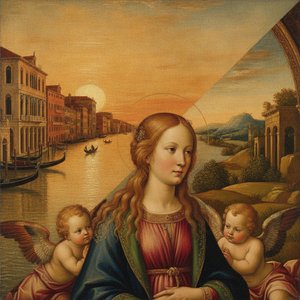
“Muse with Lyre,” completed in 1560-61, exemplifies Veronese’s signature approach to monumental painting. Located within Villa Barbaro in Maser—a villa designed by Andrea Palladio—the fresco occupies a prominent position within the palazzo's decorative scheme, demonstrating Veronese’s dedication to creating immersive environments that captivated viewers. The artwork depicts a woman adorned with opulent jewelry and draped in crimson fabric, holding aloft a lyre – an instrument symbolizing music and divine inspiration. This evocative image transcends mere representation; it embodies Veronese’s masterful manipulation of perspective and color to convey a profound sense of serenity and contemplation.

Technique and Style: Illusionistic Realism

Veronese's technique is rooted in the principles of Mannerism, a stylistic movement that prioritized stylized forms and exaggerated proportions over naturalistic accuracy. He achieved breathtaking visual effects through meticulous layering of glazes—thin coats of translucent pigment—creating luminous surfaces that shimmer with reflected light. This painstaking process allowed him to capture not only the physical appearance of his subjects but also their psychological states, imbuing the painting with an emotional resonance that continues to captivate audiences centuries later. The artist’s masterful use of chiaroscuro – dramatic contrasts between light and shadow – further enhances the depth and dimensionality of the scene, guiding the viewer's gaze across the composition and emphasizing key elements.

Historical Context: Venetian Patronage and Mythological Narrative

“Muse with Lyre” reflects the prevailing artistic tastes of its time—a period marked by fervent interest in classical mythology and humanist scholarship. Villa Barbaro itself was conceived as a testament to Palladio’s architectural ideals, aiming for harmonious proportions and elegant ornamentation. Veronese's commission underscored the importance of aristocratic patronage within Venice, where artists like him thrived on commissions from wealthy families eager to adorn their homes with masterpieces that proclaimed their status and refined sensibilities. The fresco’s depiction of Apollo—the Greek god of music and poetry—and Daphne—transformed into laurel trees by Apollo’s divine intervention—references prominent myths exploring themes of beauty, transformation, and the pursuit of artistic excellence.

Symbolism and Emotional Impact: Beauty and Tranquility

Beyond its formal brilliance, “Muse with Lyre” communicates a powerful emotional message. The woman's serene gaze and graceful posture convey an aura of composure and contemplation—a deliberate contrast to the turbulent political landscape of Venice during Veronese’s lifetime. The lyre itself serves as a potent symbol of artistic creativity and divine grace, reminding viewers of the transformative power of beauty and intellect. Ultimately, Veronese’s masterpiece invites us to savor the sublime – an experience characterized by awe and wonder—and celebrates the enduring legacy of Venetian Renaissance art.

Fragen & Antworten

Wann wurde "Muse with Lyre" geschaffen und welcher Stilrichtung lässt es sich zuordnen?

"Muse with Lyre" von Paolo Veronese datiert aus dem Jahr 1560 und gehört zur Baroque Renaissance Master.

Welche Art von Kunstwerk ist "Muse with Lyre" von Paolo Veronese?

"Muse with Lyre" von Paolo Veronese wird als WallArt klassifiziert. Die Kategorie beschreibt die Art des Kunstwerks, um das es sich beim Original handelt.

Wie intensiv sind die Farben von "Muse with Lyre"?

Die Farben von "Muse with Lyre" von Paolo Veronese bestechen durch eine Balanced Soft Sättigung und eine Balanced Intensität.

More about this painting

Vorschau anzeigen In AR ansehen Zum Druck wechseln Zum digitalen Bild wechseln Versenden
Details anzeigen Leitfaden Zu Favoriten hinzufügen Herunterladen Ähnliche Objekte Röntgenaufnahme Diashow Q&A Statistiken

In numbers

  • 1560the year it was painted
  • 29frames to choose from
  • standard sizes, in its own proportions
  • 5weeks to paint and deliver it
Paolo Veronese

Paolo Veronese

1528 - 1588, Italien

Quick facts about Paolo Veronese

  • Artistic Movement Or Style: Renaissance, Mannerismus
  • Artists Or Movements Influenced By This Artist: ['Rubens']
  • Artists Who Influenced This Artist: ['Titian']
  • Date Of Birth: 1528
  • Full Name: Paolo Caliari
  • Nationality: Italienisch
  • Notable Artworks:
    • Die Hochzeit zu Kana
    • Feast in the House of Levi
  • Place Of Birth: Verona, Italien

Künstlerbiografie

Ein venezianischer Visionär: Das Leben und die Kunst von Paolo Veronese

Paolo Caliari, der der Welt als Paolo Veronese bekannt wurde, trat aus der lebendigen künstlerischen Landschaft des Venedigs des 16. Jahrhunderts als ein Meister der Farbe, der Komposition und des opulenten Spektakels hervor. Geboren 1528 in Verona als Sohn eines Steinmetzes, war sein frühes Leben tief verwurzelt in der visuellen Pracht seiner Umgebung – der klassischen Architektur, den skulpturalen Formen und den aufstrebenden humanistischen Idealen, die diese Region prägten. Seine erste Ausbildung bei Antonio Badile und Giovanni Francesco Caroto legte zwar das Fundament für traditionelle Techniken, doch erst sein Umzug nach Venedig in den 1550er Jahren entfachte sein wahres künstlerisches Genie. Die Stadt selbst wurde zu seiner Muse; ihre geschäftigen Marktplätze, prächtigen Palazzi und schimmernden Wasserwege prägten die Dimensionen und das Drama seines Schaffens. Er sog die Einflüsse etablierter venezianischer Meister wie Tizian in sich auf, dessen Meisterschaft der Farbe Veroneses Palette tiefgreifend beeinflusste, doch er formte einen ganz eigenen Stil, der durch ein unvergleichliches Gefühl für Theatralik und Grandiosität besticht.

Der Maler der Festmähler und großen Erzählungen

Veroneses Ruhm gründet auf seinen monumentalen Gemälden, insbesondere jenen, die prunkvolle Festmähler und biblische Szenen in glanzvolle Darstellungen des venezianischen Lebens verwandeln. Das Gastmahl in Kana, vollendet 1563 für das Benediktinerkloster San Giorgio Maggiore, steht als Zeugnis seiner außergewöhnlichen Fertigkeit. Diese kolossale Leinwand ist nicht bloß eine Illustration eines Wunders; sie ist ein lebendiges Panorama der Gesellschaft des 16. Jahrhunderts, belebt von elegant gekleideten Figuren, Musikanten und architektonischen Details, die mit atemberaubender Präzision wiedergegeben sind. Das Gemälde erzählt nicht nur davon, was in Kana geschah, sondern wie es ausgesehen hätte, wäre es zur Zeit Veroneses in Venedig geschehen. Ähnlich sorgte Das Fest im Haus des Levi, ursprünglich als Das Letzte Abendmahl betitelt, für Kontroversen mit der Inquisition, da es zeitgenössische Figuren und eine beinahe respektlose Atmosphäre enthielt. Veronese verteidigte seine künstlerische Freiheit und behauptete, dass Maler denselben schöpferischen Freiheiten wie Dichter oder Hofnarren unterliegen – eine kühne Aussage, die seinen Glauben an die Macht der Kunst widerspiegelt, heilige Erzählungen zu interpretieren und neu zu imaginieren. Diese Werke waren keine rein religiösen Darstellungen; sie waren Feierlichkeiten des Lebens, des Reichtums und des Glanzes Venedigs selbst. Er suchte nicht nach asketischer Spiritualität, sondern wollte die Freude und den Überfluss der Existenz einfangen.

Einflüsse und künstlerische Entwicklung

Obwohl Tizians Einfluss auf Veroneses Kolorismus unbestreitbar ist, war seine künstlerische Entwicklung ein komplexes Zusammensprechen verschiedener Einflüsse. Die architektonische Präzision, die er in seine Kompositionen einbrachte, verdankt er weitgehend der klassischen Tradition, die in seinen prägenden Jahren in Verona vorherrschte, insbesondere den Werken von Architekten wie Michele Sanmicheli. Er absorbierte zudem Elemente italienischer Meister wie Raffael und Parmigianino, was in den anmutigen Linien und harmonischen Anordnungen seiner Gemälde deutlich wird. Veronese imitierte diese Einflüsse jedoch nicht einfach; er synthetisierte sie zu einem einzigartig venezianischen Stil, der durch den dramatischen Einsatz von Licht, lebendige Farbpaletten und akribische Detailliebe gekennzeichnet ist. Er verstand es meisterhaft, Illusionen von Raum und Tiefe zu erschaffen, indem er Perspektivtechniken einsetzte, um den Betrachter in das Herz seiner aufwendigen Szenen zu ziehen. Seine Meisterschaft der Ölmalerei ermöglichte ihm eine unvergleichliche Leuchtkraft und eine reiche Textur. Zudem leitete er eine große Werkstatt, die durch die Beiträge seines Bruders Benedetto sowie seiner Söhne Gabriele und Carlo ergänzt wurde, was sicherstellte, dass sein Stil auch nach seinem Tod im Jahr 1588 weiter florierte.

Vermächtnis und historische Bedeutung

Die Wirkung von Paolo Veronese reicht weit über den Bereich der Renaissance-Kunst hinaus. Sein Werk hallt durch die Jahrhunderte nach und inspirierte Künstler verschiedenster Disziplinen. Seine dramatischen Kompositionen und lebendigen Farbschemata werden als Einflüsse auf alles Mögliche angeführt – von der Barockmalerei bis hin zum modernen Kino, wo sie sogar in der visuellen Ästhetik der Spaghetti-Western widerhallen können. Er war Teil des „großen Trios“ venezianischer Maler – an der Seite von Tizian und Tintoretto –, wobei jeder auf seine Weise zum künstlerischen Erbe der Stadt beitrug, doch Veronese hebt sich oft durch seine reine Exuberanz und die Feier weltlicher Freuden ab. Seine Gemälde ziehen das Publikum bis heute mit ihrer Erhabenheit und ihrem Spektakel in ihren Bann und bieten einen Blick in die opulente Welt des Venedigs des 16. Jahrhunderts.
  • Er definierte die Historienmalerei neu, indem er sie mit zeitgenössischem Leben durchdrang.
  • Sein Umgang mit Farbe bleibt für heutige Künstler wegweisend.
  • Sein Werk verkörpert den Geist des Renaissance-Humanismus und die Feier der irdischen Schönheit.
Veroneses Vermächtnis ist ein Zeugnis seines künstlerischen Genies, seiner Fähigkeit, das Wesen einer Ära einzufangen, und seines bleibenden Beitrags zur Kunstgeschichte.

Eckdaten

  • Movement: Mannerism
  • Medium: Oil on canvas
  • Notable elements or techniques: Light and shadow; Classical architectural elements
  • Artist: Paolo Veronese
  • Title: Muse with Lyre

Kunst-Quiz

Jede Frage hat nur eine richtige Antwort.

Frage 1:
What artistic movement is Paolo Veronese’s ‘Muse with Lyre’ considered to be?
Frage 2:
In which Italian villa is the fresco painting ‘Muse with Lyre’ located?
Frage 3:
What prominent Venetian artist greatly influenced Veronese's color palette?
Frage 4:
The fresco utilizes a technique known for creating depth and illusion, primarily through...
Frage 5:
What is the primary subject matter depicted in ‘Muse with Lyre’, reflecting themes of classical mythology?