Zum Druck wechseln
 Weiterlesen







































 Bei Kunstwerken oder Reproduktionen, die an einer Seite größer als 105 cm (ca. 41 Zoll) sind, wird der Rahmen zerlegt als Bausatz geliefert. Diese Methode gewährleistet eine sichere Zustellung und verhindert Schäden während des Transports.


Introduction
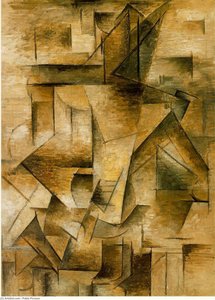
Pablo Picasso's "Still Life on a Piano" is a seminal work in the Cubist movement, showcasing the artist's innovative approach to still life painting. Created in 1911, this oil on canvas masterpiece exemplifies the analytical cubism style that Picasso pioneered alongside Georges Braque.Artistic Context
During the early 20th century, Cubism revolutionized the art world by introducing a new way of representing reality. By breaking objects into geometric shapes and multiple perspectives, artists like Picasso and Braque challenged traditional techniques of visual representation. "Still Life on a Piano" is a quintessential example of this movement, featuring fragmented forms and overlapping planes that create a complex composition.Composition and Style
The painting depicts various objects such as a clock, book, vase, and bottle arranged on a piano. The Cubist style is evident in the way these objects are depicted with multiple perspectives and angles. Soft, earthy tones dominate the work, with subtle gradations imparting form and depth to the fragmented objects. Typography elements are also incorporated into the work, adding an extra layer of complexity.Significance
"Still Life on a Piano" is significant not only for its contribution to Cubism but also for its influence on subsequent art movements. The painting's emphasis on line and form, as well as its deconstruction of conventional perspectives, paved the way for various avant-garde styles in the 20th century.Relevance Today
Today, "Still Life on a Piano" is recognized as a landmark piece in modern art history. Its innovative style continues to inspire artists and art enthusiasts alike. For those interested in exploring more of Picasso's works or learning about the Cubist movement, Pablo Picasso: Still life on a piano (Cubism,Oil,) and Cubism are valuable resources.Conclusion
"Still Life on a Piano" by Pablo Picasso is a masterpiece of Cubist art that continues to captivate audiences with its innovative composition and style. As a testament to the enduring influence of Cubism, this painting remains an essential part of modern art history.Fragen & Antworten
Welche Farbtönung dominiert in "Stillleben auf einem Klavier"?
"Stillleben auf einem Klavier" weist einen Spektrum von Grün bis Violett Farbton auf.
Was für ein Kunstwerk ist "Stillleben auf einem Klavier"?
"Stillleben auf einem Klavier" ist ein Werk der Gattung Wandkunst.
Wie gesättigt ist die Farbpalette von "Stillleben auf einem Klavier"?
Die Farbpalette von "Stillleben auf einem Klavier" weist eine Sättigung von Deutliche Farbsättigung auf.
 Vorschau anzeigen
 Versenden
 Teilen
 Details anzeigen
 Leitfaden

 Herunterladen
 Ähnliche Objekte
 Röntgenaufnahme
 Diashow
 Fragen & Antworten
 Statistiken