Vorschau anzeigen
 Versenden
 Teilen
 Details anzeigen
 Leitfaden

 Herunterladen
 Ähnliche Objekte
 Röntgenaufnahme
 Diashow
 Fragen & Antworten
 Statistiken
Standard-bearer


 Weiterlesen
Giclée / Kunstdruck
Giclée- oder Leinwanddruck in Museumsqualität mit schneller Produktion und flexiblen Veredelungsoptionen. ( Handgemalte Reproduktion bestellen Zum digitalen Bild wechseln)




P118B €10

P118H €10

P118W €10

P438Z €10

P508JH €12

P508YH €12

P805H €10

P805Z €10

P919BZ €10

P919G €10

P919XJ €10

P959ZH €10

P968JZ €12

W106C €8

W218G €10

W218JH €8

W218Y €10

W307PJ €10

W316G €10

W316PJ €8

W316Y €10

W398PJ €8

W4111J €10

W500HY €15

W500JH €15

W692G €12

W849H €8

W940BG €15

W953PJ €8




Wählen Sie aus unseren vordefinierten Formaten, die den ursprünglichen Proportionen des Kunstwerks entsprechen.

Geben Sie die benötigte Breite und Höhe an, damit der Druck perfekt in Ihren Rahmen oder an Ihre Wand passt. Ein Druck kann nur beschnitten, aber niemals größer als das Originalbild angefertigt werden; daher verliert ein Format mit anderen Proportionen einen Teil des Bildes. Wir senden Ihnen ein digitales Mockup zur Freigabe, bevor wir den Druck ausführen. Das auf dieser Seite gezeigte Bild zeigt nicht den tatsächlichen Beschnitt – dies ist nur im Mockup ersichtlich.
Weltweiter Versand () innerhalb von 2 Wochen statt der üblichen 4/5 Wochen. (8 November)

Kostenloser weltweiter Expressversand

Hochwertige Leinenleinwand

Umfassender Versicherungsschutz beim Versand

Zollgebühren-Rückerstattungsgarantie

Garantie für exakte Farbtreue

100 Tage Rückgaberecht (nur bei Mängeln)

100% Geld-zurück-Garantie

Mengenrabatt verfügbar
 Die Glasoption ist nur für Größen unter 110 cm verfügbar.

Standard-bearer
Giclée / Kunstdruck
Format der Reproduktion
-


Endpreis
€ 72
A Monochromatic Echo of Ancient Rituals: Exploring Nicholas Roerich’s ‘Standard-bearer’
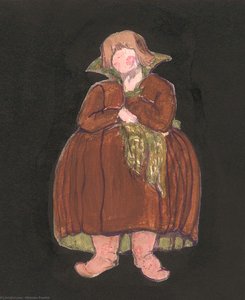
Nicholas Roemerich's 1921 painting, “Standard-bearer,” is more than just a depiction of a figure holding a banner; it’s a potent distillation of historical memory, spiritual yearning, and the enduring power of symbolic representation. Executed in a strikingly austere grayscale palette, the work immediately draws the viewer into a world stripped bare of extraneous detail, forcing a concentrated engagement with its core elements – form, line, and the implied narrative woven within.
- Primitive Roots: The artwork’s aesthetic aligns powerfully with Roerich's broader artistic philosophy, rooted in his fascination with ancient cultures and their spiritual traditions. This influence manifests in a style reminiscent of folk art or medieval illumination – bold lines define the central figure and banner, while simplified geometric shapes construct the background, evoking a sense of timelessness and ritualistic solemnity.
- A Flattened Perspective: The deliberate rejection of traditional perspective creates an almost iconographic quality, akin to religious icons. This flattened space emphasizes the symbolic weight of the subject rather than striving for realistic representation. It’s as if Roerich sought to capture not a moment in time, but a timeless archetype.
Technique and Materials: Charcoal's Dance on Paper
The execution of “Standard-bearer” reveals a meticulous hand at work. The artist employed charcoal or graphite on paper, utilizing hatching and cross-hatching with remarkable precision to build up tonal variations within the grayscale palette. This technique isn’t merely about shading; it’s about creating texture and suggesting volume – the rough application of lines lends a tactile quality to the image, as if one could almost feel the grit of the charcoal on the paper.
- Hatching and Cross-hatching: The deliberate layering of lines creates depth and dimension within the limited palette. This technique is characteristic of Roerich’s approach, prioritizing expressive mark-making over photographic realism.
- Likely Materials: Based on the grainy texture and tonal range, it's highly probable that charcoal or graphite was used, creating a surface rich in visual information despite its monochromatic nature.
Symbolism and Emotional Resonance
Beyond its formal qualities, “Standard-bearer” resonates with profound symbolic meaning. The figure holding the banner – a potent emblem of leadership, authority, and perhaps even divine mandate – commands our attention. The downward angle of the banner suggests both submission and defiance, creating a dynamic tension within the composition. The lack of color amplifies this emotional impact, lending an air of mystery and solemnity.
- Historical Context: Painted in 1921, during a period of significant social and political upheaval, the artwork can be interpreted as a reflection on tradition, duty, and the enduring values of civilization.
- Spiritual Undertones: Roerich’s work frequently explored themes of spirituality and interconnectedness, suggesting that “Standard-bearer” may represent a connection to ancient rites and beliefs.
A Timeless Masterpiece – Perfect for Collection or Interior Design
“Standard-bearer,” with its striking simplicity and powerful symbolism, is a testament to Nicholas Roerich’s artistic vision. OriginalUniqueArt offers meticulously crafted hand-painted reproductions of this captivating artwork, allowing you to bring its timeless beauty into your home or office. Whether you are an art collector seeking to expand your collection or an interior designer looking for a statement piece, this reproduction provides an authentic and evocative representation of a truly remarkable work.
Fragen & Antworten
Wie viele Personen sehen "Standard-bearer"?
Auf der Besucherzahlen-Seite des Kunstwerks finden Sie Statistiken zu "Standard-bearer" von Nikolai Konstantinowitsch Roerich: monatliche Aufrufe des Kunstwerks, Aufrufe der Werke des Künstlers sowie eine Aufschlüsselung der jüngsten Besucher nach Land und Sprache.
Wie kann ich das Bild von "Standard-bearer" von Nikolai Konstantinowitsch Roerich herunterladen?
"Standard-bearer" von Nikolai Konstantinowitsch Roerich kann auf der Download-Seite des Kunstwerks als hochauflösender digitaler Bild-Download heruntergeladen werden.
Welche Stimmung vermittelt "Standard-bearer" von Nikolai Konstantinowitsch Roerich innerhalb der Primitive Folk Art?
"Standard-bearer" vermittelt eine Nostalgic emotionale Stimmung innerhalb der Primitive Folk Art-Strömung.
Künstlerbiografie
Nicholas Roerich: Leben, Kunst und Vermächtnis
Frühes Leben und Ausbildung
- Nikolai Konstantinowitsch Roerich wurde am 9. Oktober 1874 in Sankt Petersburg, Russland, geboren.
- Sein Vater, ein baltischer Deutscher Notar, und seine Mutter, eine russische Frau, förderten von frühester Kindheit sein Interesse an den Künsten.
- Roerich studierte sowohl Jura als auch Kunst gleichzeitig und nahm 1893 am St. Petersburger Universität und der Kaiserlichen Akademie der Künste auf.
- Er erhielt 1897 den Titel „Künstler“ und das Jurastudium im Folgejahr.
Künstlerische Bestrebungen und Einflüsse
- Roerichs künstlerische Entwicklung wurde maßgeblich von Russischer Symbolismus, einer Bewegung, die Spiritualität und emotionale Tiefe betonte, beeinflusst.
- Er engagierte sich in der „Weltkunst“-Gesellschaft von Sergei Diaghilew und war von 1910 bis 1916 deren Präsident.
- Seine frühen Arbeiten zeigten eine Faszination für Archäologie und Bühnenbild, was zu Kooperationen bei Produktionen für die Ballets Russes führte.
- Er ließ sich auch von apokryphen und mittelalterlichen sektiererischen Schriften wie dem Dovenbuch beeinflussen.
Zusammenarbeit mit den Ballets Russes
- Roerichs Bühnenbilder für die Ballets Russes wurden hoch gelobt, insbesondere seine Arbeit an Alexander Borodins Fürst Igor (1909) und Igor Strawinskys Das Ritus des Frühlings (1913).
- Seine Bühnenbilder vereinten historische Forschung mit fantasievoller Kunst und schufen visuell beeindruckende Produktionen.
- Diese Zusammenarbeit etablierte ihn als eine führende Figur im Theaterdesign im frühen 20. Jahrhundert.
Künstlerische Entwicklung und Themen
- Roerichs Gemälde entwickelten sich weiter und integrierten zunehmend mystische und spirituelle Themen, die seine wachsende Interesse an der Theosophie und den östlichen Religionen widerspiegelten.
- Seine Serie Architektonische Studien (1904–1905) demonstrierte sein architektonisches Können und sein Engagement für den Erhalt des kulturellen Erbes.
- Wiederkehrende Motive in seiner Arbeit sind majestätische Landschaften, antike Städte und religiöse Figuren wie St. Pantaleimon und Kuan Yin.
- Er stellte oft die Himalaya-Region dar, die für ihn eine tiefe spirituelle Bedeutung hatte.
Wichtige Errungenschaften und Anerkennung
- Roerich war ein engagierter Verfechter des Schutzes von Kunst und Architektur in Kriegszeiten.
- Seine Bemühungen führten zur Schaffung des Roerich-Pakt (1935), eines internationalen Vertrags zum Schutz kultureller Objekte, für die er mehrere Nominierungen für den Friedensnobelpreis erhielt.
- Er reiste weite Teile Zentralasiens ab und führte archäologische Forschungen durch und dokumentierte alte Kulturen.
- Seine Werke sind in bedeutenden Museumssammlungen auf der ganzen Welt zu sehen, darunter die Staatliche Astrakhan-Gemäldegalerie.
Historische Bedeutung und Vermächtnis
- Nicholas Roerichs Einfluss auf die russische Kunst und Kultur ist unermesslich.
- Er schloss die Lücke zwischen künstlerischem Ausdruck und spiritueller Erforschung und beeinflusste Generationen von Künstlern und Denkern.
- Sein Engagement für den Schutz des kulturellen Erbes ist auch heute noch relevant und unterstreicht die Bedeutung des Schutzes unseres gemeinsamen Erbes.
- Roerichs Vermächtnis erstreckt sich über seine Gemälde hinaus; er wird als visionärer Künstler, Gelehrter und Humanitär in Erinnerung behalten.

Nikolai Konstantinowitsch Roerich
1874 - 1947 , Russland
Kurzinfos
- Beeinflusste Künstler: ['Helena Blavatsky']
- Beeinflusste Richtungen:
- Russische Kunst
- Spirituelle Kunst
- Bemerkenswerte Werke:
- St. Pantaleimon der Heiler
- Kuan Yin
- Architektonische Studien
- Ballets Russes (Fürst Igor)
- Geburtsdatum: 9. Oktober 1874
- Geburtsort: Sankt Petersburg, Russland
- Künstlerische Richtung: Symbolismus, Russischer Symbolismus
- Nationalität: Russisch
- Sterbedatum: 13. Dezember 1947
- Vollständiger Name: Nikolai Konstantinowitsch Rerich
Ähnliche Artikel

OriginalUniqueArt.com F.A.Q.: Elevate Your Decor with Premium Textured Giclée Prints
Discover the distinction of OriginalUniqueArt.com premium textured Giclée prints. Expertly crafted with archival 12-color pigments and museum-grade substrates, our prints offer unparalleled vividness for the discerning collector seeking luxury, durability, and timeless elegance.