In echtem Maßstab anzeigen
 Versenden als Grußkarte
 Teilen
 Details anzeigen
 Leitfaden öffnen

 Herunterladen
 Ähnliche Objekte
 Röntgenaufnahme
 Diashow
 Besucherstatistiken
Partition


 Mehr anzeigen
Die auf dieser Seite dargestellten Kunstwerke sind urheberrechtlich geschützt, was bedeutet, dass wir keine identische Reproduktion rechtmäßig erstellen oder verkaufen dürfen. Dieser Schutz wird durch internationale Abkommen wie die Berner Übereinkunft und durch nationale Gesetze, einschließlich derer, die von den ... festgelegt wurden US-Urheberrecht – Titel 17.
Diese Methode entspricht vollumfänglich den Urheberrechtsbestimmungen, da sie keine Kopie oder Vervielfältigung des geschützten Kunstwerks darstellt. Stattdessen handelt es sich um eine kreative Neuinterpretation – ein neues Gemälde, das vom Original inspiriert, aber nicht identisch mit ihm ist.
Giclée / Kunstdruck
Giclée- oder Leinwanddruck in Museumsqualität mit schneller Produktion und flexiblen Veredelungsoptionen. ( Handgemalte Reproduktion kaufen Zum digitalen Bild wechseln)




P118B €10

P118H €10

P118W €10

P438Z €10

P508JH €12

P508YH €12

P805H €10

P805Z €10

P919BZ €10

P919G €10

P919XJ €10

P959ZH €10

P968JZ €12

W106C €8

W218G €10

W218JH €8

W218Y €10

W307PJ €10

W316G €10

W316PJ €8

W316Y €10

W398PJ €8

W4111J €10

W500HY €15

W500JH €15

W692G €12

W849H €8

W940BG €15

W953PJ €8




Wählen Sie aus unseren vordefinierten Formaten, die den ursprünglichen Proportionen des Kunstwerks entsprechen.

Geben Sie die Breite und die Höhe an, die Sie benötigen, damit der Druck perfekt in Ihren Rahmen oder an Ihre Wand passt. Ein Druck kann nur beschnitten werden und niemals größer als das Originalbild gemacht werden; daher verliert ein Format mit einer anderen Proportion einen Teil des Bildes. Wir senden Ihnen ein digitales Mockup zur Freigabe, bevor wir den Druck ausführen. Das auf dieser Seite gezeigte Bild zeigt nicht den tatsächlichen Beschnitt – dies ist nur im Mockup ersichtlich.
Weltweiter Versand () innerhalb von 2 Wochen statt der üblichen 4/5 Wochen. (19 Oktober)

Kostenloser weltweiter Expressversand

Hochwertige Leinenleinwand

Vollständiger Versicherungsschutz beim Versand

Zollgebühren-Rückerstattungsgarantie

Garantie für exakte Farbtreue

100-tägiges Rückgaberecht (nur bei Mängeln)

100% Geld-zurück-Garantie

Angebot für Mengenrabatt
 Die Glasoption ist nur für Größen unter 110 cm verfügbar.

Partition
Giclée / Kunstdruck
Format der Reproduktion
-


Gesamtpreis
€ 70
The Serene Geometry of Color Field Abstraction
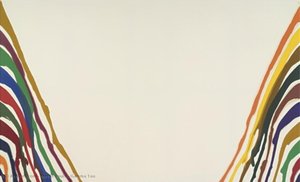
To stand before Morris Louis's Partition is to encounter a moment of profound visual stillness. This work does not shout for attention; rather, it invites the viewer into a hushed contemplation, guiding the eye across an expanse built entirely from color and line. The composition is a masterful study in horizontality, dominated by parallel bands that stretch across the canvas like stratified layers of memory or calm water at dawn. Louis eschews any single focal point, instead orchestrating a visual rhythm that encourages the gaze to drift uninterruptedly from one hue to the next. It is an experience less about looking and more about breathing with the painting.
A Dialogue Between Color and Flow
The palette itself speaks of muted elegance—a sophisticated gathering of yellows, soft blues, gentle reds, and purples set against a creamy, luminous ground. These are not the aggressive, vibrant tones of high drama; instead, they possess an earthy subtlety that lends the piece an immediate sense of tranquility. Louis’s technique is central to its magic. He pioneered methods involving the pouring and flowing of diluted paint, allowing the acrylic medium to interact with gravity and surface tension. This process results in edges that are remarkably soft, almost breathing at the boundaries between colors, giving the entire structure a fluid, organic quality despite the underlying geometric order. The texture appears impossibly smooth, as if the pigment itself has been poured from liquid light.
Historical Echoes of Abstract Expressionism
Positioned within the lineage of Color Field painting and Abstract Expressionism, Partition anchors itself in a pivotal moment of 20th-century art. Louis’s career was marked by relentless experimentation, culminating in his groundbreaking work with Magna paint. This piece embodies that spirit—a move away from narrative representation toward the pure emotional resonance achievable through color relationships. While the title suggests division or separation, the actual effect is one of integration; the bands do not fight against each other but rather coexist in a harmonious, measured dialogue. It speaks to an era grappling with profound change, finding solace and structure within abstraction.
Integrating Art into Living Space
For the collector or designer, Partition offers more than mere decoration; it offers an atmospheric anchor for any room. Its inherent calm makes it a perfect counterpoint to cluttered modern life. Imagine this piece lending its spacious, breathable quality to a formal living area or a serene study. The subtle interplay of muted tones ensures that the artwork will complement—rather than compete with—your existing décor. It is a sophisticated whisper of color that elevates any space by introducing an element of considered, meditative beauty.
Fragen & Antworten
An welcher Stelle innerhalb des Gesamtwerks von Morris Louis lässt sich "Partition" einordnen?
"Partition" teilt mit anderen Werken von Morris Louis den Color Field Painting-Stil sowie die wiederkehrenden Themen: color field expressionism, veil painting technique, abstract minimalism, american art legacy, louis influence.
Wie wird die Farbpalette von "Partition" von Morris Louis beschrieben?
Die Farben von "Partition" bilden eine Neutrals-Palette. Diese Klassifizierung beschreibt die dominierenden Farbfamilien.
Wo kann man "Partition" von Morris Louis heute besichtigen?
"Partition" von Morris Louis wird im Tate Modern, London, Vereinigtes Königreich ausgestellt. Die Museumsangabe bezieht sich auf das Originalwerk, nicht auf Reproduktionen.
Biografie des Künstlers
Frühes Leben und Ausbildung
- Geboren: Morris Louis Bernstein, 28. November 1912, Baltimore, Maryland
- Eltern: Louis Bernstein (Möbelhändler) und Cecelia Luckman Bernstein.
- Ausbildung: Besuchte öffentliche Schulen in Baltimore; Maryland Institute of Fine and Applied Arts (heute MICA), 1929-1932. Erlangte keinen Abschluss.
- Frühe Einflüsse waren Eugene Speicher und Paul Cézanne.
- Zeigte früh Interesse an Kunst, ermutigt von seiner Familie trotz begrenzter Möglichkeiten in Baltimore.
Entwicklung als Künstler & Schlüsselinfluenzen
- 1930er Jahre: Arbeitete verschiedene Gelegenheitsjobs, um sich selbst zu unterstützen und gleichzeitig zu malen (Gemüseputzen, Wäschearbeit, Gallup Poll Forschung).
- 1934-1936: Beteiligte sich am Public Works of Art Project Wandgemälde-Projekt unter Sam Swerdloff.
- 1936-1937: Umzug nach New York City; Experimente mit Techniken im Siqueiros Workshop.
- Magna Paint Entdeckung (1948): Ein entscheidender Moment – Louis war Pionier bei der Verwendung von Magna Farbe, einer neu entwickelten ölbasierenden Acrylfarbe, die für ihn von Leonard Bocour und Sam Golden hergestellt wurde. Dies ermöglichte größere Flüssigkeit und Transparenz in seiner Arbeit.
- Einfluss von Helen Frankenthaler: 1953 besuchten Louis und Kenneth Noland Frankenthalers Atelier und waren tief beeindruckt von ihren Stain-Gemälden (insbesondere "Mountains and Sea"). Dies inspirierte ihre Experimente mit Pouring- und Staining-Techniken.
Die Veil Gemälde & Farbflächen Innovationen
- Reife Veil Gemälde (1954): Charakterisiert durch überlappende, übereinanderliegende Farbschichten, die auf und in eine verspannte oder ungespannte Leinwand gegossen und gefärbt werden.
- Technik: Extrem verdünnte Farbe wurde auf eine unbehandelte, ungespannte Leinwand aufgetragen, so dass sie über die geneigte Oberfläche fließen konnte und transparente Farbschleier erzeugte. Dies eliminierte Pinselstriche und betonte die Flachheit.
- Farbflächenmalerei: Louis wurde zu einer zentralen Figur der Farbflächenmalerei, neben Künstlern wie Kenneth Noland und Helen Frankenthaler. Er vereinfachte den räumlichen Bildraum und betonte flache Farbebene. Er war Teil der Washington Color School Bewegung.
- Serien & Stile: Abgesehen von den Veil Gemälden erforschte er Serien wie Florale, Säulen (1960), Unfurleds (1960-61) – mit Rinnsalen opaker Farbe – und Streifenmalereien (1961-62).
Wichtige Errungenschaften & Historische Bedeutung
- Pionierarbeit der Farbflächenmalerei: Louis gilt als wichtiger Innovator in der Farbflächenmalerei, neben Künstlern wie Kenneth Noland und Helen Frankenthaler.
- Einfluss auf den abstrakten Expressionismus: Seine Arbeit erweiterte die Grenzen des abstrakten Expressionismus, indem sie sich auf Farbe und Flachheit statt Geste oder Komposition konzentrierte.
- Washington Color School: Ein bedeutender Beitrag zu dieser einflussreichen Bewegung, die einen reduktionistischen Ansatz in der Malerei betonte.
- Zerstörung von Werken: Bemerkenswert ist, dass Louis zwischen 1955 und 1957 viele seiner Gemälde zerstörte, was eine kritische Selbstbeurteilung seiner Arbeit widerspiegelt.
- Vermächtnis: Sein Fokus auf Farbe, Flachheit und die Materialität der Farbe beeinflusst zeitgenössische Künstler weiterhin.
Spätere Jahre & Tod
- Louis malte bis zu seinem Tod produktiv weiter.
- Tod: Starb am 7. September 1962 in Washington, D.C., im Alter von 49 Jahren.
- Gedenkausstellung (1963): Eine bedeutende Ausstellung fand kurz nach seinem Tod im Solomon R. Guggenheim Museum statt.
- Retrospektive Ausstellungen: Folgten wichtige Retrospektiven im Museum of Fine Arts, Boston (1967), und der National Gallery of Art, Washington, D.C. (1976).

Morris Louis
1912 - 1962 , Vereinigte Staaten von Amerika
Eckdaten zum Künstler
- Beeinflusste Künstler: ['Kenneth Noland']
- Bemerkenswerte Werke:
- High
- Number 1-36
- Wo
- Number 1-68
- Gamma Tau
- Delta Theta
- Einflussreiche Künstler: ['Helen Frankenthaler']
- Geburtsdatum: 28. November 1912
- Geburtsort: Baltimore, USA
- Künstlerische Bewegung: Farbflächenmalerei
- Nationalität: Amerikanisch
- Todatum: 7. September 1962
- Vollständiger Name: Morris Louis
Verwandte Artikel

Abstrakter Expressionismus: Die 10 Meisterwerke, die eine Kunstbewegung prägten |
Entdecken Sie die 10 Meisterwerke des Abstrakten Expressionismus! Von Jackson Pollock bis Mark Rothko – erfahren Sie die Geschichten hinter ikonischen Gemälde und finden Sie hochwertige Reproduktionen für Ihr Zuhause. Jetzt bei entdecken!
Acryl auf Leinwand: Eine moderne Meisterleistung – Technik, Geschichte und zeitgenössischer Ausdruck
Entdecken Sie die Welt der Acrylmalerei! Expertenwissen zu Technik, Geschichte und aktuellen Trends für Kunstsammler. Hochwertige Reproduktionen & individuelle Beratung bei OriginalUniqueArt.
Color Field Painting: The Emotional Power of Pure Abstraction and Chromatic Depth
Explore the profound emotional depth of Color Field painting. Discover the history of mid-century abstraction, from Rothko to Newman, and learn how pure color transforms the viewer's experience through our expert art history guide.

Kandinsky: Die 25 Meisterwerke des Abstrakten – Kunst für Ihr Zuhause | OriginalUniqueArt
Entdecken Sie die 25 bedeutendsten Gemälde von Wassily Kandinsky! Tauchen Sie ein in die Welt der abstrakten Kunst, des Expressionismus und der Farbkomposition. Hochwertige Kunstdrucke & Inspiration für Ihr Zuhause auf OriginalUniqueArt.com.
Acryl auf Papier: Zeitgenössischer Ausdruck und die Renaissance einer modernen Leinwand
Entdecken Sie die faszinierende Welt der Acrylmalerei auf Papier! Expertenwissen über Techniken, Künstler und den wachsenden Wert zeitgenössischer Kunst. Jetzt informieren & sammeln.