Vorschau anzeigen
 Versenden
 Teilen
 Details anzeigen
 Leitfaden

 Herunterladen
 Ähnliche Objekte
 Röntgenaufnahme
 Diashow
 Q&A
Q&A Statistiken
The Fourth Wise Virgin

- 122.0 x 84.0 cm


 Weiterlesen
Giclée / Kunstdruck
Giclée- oder Leinwanddruck in Museumsqualität mit schneller Produktion und flexiblen Veredelungsoptionen. ( Handgemalte Reproduktion bestellen Zum digitalen Bild wechseln)




P118B €10

P118H €10

P118W €10

P438Z €10

P508JH €12

P508YH €12

P805H €10

P805Z €10

P919BZ €10

P919G €10

P919XJ €10

P959ZH €10

P968JZ €12

W106C €8

W218G €10

W218JH €8

W218Y €10

W307PJ €10

W316G €10

W316PJ €8

W316Y €10

W398PJ €8

W4111J €10

W500HY €15

W500JH €15

W692G €12

W849H €8

W940BG €15

W953PJ €8




Wählen Sie aus unseren vordefinierten Formaten, die den ursprünglichen Proportionen des Kunstwerks entsprechen.

Geben Sie die benötigte Breite und Höhe an, damit der Druck perfekt in Ihren Rahmen oder an Ihre Wand passt. Ein Druck kann nur beschnitten, aber niemals größer als das Originalbild angefertigt werden; daher verliert ein Format mit anderen Proportionen einen Teil des Bildes. Wir senden Ihnen ein digitales Mockup zur Freigabe, bevor wir den Druck ausführen. Das auf dieser Seite gezeigte Bild zeigt nicht den tatsächlichen Beschnitt – dies ist nur im Mockup ersichtlich.
Weltweiter Versand () innerhalb von 2 Wochen statt der üblichen 4/5 Wochen. (3 November)

Kostenloser weltweiter Expressversand

Hochwertige Leinenleinwand

Umfassender Versicherungsschutz beim Versand

Zollgebühren-Rückerstattungsgarantie

Garantie für exakte Farbtreue

100 Tage Rückgaberecht (nur bei Mängeln)

100% Geld-zurück-Garantie

Mengenrabatt verfügbar
 Die Glasoption ist nur für Größen unter 110 cm verfügbar.

The Fourth Wise Virgin
Giclée / Kunstdruck
Format der Reproduktion
-


Endpreis
€ 71
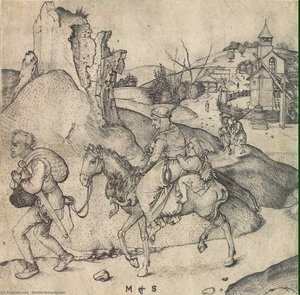
The Fourth Wise Virgin: A Glimpse into Northern Renaissance Mystery
Martin Schongauer’s “The Fourth Wise Virgin,” created around 1490, is more than just an engraving; it's a meticulously crafted window into the spiritual and artistic currents of late medieval Germany. This captivating image, housed within the National Gallery of Art in Washington D.C., draws upon both established iconography – referencing the biblical tale of the Wise Virgins – and Schongauer’s own distinctive style, blending meticulous detail with an almost haunting sense of introspection. The work immediately commands attention not through grand scale or overt drama, but through a profound quietude and a subtle layering of symbolism that invites prolonged contemplation.
Schongauer's artistic lineage is deeply rooted in the traditions of goldsmithing, a craft he likely learned from his father. This background profoundly shaped his approach to engraving – an art demanding unparalleled precision and control over line. The image’s remarkable clarity stems from Schongauer’s mastery of hatching and cross-hatching techniques, creating a sophisticated illusion of form and texture. He doesn't simply depict the figure; he sculpts her presence with carefully placed lines, imbuing the composition with an almost palpable sense of weight and volume. The use of negative space is equally crucial, drawing attention to the central subject while subtly suggesting the vastness of the surrounding world – a world both familiar and potentially perilous.
A Biblical Narrative Illuminated
The scene itself draws upon the well-known parable of the Wise and Foolish Virgins. Ten young women are preparing for the wedding of the king, each carrying a lamp filled with oil. The foolish ones neglect their duty, leaving their lamps unlit, and are subsequently barred from entering the celebration. The Fourth Virgin, depicted here in profile, embodies a serene yet subtly melancholic acceptance of her fate. Her posture is dignified, suggesting not despair but a quiet understanding of divine judgment. The candle she holds – a potent symbol of faith, enlightenment, and guidance – casts a gentle glow upon her face, illuminating her expression with an ethereal light.
Schongauer’s choice to focus on this particular virgin is intriguing. Unlike the more overtly dramatic depictions found in other prints from the series, Schongauer's rendering emphasizes introspection rather than external action. The background is deliberately sparse, devoid of elaborate details or distracting elements. This minimalist approach directs the viewer’s attention entirely onto the figure herself, amplifying her internal state and inviting us to contemplate the moral implications of the story. The composition subtly suggests a sense of isolation – a solitary figure contemplating a universal truth.
Technique and Historical Context
“The Fourth Wise Virgin” is a prime example of Northern Renaissance engraving, characterized by its meticulous detail, refined draftsmanship, and a deep engagement with both religious iconography and contemporary fashion. Schongauer’s work reflects the influence of Early Netherlandish painting, particularly the realism and attention to texture evident in the drapery and facial features. The print's creation coincided with a period of significant artistic innovation, as engravers began to explore new techniques for achieving greater tonal range and simulating the effects of paint. The use of a copper or iron plate, meticulously etched with lines using specialized tools like burins, is itself a testament to Schongauer’s technical skill.
Furthermore, the print's creation occurred during a time of intense religious fervor and social upheaval in Europe. The Reformation was gaining momentum, challenging traditional beliefs and practices. Schongauer’s work can be interpreted as a meditation on themes of faith, judgment, and redemption – timeless concerns that resonated deeply with audiences throughout the Renaissance.
A Timeless Symbol of Reflection
“The Fourth Wise Virgin” endures not merely as a beautiful engraving but as a poignant reflection on human nature. Schongauer’s masterful use of line, light, and shadow creates an image that is both visually arresting and emotionally resonant. It's a work that invites viewers to contemplate their own choices, their own faith, and their place within the larger narrative of life and death. The engraving’s quiet dignity and subtle symbolism continue to captivate audiences centuries after its creation, solidifying Schongauer’s legacy as one of the most important printmakers of the Northern Renaissance.
Fragen & Antworten
Wie intensiv sind die Farben von "The Fourth Wise Virgin" von Martin Schongauer?
Die Farben in "The Fourth Wise Virgin" von Martin Schongauer besitzen eine Monochromatic Intensität.
Ist "The Fourth Wise Virgin" von Martin Schongauer im Hoch-, Quer- oder Quadratformat angeordnet?
"The Fourth Wise Virgin" von Martin Schongauer ist eine Komposition im Portrait-Format. Die Proportionen sollten vor der Wahl der Druckgröße überprüft werden.
Welche Technik wurde für "The Fourth Wise Virgin" von Martin Schongauer verwendet?
"The Fourth Wise Virgin" wurde in Engraving ausgeführt.
Künstlerbiografie
Martin Schongauer: Leben und Vermächtnis
Frühes Leben und Ausbildung
Martin Schongauer, geboren um 1450 in Colmar, Elsass (heute Frankreich), war eine zentrale Figur bei der Entwicklung des Holzschnitts während der nördlichen Renaissance. Er stammte aus einer Familie von Handwerkern; sein Vater, Caspar Schongauer, war ein Goldschmied, der sich um 1440 von Augsburg, Deutschland, nach Colmar bewegt hatte. Dieser familiäre Hintergrund beeinflusste seine frühe künstlerische Ausbildung maßgeblich, da das Goldschmieden eine solide Grundlage in präziser Detailverarbeitung und Metallbearbeitungstechniken – Fähigkeiten, die direkt auf Gravieren übertragbar waren – bot.
Bildung und künstlerische Entwicklung
Im Jahr 1465 besuchte Schongauer kurzzeitig die Universität Leipzig, gab seine akademischen Studien aber bald wieder auf, um sich voll und ganz der Kunst zu widmen. Zunächst wurde er von Caspar Isenmann ausgebildet, einem lokalen Meister, der von der Frühflämischen Malerei beeinflusst war, insbesondere vom Werk von Rogier van der Weyden. Diese frühe Auseinandersetzung mit flämischer Realismus und Detailgenauigkeit sollte sich zu den Markenzeichen seines eigenen Stils entwickeln.
Künstlerischer Stil und Einflüsse
Schongauers künstlerischer Stil ist durch eine klare, organisierte gotische Ästhetik geprägt, die mit den aufkommenden Einflüssen der nördlichen Renaissance verschmolzen ist. Er hatte keine direkte italienische Beeinflussung, sondern ließ sich stattdessen von deutschen und Frühflämischen Traditionen inspirieren. Seine Werke zeigen akribische Detailverarbeitung, ausdrucksstarke Figuren und ein raffiniertes Verständnis der Komposition.
- Schlüsselmerkmale: Präzise Gravuren, realistische Darstellungen, dramatische Erzählungen, gotische Struktur
- Einflüsse: Rogier van der Weyden, Caspar Isenmann, deutsche gotische Traditionen
Wichtige Leistungen und Werke
Schongauer ist vor allem für seine 116 Kupferstiche bekannt, die alle mit seinem Monogramm identifiziert sind. Diese Drucke wurden in ganz Europa weit verbreitet und hatten einen erheblichen Einfluss auf die Entwicklung von Holzschnitttechniken und künstlerischen Stilen. Seine Kupferstiche zeigten oft religiöse Szenen, Porträts und allegorische Themen.
- Madonna der Rosenlaube (1473): Ein bedeutendes Gemälde, das seine Fähigkeit zur Darstellung zarter Details und emotionaler Tiefe demonstriert.
- Kupferstiche: Dazu gehören *Die Versuchung des Heiligen Antonius*, *Die Verehrung der Hirten* und zahlreiche andere, die seine Meisterschaft in der Gravurtechnik demonstrieren.
Historische Bedeutung und Vermächtnis
Schongauers Einfluss auf die Kunstwelt war beträchtlich. Er war einer der ersten deutschen Künstler, der international als Holzschnitzer anerkannt wurde. Seine Drucke waren sehr begehrt und vielfach kopiert, wodurch sein künstlerischer Stil in ganz Europa verbreitet wurde. Es ist sogar dokumentiert, dass Michelangelo einen seiner Kupferstiche – *Der Prozess des Heiligen Antonius* – studierte und kopierte, was den hohen Respekt zeigt, den Schongauer bei späteren Meistern genoss.
Schongauers Werk schloss die Lücke zwischen der Gotik und der Renaissance und ebnete den Weg für Künstler wie Albrecht Dürer. Seine innovative Verwendung von Holzschnitttechniken und sein Engagement für künstlerische Detailgenauigkeit hinterließen ein bleibendes Erbe in der Geschichte des Holzschnitts und der nordeuropäischen Kunst.
Tod
Martin Schongauer starb am 2. Februar 1491 in Breisach und hinterließ ein bemerkenswertes Werk, das bis heute für seine künstlerische Qualität und historische Bedeutung gefeiert wird.

Martin Schongauer
1450 - 1491 , Deutschland
Kurzinfos
- Artistic Movement Or Style: Nordliche Renaissance
- Artists Or Movements Influenced By This Artist: ['Albrecht Dürer']
- Artists Who Influenced This Artist:
- Rogier van der Weyden
- Caspar Isenmann
- Date Of Birth: ca. 1450/1453
- Full Name: Martin Schongauer
- Nationality: Deutsch
- Notable Artworks:
- Madonna der Rosenlaube
- Christ befire pilate
- Place Of Birth: Colmar, Elsass
Ähnliche Artikel

Die 10 legendärsten Radierungen: Meisterwerke, die Kunstgeschichte schrieben | OriginalUniqueArt
Entdecken Sie die 10 legendärsten Radierungen von Dürer, Rembrandt & Goya! Erfahren Sie die Geschichten hinter diesen Meisterwerken der Kunstgeschichte und lassen Sie sich von Druckgrafik inspirieren. Hochwertige Kunstdrucke auf OriginalUniqueArt.com – für Ihr Zuhause.

Hendrick Goltzius: Meister der Linie und des Manierismus – Ein niederländischer Virtuose
Entdecken Sie Hendrick Goltzius, den niederländischen Meister des Manierismus und virtuosen Kupferstechers! Erfahren Sie mehr über sein Leben, seine Technik und seinen Einfluss auf die Kunstgeschichte. Jetzt lesen!

Präzision in Metall: Die faszinierende Welt des Kupferstichs und der Tiefdruckkunst
Erfahren Sie alles über die Meisterschaft des Kupferstichs und der Radierung. Entdecken Sie die Tiefe der klassischen Tiefdruckkunst.

Die filigrane Welt des Kupferstichs: Technik, Kunst und bleibendes Erbe
Entdecken Sie die faszinierende Welt des Kupferstichs! Erfahren Sie alles über Technik, Geschichte, Künstler und Sammlungen – mit Expertenwissen von OriginalUniqueArt.

Engraving: A Historical Survey of Technique, Artistic Expression & Enduring Legacy
Explore the rich history of engraving with OriginalUniqueArt. Discover techniques, iconic artists like Dürer & Callot, collecting tips, and expert guidance for preserving your art investment. Learn about intaglio printing & more!