
 Versenden
 Teilen
 Details anzeigen

 Herunterladen
 Ähnliche Objekte
 Diashow
Matrices for printing textiles
 Textile
- Art Deco
 1920
1920 9.0 x 12.0 cm
 Palazzo Fortuny
 Weiterlesen
Erwerben Sie ein hochauflösendes, optimiertes digitales Bild, das der Online-Vorschau weit überlegen ist.
Jede Datei wird von unseren hauseigenen Spezialisten mit modernsten Werkzeugen und fachmännischer manueller Retusche sorgfältig vorbereitet. Wir stellen sicher, dass jedes Bild eine außergewöhnliche Klarheit, präzise Farbgenauigkeit und feinste Details aufweist.
Die endgültige Datei wird innerhalb von 72 Stunden per E-Mail zugestellt und ist für den sofortigen Einsatz in professionellen, redaktionellen und Druckumgebungen optimiert. Es handelt sich um dieselbe Qualität, der führende Designstudios, Verlage und Galerien vertrauen.
Digitales Bild
Laden Sie eine hochauflösende Datei für die persönliche Präsentation, den Druck und kreative Projekte herunter. ( Druck bestellen Handgemalte Reproduktion bestellen)
In jeder Bestellung digitaler Bilder enthalten
Professionelle digitale Bereitstellung, garantiert
Wenn Sie sich für OriginalUniqueArt.com entscheiden, erhalten Sie nicht nur ein Bild – Sie erhalten ein professionell aufbereitetes digitales Kunstwerk, das mit höchster Präzision erstellt und durch eine Zufriedenheitsgarantie abgesichert wird. Hier ist alles, was automatisch mit Ihrer Bestellung geliefert wird:

Schnelle E-Mail-Zustellung
Ihre hochauflösende digitale Bilddatei wird Ihnen innerhalb von 72 Stunden nach der Bestellung per E-Mail zugestellt – bereit zur sofortigen Verwendung.

KI-optimierte digitale Datei
Ihre Kunstwerke werden professionell mithilfe fortschrittlicher KI-Tools und manueller Bearbeitung optimiert, um maximale Detailtreue, Klarheit und Farbgenauigkeit zu gewährleisten.

Lebenslanger kostenloser Neudruckservice
Datei versehentlich gelöscht oder verloren? Keine Sorge – wir senden sie Ihnen jederzeit kostenlos erneut zu.

Keine Einfuhrgebühren – jemals
Genießen Sie Ihr Kunstwerk sofort ohne Zollgebühren, Einfuhrabgaben oder Versandkosten – digitale Downloads sind immer steuerfrei.

Garantierte Farbtreue
Wir garantieren, dass Ihr digitales Bild mithilfe professioneller Werkzeuge und Farbmanagement die Originalfarben so präzise wie möglich wiedergibt.

60-Tage-Zufriedenheitsgarantie
Sollten Sie mit Ihrem digitalen Bild nicht zufrieden sein, werden wir es überarbeiten oder Ihnen innerhalb von 60 Tagen 100% erstatten – ohne Wenn und Aber.

100% Geld-zurück-Garantie
Nicht zufrieden? Erhalten Sie innerhalb von 60 Tagen nach Erhalt Ihrer digitalen Datei eine vollständige Rückerstattung – ohne Angabe von Gründen.

Rabatte bei Großbestellungen
3 Bilder kaufen, 10% sparen – 5 Bilder kaufen, 15% sparen – Ab 10 Bildern 20% sparen. Ideal für kreative Projekte, Galerien und Agenturen.
Details zum Sammlerstück
A Window into a Spanish Atelier: Exploring ‘Matrices for Printing Textiles’
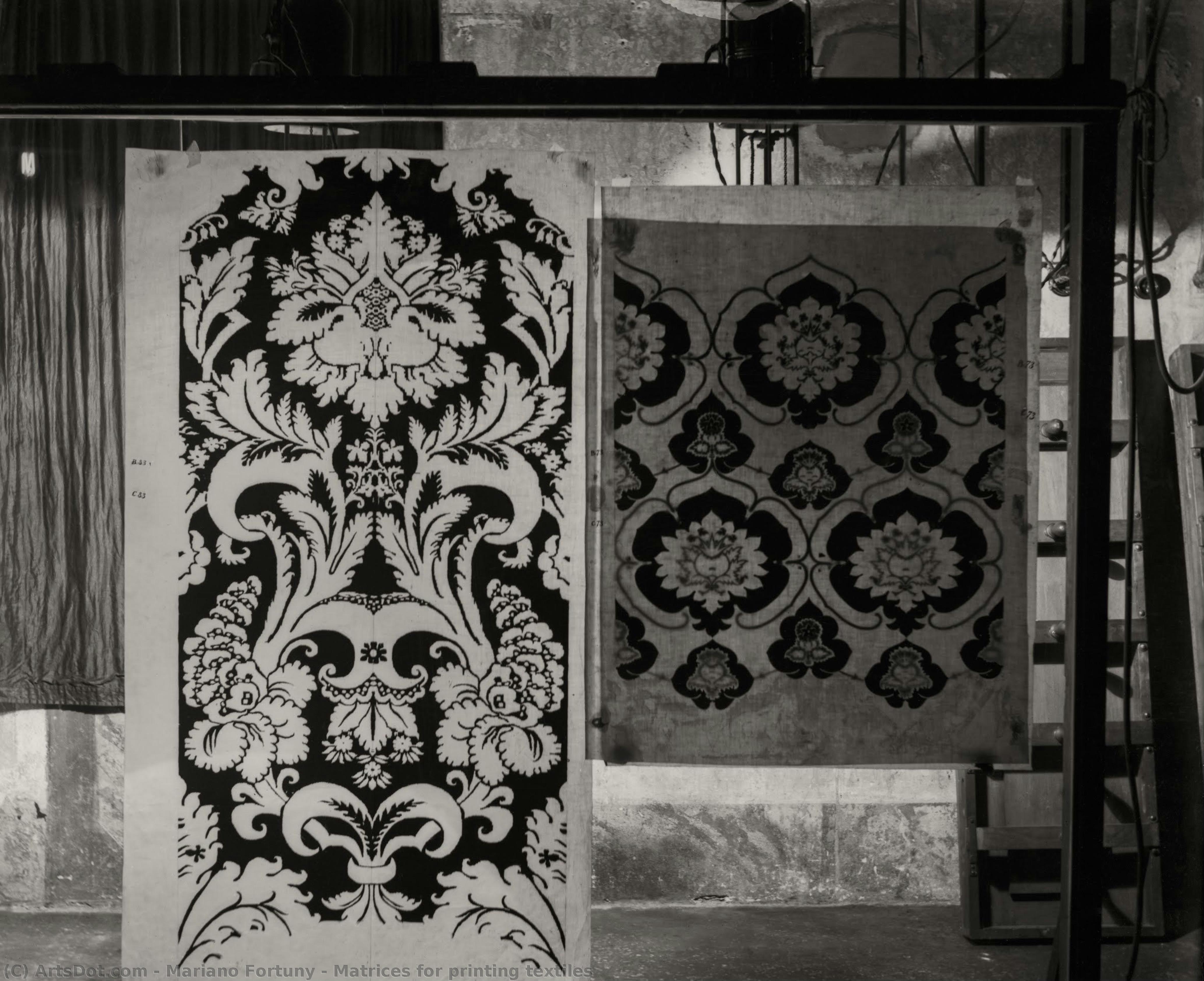
Mariano Fortuny y Madrazo's “Matrices for Printing Textiles,” created in 1920, isn’t merely a depiction of fabric; it’s a meticulously crafted glimpse into the heart of a vibrant artistic and industrial world. This black-and-white photograph, housed within a serene art studio setting, captures a pivotal moment in Fortuny's career – his innovative approach to textile design and production. The image isn’t simply about patterns; it’s about the process itself: the careful arrangement of matrices, the tools that translated artistic vision into tangible, repeating designs destined for luxurious fabrics.
The composition immediately draws the eye to the two wall hangings dominating the scene. One bursts with a dense floral tapestry, a riot of swirling leaves and stylized blossoms rendered in rich, layered textures. The other presents a more controlled geometric design – a symmetrical framework of repeating motifs that subtly resemble abstracted flowers. Fortuny’s genius lies not just in his aesthetic choices but also in his understanding of how these designs would be realized through the intricate process of matrix creation. Notice the precise lines and angles, suggesting a methodical approach to pattern development, a testament to Fortuny's engineering mind alongside his artistic sensibilities.
The Master of Delphos and Orientalist Influence
Mariano Fortuny (1871-1949) was far more than just a painter; he was a polymath – a designer, stage lighting innovator, architect, and textile pioneer. Born in Granada, Spain, his early life was profoundly shaped by the loss of his father, leading to a move to Paris where his mother introduced him to the world of textiles. This exposure ignited a lifelong fascination with fabrics, culminating in his revolutionary “Delphos” gowns – inspired by ancient Greek drapery and celebrated for their flowing elegance. His work is deeply rooted in Orientalist themes, reflecting a fascination with exotic cultures and incorporating intricate patterns and motifs borrowed from North African and Middle Eastern designs.
Fortuny’s influence extended beyond fashion; he revolutionized theatrical lighting design with his “fortuny cyclorama dome,” a groundbreaking invention that created seamless transitions between scenes through the strategic use of reflected light. This technical innovation, combined with his artistic vision, cemented his reputation as a true innovator and a master of visual storytelling.
Decoding the Symbolism: Craft, Tradition, and Artistic Vision
Beyond the purely decorative, “Matrices for Printing Textiles” speaks to a deeper narrative about craftsmanship, tradition, and the marriage of art and industry. The photograph’s muted tones evoke a sense of timelessness, suggesting a process that has remained largely unchanged for centuries. The studio setting itself – with its worn walls and simple furniture – hints at an environment dedicated to meticulous work and artistic contemplation. The matrices themselves are not just tools; they represent the culmination of creative thought, transforming abstract ideas into reproducible patterns.
Furthermore, the image subtly references Spain’s rich history of textile production. Fortuny's work builds upon a long tradition of intricate weaving and dyeing techniques, while simultaneously pushing the boundaries of design with his innovative approach to pattern creation. The photograph serves as a visual testament to this legacy – a bridge between past and present, artistry and industry.
A Legacy in Reproduction: Bringing Fortuny’s Vision to Life
Today, OriginalUniqueArt offers high-quality reproductions of “Matrices for Printing Textiles,” allowing art lovers worldwide to experience the beauty and intricacy of this remarkable work. Whether adorning a wall or serving as a focal point in an interior design scheme, this print captures the essence of Fortuny’s artistic vision – a celebration of craftsmanship, pattern, and the enduring power of visual storytelling. Consider commissioning a custom-sized reproduction to perfectly complement your space and bring a touch of Spanish elegance into your home.
Biografie des Künstlers
Frühe Jahre und Inspiration
Mariano Fortuny, ein spanischer Modeschöpfer, wurde am 11. Mai 1871 in Granada, Spanien, geboren. Sein Vater, Mariano Fortuny y Marsal, war ein Maler des Genrebildes, der verstarb, als Mariano erst drei Jahre alt war. Dieses tragische Ereignis führte dazu, dass die Familie nach Paris, Frankreich, zog, wo die Mutter von Mariano ihn mit verschiedensten Textilien und Stoffen vertraut machte, die später seine schöpferische Kraft maßgeblich beeinflussen sollten.Künstlerische Talente und Erfindungen
Schon in jungen Jahren offenbarte Mariano Fortuny sein außergewöhnliches künstlerisches Talent und bewies meisterhafte Fähigkeiten in der Malerei, Fotografie, Bildhauerei, Architektur, Radierung sowie in der theatralischen Bühnenbeleuchtung. Seine Erfindungen, darunter über zwanzig Patente, die zwischen 1901 und 1934 angemeldet wurden, revolutionierten die Welt des Bühnendesigns grundlegend.- Er entwickelte das Fortuny-Cyclorama-Dome, eine halbkuppelförmige Struktur aus Gips oder Stoff, die indirektes Licht nutzte, um einen nahtlosen Übergang zwischen den Szenen zu schaffen.
- In seiner Abhandlung „Eclairage Scénique“ (1904) beschrieb er seine Entdeckung, wie Licht von verschiedenen Oberflächen reflektiert werden kann, wodurch sich dessen Farbe, Intensität und Eigenschaften verändern lassen.
Bemerkenswerte Beiträge und Kollaborationen
Die Arbeit von Mariano Fortuny erlangte in den 1920er Jahren weltweite Anerkennung. Er arbeitete mit bedeutenden Persönlichkeiten zusammen, darunter:- Richard Wagner, ein deutscher Komponist, dessen Opern Mariano dazu inspirierten, ganze Szenen zu malen.
- Das berühmte Opernhaus La Scala in Mailand, in dem er seine Kuppel installierte, wobei er sie für das größere Theater anpasste und einen Saugventilator erfand, um die straffe Struktur aufrechtzuerhalten.
Vermächtnis und spätes Leben
Mariano Fortuny verstarb am 3. Mai 1949 in Venedig, Italien. Sein Werk inspirierte den französischen Schriftsteller Marcel Proust, und sein Leben fand in Pere Gimferrer's Roman „Fortuny“ Niederschlag. Das Erbe von Mariano beeinflusst die Welt des Bühnendesigns bis heute nachhaltig.- Erforschen Sie mehr über die Erfindungen und Entwürfe von Mariano Fortuny in der Sammlung von OriginalUniqueArt.
- Entdecken Sie die Auswirkungen seines Werkes auf die Theaterbeleuchtung in The Museum Destroyed by Fire (USA), einer Erzählung über ein unglückliches Ereignis, das die amerikanische Kunstgeschichte prägte, verfügbar im Blog von OriginalUniqueArt.
Ausgewählte Gemälde von Mariano Fortuny und anderen Künstlern
- Mariano Fortuny: Teagown (Museum of Fine Arts, Boston, USA), verfügbar in der Sammlung von OriginalUniqueArt.
- Marc Chagall: Studie zu 'Hohelied IV' (Naive Kunst / Primitivismus), verfügbar in der Sammlung von OriginalUniqueArt.
- Pablo Picasso: Klarinette (Analytischer Kubismus, Öl auf Leinwand), verfügbar in der Sammlung von OriginalUniqueArt.
- Vincent van Gogh: Baumwurzeln (50 x 100 cm, Post-Impressionismus, Öl auf Leinwand), verfügbar in der Sammlung von OriginalUniqueArt.

Mariano Fortuny
1871 - 1949 , Spanien
Kurzinfos
- Artistic Movement Or Style: Orientalism art
- Artists Or Movements Influenced By This Artist: ['Marcel Proust']
- Artists Who Influenced This Artist: ['Richard Wagner']
- Date Of Birth: 11. Juni 1838
- Date Of Death: 21. November 1949
- Full Name: Mariano Fortuny y Marsal
- Nationality: Spanisch
- Notable Artworks:
- Teagown
- Portrait of Henriette Fortuny
- Place Of Birth: Granada, Spanien

