Zum Druck wechseln
 Weiterlesen







































 Bei Kunstwerken oder Reproduktionen, die an einer Seite größer als 105 cm (ca. 41 Zoll) sind, wird der Rahmen zerlegt als Bausatz geliefert. Diese Methode gewährleistet eine sichere Zustellung und verhindert Schäden während des Transports.


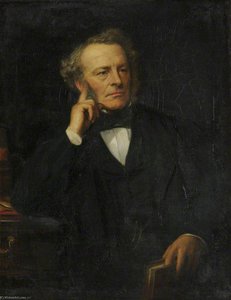
A Portrait of Moral Resolve: John Bright by Lowes Cato Dickinson
Lowes Cato Dickinson’s 1873 portrait of John Bright stands as a testament to Victorian England's fascination with capturing the dignity and intellect of prominent figures. Located at Touchstones Rochdale, this oil on canvas masterpiece offers more than just a likeness; it embodies the spirit of a man deeply committed to social reform and moral conviction.
Subject Matter and Composition
The painting depicts John Bright seated in a chair, dressed impeccably in dark attire—a suit complemented by a crisp white shirt. Dickinson meticulously rendered Bright’s features: a prominent beard and mustache indicative of his age, conveying wisdom and experience. His gaze is directed inward, suggesting contemplation and profound thought – an expression that speaks volumes about his inner life.
Stylistic Considerations: Realism Infused with Pre-Raphaelite Sensibility
Dickinson’s approach aligns closely with the tenets of Pre-Raphaelitism, prioritizing accuracy and detail alongside a subtle infusion of Romantic idealism. Unlike many portraits of the era that prioritized idealized beauty, Dickinson focused on portraying Bright realistically, capturing the nuances of his appearance and environment. The soft lighting illuminates Bright's face without harsh shadows, enhancing the sense of intimacy and conveying sincerity.
Setting and Symbolism
The backdrop is a dimly lit room furnished with a desk and books—a deliberate choice that underscores Bright’s intellectual pursuits and professional life as a barrister. This setting symbolizes his dedication to reason and knowledge, aligning perfectly with the broader Victorian ethos of moral seriousness. Dickinson's restrained palette emphasizes textures and tones rather than vibrant hues, contributing to the painting’s contemplative mood.
Legacy and Emotional Impact
“John Bright” transcends mere representation; it captures a man grappling with weighty ethical dilemmas—a figure who championed universal suffrage and advocated for social justice. Dickinson's masterful technique conveys not only Bright’s physical presence but also his inner character, inviting viewers to contemplate the importance of moral courage and intellectual integrity. It remains an enduring symbol of Victorian idealism and continues to inspire admiration for its artistic merit.
Fragen & Antworten
Wer hat "John Bright (1811–1889)" geschaffen und in welchem Stil ist es gehalten?
"John Bright (1811–1889)" wurde von Lowes Cato Dickinson im Stil der Pre-Raphaelite Realism geschaffen. Künstler und Epoche bestimmen die Tradition des Werkes.
Wie hell ist "John Bright (1811–1889)" insgesamt?
Insgesamt wird „John Bright (1811–1889)“ mit einer Helligkeit von Tiefster Schatten erfasst. Die wahrgenommene Helligkeit beschreibt, wie hell oder dunkel das Werk erscheint.
Wer hat "John Bright (1811–1889)" geschaffen und in welchem Jahr?
Lowes Cato Dickinson schuf „John Bright (1811–1889)“ im Jahr 1873.
 Vorschau anzeigen
 Versenden
 Teilen
 Details anzeigen
 Leitfaden

 Herunterladen
 Ähnliche Objekte
 Röntgenaufnahme
 Diashow
 Fragen & Antworten
 Statistiken