Zum Druck wechseln
 Weiterlesen







































 Bei Kunstwerken oder Reproduktionen, die an einer Seite größer als 105 cm (ca. 41 Zoll) sind, wird der Rahmen zerlegt als Bausatz geliefert. Diese Methode gewährleistet eine sichere Zustellung und verhindert Schäden während des Transports.


L'étang: A Tranquil Reflection of Barbizon Landscape Painting
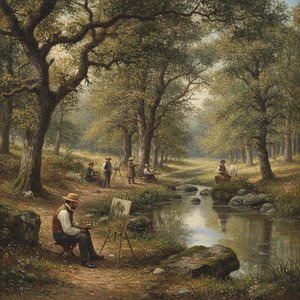
Jules Dupré’s “L’étang” (The Pond) stands as a quintessential example of the Barbizon School’s artistic ethos—a profound engagement with nature driven by emotion and observation rather than idealized beauty. Painted circa 1870, this oil on canvas captures a serene riverside scene bathed in diffused sunlight, transporting viewers to the heart of rural France during its Belle Époque period. The artwork's understated palette – dominated by browns, muted greens, and grays – contributes to an atmosphere of contemplative melancholy, mirroring the melancholic grandeur often found within Barbizon landscapes.Composition and Technique: Mastering Atmospheric Perspective
Dupré skillfully employs compositional techniques characteristic of his time. The horizon line bisects the canvas roughly in half, establishing a balanced visual rhythm that emphasizes the expansive sky above and the tranquil water below. A crucial element is Dupré’s masterful use of atmospheric perspective—a technique perfected by artists like Corot—where objects receding into the distance appear paler and less sharply defined than those closer to the viewer. This illusionistic depth creates a convincing sense of space, drawing the eye inwards and fostering an immersive experience for the observer. The visible brushstrokes, particularly prominent in the sky and foliage, lend texture to the painting, conveying the materiality of the landscape itself. Impasto—thickly applied paint—creates palpable surface irregularities that heighten visual interest and communicate Dupré’s commitment to capturing the immediacy of his observations.Symbolism Within Nature's Embrace
Beyond its aesthetic qualities, “L’étang” resonates with symbolic meaning rooted in Barbizon iconography. The pond itself represents stillness and reflection – a metaphor for inner contemplation—while the grazing sheep symbolize innocence and simplicity. Scattered amongst the trees and distant buildings are elements of everyday rural life, subtly reinforcing the Barbizon School's fascination with portraying the commonplace as imbued with spiritual significance. Dupré’s depiction isn’t merely a representation of a landscape; it’s an invitation to contemplate its beauty and find solace in its quiet grandeur.Historical Context: The Barbizon Legacy
The Barbizon School emerged in France during the mid-19th century, reacting against the academic conventions prevalent at the Salon exhibitions. Artists like Dupré rejected idealized depictions of classical mythology or historical narratives, instead prioritizing direct engagement with the natural world—specifically the Fontainebleau Forest and its surrounding areas. This movement championed a return to disegno (drawing), valuing meticulous observation and tonal gradations as tools for conveying emotion and capturing the essence of place. “L’étang” embodies this legacy, securing Dupré's position as one of the foremost practitioners of Barbizon landscape painting—a style that continues to inspire artists and collectors today.Emotional Impact: A Moment Frozen in Time
Ultimately, "L’étang" succeeds in evoking a profound emotional response. The soft lighting, combined with the muted color palette and textured brushstrokes, creates an atmosphere of serene tranquility. It's a painting designed not for grand spectacle but for quiet contemplation—a reminder of the beauty inherent in the natural world and the importance of slowing down to appreciate its subtleties. Like many Barbizon masterpieces, Dupré’s work invites viewers to immerse themselves in a timeless scene, fostering a connection with both art history and the enduring power of landscape painting.Fragen & Antworten
Wie harmonisch sind die Farben von "L'étang" von Jules Dupré?
Die Farben von "L'étang" von Jules Dupré weisen eine Unified Palette Harmonie auf. Harmonie beschreibt das Zusammenspiel der Farben untereinander.
Kann ich "L'étang" von Jules Dupré unter verschiedenen Lichtverhältnissen sehen?
Die Röntgenansicht von "L'étang" von Jules Dupré finden Sie auf der Röntgenblick-Seite des Kunstwerks: eine interaktive Untersuchung des Bildes durch elf optische Schichten.
Kann man "L'étang" von Jules Dupré als Diashow ansehen?
Das Diaporama zu „L'étang“ finden Sie auf der Diashow-Seite des Kunstwerks.
 Vorschau anzeigen
 Versenden
 Teilen
 Details anzeigen
 Leitfaden

 Herunterladen
 Ähnliche Objekte
 Röntgenaufnahme
 Diashow
 Fragen & Antworten
 Statistiken