Text size

() ·

A painting made for you, by hand

Violin and Guitar

Handgefertigte Ölreproduktion

Handgemaltes Ölgemälde auf Leinwand in Ihrer Wunschgröße und mit Rahmen, auf Bestellung von unseren Künstlern angefertigt. ( Zum Druck wechseln Zum digitalen Bild wechseln)

Beschreibung des Sammlerstücks

Explore Juan Gris’s ‘Violin and Guitar’ (1913), a groundbreaking Cubist still life. Geometric forms, cool tones & layered glazes define this iconic piece – a must-see for art collectors.

Künstlerbiografie

Entdecken Sie Juan Gris (1887-1927), den spanischen Kubismus-Meister! Erforschen Sie seinen geometrischen Stil, synthetische Kubismus & bleibenden Einfluss auf die moderne Kunst. Kunstwerke jetzt entdecken.

from ·

Chapter 1

How large should it be?

Slide to change the size; the picture on the left shows the frame at its real width. The proportions of the original are kept.

Standardformat
individuell anpassbar
CM
INCH

Wählen Sie aus unseren vordefinierten Formaten, die den ursprünglichen Proportionen des Kunstwerks entsprechen.

Breite
Höhe

Geben Sie die Breite und die Höhe an, die Sie für Ihren Rahmen oder Ihre Wand benötigen. Da dieses Werk handgemalt ist, kann der Künstler bei einer anderen Form etwas mehr um das Bild herum malen oder etwas abschneiden – Sie entscheiden. Wir senden Ihnen ein digitales Mockup zur Freigabe, bevor mit dem Malen begonnen wird. Das auf dieser Seite gezeigte Bild stellt nicht das tatsächliche Ergebnis dar – dies tut nur das Mockup.

Chapter 2

How should it arrive?

Choose the edges of the stretched canvas

Choose your frame

Corner sample of the WhiteWrap canvas edge finish, stretched on Massivholz bars
White €1
Corner sample of the BlurSideWrap canvas edge finish, stretched on Massivholz bars
Blurside €1
Corner sample of the ExtendedWrap canvas edge finish, stretched on Massivholz bars
Extended €1
Corner sample of the P118B picture frame: formgepresstes Polystyrol, 5 cm wide and 3 cm thick
P118B €10
Corner sample of the P118H picture frame: formgepresstes Polystyrol, 5 cm wide and 3 cm thick
P118H €10
Corner sample of the P118W picture frame: formgepresstes Polystyrol, 5 cm wide and 3 cm thick
P118W €10
Corner sample of the P438Z picture frame: formgepresstes Polystyrol, 5.5 cm wide and 3.5 cm thick
P438Z €10
Corner sample of the P508JH picture frame: formgepresstes Polystyrol, 7 cm wide and 3.5 cm thick
P508JH €12
Corner sample of the P508YH picture frame: formgepresstes Polystyrol, 7 cm wide and 3.5 cm thick
P508YH €12
Corner sample of the P805H picture frame: formgepresstes Polystyrol, 5 cm wide and 3.5 cm thick
P805H €10
Corner sample of the P805Z picture frame: formgepresstes Polystyrol, 5 cm wide and 3.5 cm thick
P805Z €10
Corner sample of the P919BZ picture frame: formgepresstes Polystyrol, 7 cm wide and 3.5 cm thick
P919BZ €10
Corner sample of the P919G picture frame: formgepresstes Polystyrol, 7 cm wide and 3.5 cm thick
P919G €10
Corner sample of the P919XJ picture frame: formgepresstes Polystyrol, 7 cm wide and 3.5 cm thick
P919XJ €10
Corner sample of the P959ZH picture frame: formgepresstes Polystyrol, 5 cm wide and 3 cm thick
P959ZH €10
Corner sample of the P968JZ picture frame: formgepresstes Polystyrol, 6 cm wide and 4 cm thick
P968JZ €12
Corner sample of the W106C picture frame: Massivholz, 5 cm wide and 3 cm thick
W106C €8
Corner sample of the W218G picture frame: Massivholz, 5 cm wide and 3 cm thick
W218G €10
Corner sample of the W218JH picture frame: Massivholz, 5 cm wide and 3 cm thick
W218JH €8
Corner sample of the W218Y picture frame: Massivholz, 5 cm wide and 3 cm thick
W218Y €10
Corner sample of the W307PJ picture frame: Massivholz, 6 cm wide and 3 cm thick
W307PJ €10
Corner sample of the W316G picture frame: Massivholz, 6 cm wide and 3 cm thick
W316G €10
Corner sample of the W316PJ picture frame: Massivholz, 6 cm wide and 3 cm thick
W316PJ €8
Corner sample of the W316Y picture frame: Massivholz, 6 cm wide and 3 cm thick
W316Y €10
Corner sample of the W398PJ picture frame: Massivholz, 5 cm wide and 3 cm thick
W398PJ €8
Corner sample of the W4111J picture frame: Massivholz, 6.5 cm wide and 3.5 cm thick
W4111J €10
Corner sample of the W500HY picture frame: Massivholz, 7 cm wide and 5 cm thick
W500HY €15
Corner sample of the W500JH picture frame: Massivholz, 7 cm wide and 5 cm thick
W500JH €15
Corner sample of the W692G picture frame: Massivholz, 8 cm wide and 4 cm thick
W692G €12
Corner sample of the W849H picture frame: Massivholz, 5 cm wide and 3 cm thick
W849H €8
Corner sample of the W940BG picture frame: Massivholz, 7.5 cm wide and 4.5 cm thick
W940BG €15
Corner sample of the W953PJ picture frame: Massivholz, 6 cm wide and 3.5 cm thick
W953PJ €8
Corner sample of the H24-GOLD picture frame: geschnitztes Holz mit Gesso, 10 cm wide and 6 cm thick
H24-GOLD €30
Corner sample of the H24-SILVER picture frame: geschnitztes Holz mit Gesso, 10 cm wide and 6 cm thick
H24-SILVER €30
Corner sample of the H36-GOLD picture frame: geschnitztes Holz mit Gesso, 15 cm wide and 6.5 cm thick
H36-GOLD €45
Corner sample of the H36-SILVER picture frame: geschnitztes Holz mit Gesso, 15 cm wide and 6.5 cm thick
H36-SILVER €45

Moulding: . Overall size with the frame: .

Chapter 3

Who paints it, and should anything change?

Examples of what can be changed: Replace face with customer photo; Add pet (e.g., replace cat with dog); Include hidden message in background; Change background landscape or elements.
After order, OriginalUniqueArt.com team will email client for instructions and provide a mockup preview

Weltweiter Versand () in nur 3 bis 4 Wochen statt der üblichen 5 Wochen. (3 November). Keine Kompromisse bei der Qualität.

Chapter 4

The finishing touches

A nameplate, as in a museum?

Details der gravierten Bronzetafel

This elegant plaque features the artist's name and the title of the artwork, finely engraved for a timeless presentation.

It is made from bronze with a refined, elegant finish. The text is precisely laser-engraved for a sharp and permanent result. Measuring 9x2 cm, the plaque is compact yet easy to read. It's built to be durable and scratch-resistant, offering a professional, museum-quality look. Mounting is simple thanks to the included adhesive backing.

Details zur Acrylglas-Plakette (transparent)

The plaque includes essential engraved details such as the artist's name, the title of the artwork, the date it was created, the type of media used-like oil on canvas or watercolor-a brief description of the piece, and a QR code that links to the complete artwork information.

It is crafted from clear acrylic, offering a sleek, modern appearance. The text is UV-engraved in black to ensure strong visual contrast. With a size of 10x15 cm, it ensures optimal readability. It comes equipped with two metal hooks for secure wall mounting. The plaque is designed to be weather-resistant, making it suitable for various environments, and it includes interactive features that work seamlessly with smartphone scanning.

Details zur schwarzen Acryltafel

This elegant plaque includes engraved information such as the artist's name, the title of the artwork, the date it was created, the type of media used (like oil on canvas or watercolor), a short description of the artwork, and a QR code for quick access to more information.

The plaque itself is made from refined black acrylic with a premium finish. The text is laser-engraved in white for high contrast and readability. Its size is 10x15 cm, designed to be easy to read. It comes with two metal hooks for professional mounting. The design is sleek and fits any interior style. It is also weather-resistant and durable, with built-in digital integration for mobile compatibility.

A protective varnish?

When do you need it?

Chapter 5

Your painting, as you ordered it

Violin and Guitar

Art der Reproduktion

Format der Reproduktion

-

Erstklassige Meisterkünstler

Mehr Detailtiefe, Raffinesse und zusätzliche Produktionszeit

-

Rahmen für Reproduktionen

-

-

Bei Kunstwerken oder Reproduktionen, die an einer Seite größer als 105 cm (ca. 41 Zoll) sind, wird der Rahmen zerlegt als Bausatz geliefert. Diese Methode gewährleistet eine sichere Zustellung und verhindert Schäden während des Transports.

Professionelle Montage erforderlich – dies ist kein DIY-Produkt.
Der Bausatz muss von einem erfahrenen professionellen Rahmenmacher zusammengebaut und die Leinwand gespannt werden. Hierfür werden Holzleim (nicht im Lieferumfang enthalten), eine Leinwandspannzange sowie Klemmen benötigt, um die Keilleisten während des Trocknungsvorgangs rechtwinklig zu halten. Eine unsachgemäße Montage oder eine ungleichmäßige Spannung der Leinwand kann das Kunstwerk dauerhaft beschädigen und ist nicht durch unsere Garantie abgedeckt.

  • Alle Vollholzkomponenten sind enthalten, präzise auf Maß zugeschnitten.

  • Der Zusammenbau erfolgt mit den mitgelieferten Schrauben sowie Holzkleber für die Eckverbindungen, der nicht im Lieferumfang enthalten ist und vom Rahmenbauer selbst beschafft werden muss.

  • Professionelles Werkzeug ist erforderlich und nicht im Lieferumfang enthalten: eine Keilrahmenzange (Spannwerkzeug) sowie Klammern, um die Leisten während der Trocknungszeit des Klebers rechtwinklig zu fixieren.

Wichtiger Hinweis:
Für die Eckverbindungen wird Holzleim benötigt, die Leisten müssen mit Zwingen fixiert werden, bis der Leim vollständig getrocknet ist, und das Spannen der Leinwand auf dem fertigen Rahmen erfordert eine Keilrahmen-Zange. Keines dieser Utensilien ist im Set enthalten. Bitte stellen Sie sicher, dass ein erfahrener Rahmenmacher zur Verfügung steht, bevor Sie diese Größe bestellen.

Beschriftung

-

-

Schutzlackierung

Glanzlack (verstärkt die Farben, schützt vor Licht und Feuchtigkeit)

-

Mein Kunstwerk personalisieren

Beispiele für Anpassungsmöglichkeiten: Gesicht durch Kundenfoto ersetzen; Haustier hinzufügen (z. B. Katze durch Hund ersetzen); Versteckte Nachricht im Hintergrund einfügen; Hintergrundlandschaft oder -elemente ändern.

-

Eilt sehr

Weltweiter Versand () in nur 3 bis 4 Wochen statt der üblichen 5 Wochen. (3 November). Keine Kompromisse bei der Qualität.

-

Expressversand

Weltweiter Versand () innerhalb von 5 Wochen. (10 November).

Inklusive Versand

Endpreis

€ 267

Gesamtpreis € 267

Die Glasoption ist nur für Größen unter 110 cm verfügbar.

Included with every order

  • Kostenloser weltweiter Expressversand
  • Hochwertige Leinenleinwand
  • Umfassender Versicherungsschutz beim Versand
  • Zollgebühren-Rückerstattungsgarantie
  • Garantie für exakte Farbtreue
  • 100 Tage Rückgaberecht (nur bei Mängeln)
  • 100% Geld-zurück-Garantie
  • Mengenrabatt verfügbar

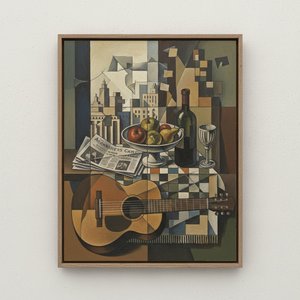
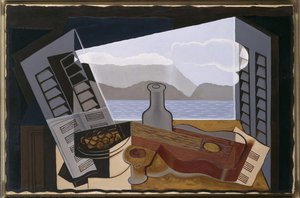
A Fragmented Harmony: Juan Gris’s “Violin and Guitar”

Juan Gris’s “Violin and Guitar,” painted in 1913, isn't merely a still life; it’s a meticulously constructed exploration of perception and the very nature of representation. Emerging from the fertile ground of early Cubism, this work embodies the movement’s revolutionary shift away from traditional perspective and towards a fractured, multi-faceted view of reality. More than just depicting musical instruments, Gris offers us a glimpse into his innovative approach to visual language – a deliberate dismantling and reassembling of form that speaks volumes about the artist's intellectual rigor and artistic vision.

The canvas is dominated by the assertive presence of a guitar and violin, rendered with an almost startling degree of realism despite their fragmented composition. However, these recognizable objects are not presented in a straightforward manner. Instead, they’re broken down into geometric planes – sharp angles, interlocking rectangles, and subtly curved lines—that suggest multiple viewpoints simultaneously. This is the hallmark of Synthetic Cubism, where elements from various perspectives are layered upon one another to create an illusion of depth and volume within a flattened space. The background, hinted at through a suggestion of a window and curtain, further reinforces this sense of spatial ambiguity, inviting the viewer to actively participate in constructing the image.

The Language of Cubism: Deconstruction and Reconstruction

Gris’s approach is deeply rooted in the principles pioneered by Picasso and Braque. He embraced the analytical cubist method – a process of dissecting objects into their constituent parts, analyzing them from multiple angles, and then reconstructing them on the canvas. Yet, “Violin and Guitar” marks a significant departure from the purely analytical style. It’s a prime example of Synthetic Cubism, where pre-existing elements—fragments of color, texture, and form—are collaged together to create a new, unified image. The use of *papier collé*, or pasted paper, is subtly present in the background, adding another layer of complexity and visual interest.

Noticeably absent is the dense, monochromatic palette often associated with early Cubism. Instead, Gris employs a vibrant and carefully considered color scheme – cool blues and grays juxtaposed against warm reds and greens. These colors aren’t merely decorative; they contribute to the overall sense of dynamism and visual tension within the composition. The deliberate use of contrasting hues draws attention to specific areas of the painting, guiding the viewer's eye through the intricate network of lines and shapes.

Symbolism and Emotional Resonance

While “Violin and Guitar” is undeniably a formal masterpiece, it also carries a subtle layer of symbolic meaning. Music itself has long been associated with harmony, emotion, and creativity. The instruments depicted—the violin and guitar—represent these concepts in tangible form. The fragmentation of the objects can be interpreted as reflecting the complexities of human experience – the way we perceive reality through multiple lenses and the challenges of integrating disparate elements into a cohesive whole.

Furthermore, the painting’s overall mood is one of quiet contemplation. The muted colors, the fragmented forms, and the sense of spatial ambiguity create an atmosphere of detachment and introspection. It's not a celebratory or overtly emotional work; rather, it invites the viewer to engage in a process of careful observation and interpretation. The deliberate lack of strong shadows contributes to this feeling of flatness and abstraction, emphasizing the painting’s formal qualities over its representational ones.

A Legacy of Innovation

“Violin and Guitar” stands as a pivotal work in Juan Gris's artistic development and a cornerstone of Cubist innovation. It demonstrates his mastery of geometric form, his innovative use of color, and his ability to create complex visual narratives through seemingly simple compositions. Gris’s unique approach—combining rigorous analytical study with a poetic sensibility—established him as one of the most influential artists of the 20th century, leaving an indelible mark on the development of modern art.

Fragen & Antworten

Welche Druckgröße wird für "Violin and Guitar" von Juan Gris empfohlen?

Für "Violin and Guitar" wird ein Druckformat von Formattyp empfohlen. Weitere Größen sind im gleichen Seitenverhältnis verfügbar.

Wie wirkt die Helligkeit von "Violin and Guitar" von Juan Gris?

Was die wahrgenommene Helligkeit betrifft, so ist "Violin and Guitar" von Juan Gris Schattenhaft.

Befindet sich "Violin and Guitar" im Land seines Schöpfers?

Ja – das Kunstwerk befindet sich im Heimatland der Künstlerin / des Künstlers. Juan Gris wurde in Spanien geboren, und das Original von „Violin and Guitar“ befindet sich in einem Museum in Spanien.

More about this painting

Vorschau anzeigen In AR ansehen Zum Druck wechseln Zum digitalen Bild wechseln Versenden
Details anzeigen Leitfaden Zu Favoriten hinzufügen Herunterladen Ähnliche Objekte Röntgenaufnahme Diashow Q&A Statistiken

In numbers

  • 1913the year it was painted
  • 29frames to choose from
  • standard sizes, in its own proportions
  • 5weeks to paint and deliver it
Juan Gris

Juan Gris

1887 - 1927, Spanien

Quick facts about Juan Gris

  • Beeinflusste Künstler/Bewegungen:
    • Amédée Ozenfant
    • Charles Edouard Jeanneret
  • Bemerkenswerte Werke:
    • Gitarre vor dem Meer
    • Hommage à Pablo Picasso
    • Stillleben vor Fenster
    • Place Ravignan
    • Fruchtkorb mit Zeitung
  • Geburtsdatum: 23. März 1887
  • Geburtsort: Madrid, Spanien
  • Künstlerische Bewegung: Kubismus, Synthetischer Kubismus
  • Künstlerische Einflüsse:
    • Pablo Picasso
    • Georges Braque
    • Henri Matisse
  • Nationalität: Spanisch
  • Sterbedatum: 11. Mai 1927
  • Vollständiger Name: Juan Gris

Künstlerbiografie

Juan Gris: Ein Pionier des Kubismus

  • Geboren: 23. März 1887, Madrid, Spanien
  • Gestorben: 11. Mai 1927

Frühes Leben und künstlerische Entwicklung

José Victoriano González-Pérez, besser bekannt als Juan Gris, wurde in Madrid, Spanien, geboren. Sein frühes Leben umfasste ein Studium der Ingenieurwissenschaften an der School of Arts and Sciences von 1902 bis 1904. Während dieser Zeit trug er Zeichnungen zu lokalen Periodika bei und demonstrierte so eine frühe Begabung für die visuelle Darstellung. Von 1904 bis 1905 studierte Gris Malerei bei José Moreno Carbonero und entwickelte seine künstlerischen Fähigkeiten weiter. Im Jahr 1905 nahm er den Pseudonym Juan Gris an, einen Namen, der mit seinem unverwechselbaren Stil in Verbindung gebracht werden sollte.

Pariser Einflüsse und die Entstehung des Kubismus

Ein entscheidender Moment in Gris’ Karriere kam im Jahr 1906, als er nach Paris zog. Diese Umsiedlung führte ihn in eine lebendige Kunstgemeinschaft, wo er Freundschaften mit einflussreichen Persönlichkeiten wie Henri Matisse, Georges Braque und Fernand Léger schloss. Er wurde tiefgreifend von Pablo Picasso beeinflusst und reichte zunächst humorvolle Illustrationen an Zeitschriften wie *L'Assiette au Beurre*, *Le Rire*, *Le Charivari* und *Le Cri de Paris* ein. Um 1910 begann Gris ernsthaft zu malen und widmete sich der Entwicklung eines persönlichen kubistischen Stils. Er löste sich von der satirischen Illustration hin zu abstrakteren Kompositionen.

Wichtige Werke und künstlerischer Stil

Juan Gris’ künstlerisches Schaffen ist durch mehrere Schlüsselfeatures gekennzeichnet:

  • Klarheit und Ordnung: Seine Arbeit betonte Klarheit und Ordnung, was den Puristenstil beeinflusste, der von Amédée Ozenfant und Charles Edouard Jeanneret (Le Corbusier) vertreten wurde.
  • Geometrische Struktur: Gris’ „Kristallperiode“, wie sie in Werken wie *Stillleben vor einem offenen Fenster* und *Place Ravignan* (1915) gezeigt wird, präsentierte eine starke geometrische Struktur.
  • Synthetischer Kubismus: Nach 1913 nahm Gris den synthetischen Kubismus an und verwendete Techniken wie Papier collé oder Collage ausgiebig. Dies beinhaltete die Einbeziehung von Materialien aus der realen Welt in seine Gemälde, wodurch Textur und Tiefe hinzugefügt wurden.

Bemerkenswerte Werke sind:

  • Gitarre vor dem Meer (1925): Demonstriert seine Einfachheit und sein Festhalten an kubistischen Prinzipien.
  • Hommage à Pablo Picasso (1912): Seine erste Ausstellung im Salon des Indépendants, ein Beweis für seine wachsende Anerkennung in der Kunstwelt.

Vermächtnis und historische Bedeutung

Juan Gris’ Beitrag zum Kubismus ist von großer Bedeutung. Er ging über die frühere analytische Phase der Bewegung hinaus zu einem strukturierteren und synthetischeren Ansatz. Sein Fokus auf Klarheit, geometrische Formen und die Einbeziehung alltäglicher Objekte in seine Kompositionen etablierten ihn als eine führende Figur in der Kunst des 20. Jahrhunderts. Seine Arbeit wird weiterhin für ihre intellektuelle Strenge und ästhetische Schönheit gefeiert und beeinflusst nachfolgende Generationen von Künstlern.