In echtem Maßstab anzeigen
 Versenden als Grußkarte
 Teilen
 Details anzeigen
 Leitfaden öffnen

 Herunterladen
 Ähnliche Objekte
 Röntgenaufnahme
 Diashow
 Besucherstatistiken
Flowers


 Mehr anzeigen
Giclée / Kunstdruck
Giclée- oder Leinwanddruck in Museumsqualität mit schneller Produktion und flexiblen Veredelungsoptionen. ( Handgemalte Reproduktion kaufen Zum digitalen Bild wechseln)




P118B €10

P118H €10

P118W €10

P438Z €10

P508JH €12

P508YH €12

P805H €10

P805Z €10

P919BZ €10

P919G €10

P919XJ €10

P959ZH €10

P968JZ €12

W106C €8

W218G €10

W218JH €8

W218Y €10

W307PJ €10

W316G €10

W316PJ €8

W316Y €10

W398PJ €8

W4111J €10

W500HY €15

W500JH €15

W692G €12

W849H €8

W940BG €15

W953PJ €8




Wählen Sie aus unseren vordefinierten Formaten, die den ursprünglichen Proportionen des Kunstwerks entsprechen.

Geben Sie die Breite und die Höhe an, die Sie benötigen, damit der Druck perfekt in Ihren Rahmen oder an Ihre Wand passt. Ein Druck kann nur beschnitten werden und niemals größer als das Originalbild gemacht werden; daher verliert ein Format mit einer anderen Proportion einen Teil des Bildes. Wir senden Ihnen ein digitales Mockup zur Freigabe, bevor wir den Druck ausführen. Das auf dieser Seite gezeigte Bild zeigt nicht den tatsächlichen Beschnitt – dies ist nur im Mockup ersichtlich.
Weltweiter Versand () innerhalb von 2 Wochen statt der üblichen 4/5 Wochen. (21 Oktober)

Kostenloser weltweiter Expressversand

Hochwertige Leinenleinwand

Vollständiger Versicherungsschutz beim Versand

Zollgebühren-Rückerstattungsgarantie

Garantie für exakte Farbtreue

100-tägiges Rückgaberecht (nur bei Mängeln)

100% Geld-zurück-Garantie

Angebot für Mengenrabatt
 Die Glasoption ist nur für Größen unter 110 cm verfügbar.

Flowers
Giclée / Kunstdruck
Format der Reproduktion
-


Gesamtpreis
€ 70
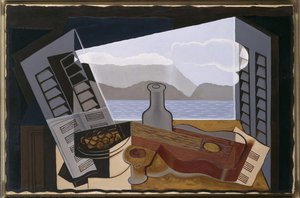
A Symphony of Cubist Geometry
In the vibrant tapestry of early twentieth-century modernism, few works capture the intellectual rigor and sensory richness of Juan Gris quite like his 1914 masterpiece, Flowers. This painting serves as a profound window into the analytical mind of a Spanish visionary who sought to deconstruct reality only to rebuild it with more potent, structural truth. At first glance, the viewer is greeted by a bustling, complex arrangement: a central vase overflowing with blossoms, anchored amidst a sea of scattered books, delicate cups, and the bright, citrusy warmth of oranges. It is a composition that refuses to be ignored, demanding an active gaze that navigates through layers of overlapping planes and intersecting lines.
The painting transcends mere still life, moving into the realm of Synthetic Cubism. Unlike the fragmented, almost monochromatic explorations of his predecessors, Gris utilizes a more structured approach where color and form coalesce to create a sense of rhythmic stability. The objects—the books, the bowls, and the fruit—are not merely depicted; they are architecturally integrated into the canvas. Each element is treated with a mathematical precision that speaks to Gris’s early training in engineering, allowing the viewer to experience the tension between the organic softness of the flowers and the rigid, geometric boundaries of the surrounding objects.
The Poetry of Form and Light
Technically, Flowers is a triumph of balance and tonal harmony. The artist employs a sophisticated palette where the bright, sun-drenched hues of the oranges provide a striking counterpoint to the more muted, earthy tones of the books and ceramics. Through masterful brushwork, Gris creates a tactile quality that invites the eye to linger on the texture of the petals and the smooth glaze of the cups. The light does not simply fall upon the objects; it seems to emerge from within the very intersections of the geometric shapes, creating a luminous depth that breathes life into the static arrangement.
For the discerning collector or interior designer, this piece offers an unparalleled opportunity to introduce a sense of intellectual sophistication and historical weight into a space. The painting’s ability to command attention through its complex composition makes it a perfect focal point for a contemporary gallery, a refined study, or a curated living area. It is more than a decoration; it is a conversation starter that bridges the gap between the classical tradition of the still life and the radical innovations of the modern era.
A Timeless Emotional Resonance
Beyond its formal brilliance, there is an undeniable emotional pulse within this work. There is a certain nostalgic intimacy in the arrangement of everyday items—the remnants of a quiet afternoon spent reading or sharing tea. This sense of domesticity, layered beneath the complex Cubist structure, creates a poignant connection with the viewer. It evokes a feeling of organized chaos, a reflection of the modern human experience where beauty and complexity are inextricably linked.
Owning a high-quality reproduction of this 1914 treasure allows one to inhabit the world of Juan Gris, bringing the spirit of Parisian avant-garde into the home. It serves as a constant reminder of the power of perspective and the enduring allure of finding order within complexity. Whether viewed as an exploration of geometric theory or a celebration of life's simple textures, Flowers remains a breathtaking testament to the transformative power of art.
Fragen & Antworten
Welche Farbpalette und welche Leitfarbe prägen "Flowers"?
Die Farbidentität von "Flowers" von Juan Gris: eine Dark-Palette, dominiert von Bronze (#c37539).
Kann ich eine Röntgenaufnahme von "Flowers" von Juan Gris sehen?
Die Röntgenansicht von "Flowers" von Juan Gris finden Sie auf der Röntgenaufnahme-Seite des Kunstwerks: eine interaktive Untersuchung des Bildes durch elf optische Schichten.
Welches Gefühl vermitteln die Farben von "Flowers" von Juan Gris?
Die Dark-Palette von "Flowers" von Juan Gris harmoniert mit seinem Reflective emotionalen Tonfall. Farbe ist eine der Arten und Weisen, wie ein Werk Gefühle vermittelt.
Biografie des Künstlers
Juan Gris: Ein Pionier des Kubismus
- Geboren: 23. März 1887, Madrid, Spanien
- Gestorben: 11. Mai 1927
Frühes Leben und künstlerische Entwicklung
José Victoriano González-Pérez, besser bekannt als Juan Gris, wurde in Madrid, Spanien, geboren. Sein frühes Leben umfasste ein Studium der Ingenieurwissenschaften an der School of Arts and Sciences von 1902 bis 1904. Während dieser Zeit trug er Zeichnungen zu lokalen Periodika bei und demonstrierte so eine frühe Begabung für die visuelle Darstellung. Von 1904 bis 1905 studierte Gris Malerei bei José Moreno Carbonero und entwickelte seine künstlerischen Fähigkeiten weiter. Im Jahr 1905 nahm er den Pseudonym Juan Gris an, einen Namen, der mit seinem unverwechselbaren Stil in Verbindung gebracht werden sollte.
Pariser Einflüsse und die Entstehung des Kubismus
Ein entscheidender Moment in Gris’ Karriere kam im Jahr 1906, als er nach Paris zog. Diese Umsiedlung führte ihn in eine lebendige Kunstgemeinschaft, wo er Freundschaften mit einflussreichen Persönlichkeiten wie Henri Matisse, Georges Braque und Fernand Léger schloss. Er wurde tiefgreifend von Pablo Picasso beeinflusst und reichte zunächst humorvolle Illustrationen an Zeitschriften wie *L'Assiette au Beurre*, *Le Rire*, *Le Charivari* und *Le Cri de Paris* ein. Um 1910 begann Gris ernsthaft zu malen und widmete sich der Entwicklung eines persönlichen kubistischen Stils. Er löste sich von der satirischen Illustration hin zu abstrakteren Kompositionen.
Wichtige Werke und künstlerischer Stil
Juan Gris’ künstlerisches Schaffen ist durch mehrere Schlüsselfeatures gekennzeichnet:
- Klarheit und Ordnung: Seine Arbeit betonte Klarheit und Ordnung, was den Puristenstil beeinflusste, der von Amédée Ozenfant und Charles Edouard Jeanneret (Le Corbusier) vertreten wurde.
- Geometrische Struktur: Gris’ „Kristallperiode“, wie sie in Werken wie *Stillleben vor einem offenen Fenster* und *Place Ravignan* (1915) gezeigt wird, präsentierte eine starke geometrische Struktur.
- Synthetischer Kubismus: Nach 1913 nahm Gris den synthetischen Kubismus an und verwendete Techniken wie Papier collé oder Collage ausgiebig. Dies beinhaltete die Einbeziehung von Materialien aus der realen Welt in seine Gemälde, wodurch Textur und Tiefe hinzugefügt wurden.
Bemerkenswerte Werke sind:
- Gitarre vor dem Meer (1925): Demonstriert seine Einfachheit und sein Festhalten an kubistischen Prinzipien.
- Hommage à Pablo Picasso (1912): Seine erste Ausstellung im Salon des Indépendants, ein Beweis für seine wachsende Anerkennung in der Kunstwelt.
Vermächtnis und historische Bedeutung
Juan Gris’ Beitrag zum Kubismus ist von großer Bedeutung. Er ging über die frühere analytische Phase der Bewegung hinaus zu einem strukturierteren und synthetischeren Ansatz. Sein Fokus auf Klarheit, geometrische Formen und die Einbeziehung alltäglicher Objekte in seine Kompositionen etablierten ihn als eine führende Figur in der Kunst des 20. Jahrhunderts. Seine Arbeit wird weiterhin für ihre intellektuelle Strenge und ästhetische Schönheit gefeiert und beeinflusst nachfolgende Generationen von Künstlern.

Juan Gris
1887 - 1927 , Spanien
Eckdaten zum Künstler
- Beeinflusste Künstler/Bewegungen:
- Amédée Ozenfant
- Charles Edouard Jeanneret
- Bemerkenswerte Werke:
- Gitarre vor dem Meer
- Hommage à Pablo Picasso
- Stillleben vor Fenster
- Place Ravignan
- Fruchtkorb mit Zeitung
- Geburtsdatum: 23. März 1887
- Geburtsort: Madrid, Spanien
- Künstlerische Bewegung: Kubismus, Synthetischer Kubismus
- Künstlerische Einflüsse:
- Pablo Picasso
- Georges Braque
- Henri Matisse
- Nationalität: Spanisch
- Sterbedatum: 11. Mai 1927
- Vollständiger Name: Juan Gris
Verwandte Artikel
Deconstructing Reality: A Comprehensive Exploration of Cubist Still Life
Explore the revolutionary world of Cubist Still Life with OriginalUniqueArt. Discover Picasso & Braque's groundbreaking techniques, its philosophical roots, and lasting impact on modern art. Expert insights for collectors.
Juan Gris: Dekonstruktion und Synthese im Kubismus – Eine umfassende Erkundung
Entdecken Sie die faszinierende Welt von Juan Gris und dem Kubismus! Unsere umfassende Analyse beleuchtet seine künstlerische Entwicklung, Techniken und seinen bleibenden Einfluss auf die moderne Kunst. Für Kenner und Sammler.

Cubist Still Life: Redefining Reality Through Fragmented Forms and Geometric Abstraction
Explore the profound evolution of Cubist still life, from Cézanne's structural foundations to the fragmented brilliance of Braque and Léger. Discover how geometric abstraction redefined reality through a sophisticated lens of form, color, and modern artistic mastery.

The Bountiful Still Life: Symbolism & Artistic Representation of Fruit Across Art History
Explore the rich history of still life painting & the symbolism of fruit across art movements. Discover masterpieces from Caravaggio to Cézanne with OriginalUniqueArt – expert guidance & museum-quality reproductions.

Paul Cézanne: Die 25 Meisterwerke des Impressionismus | OriginalUniqueArt
Entdecken Sie die 25 Meisterwerke von Paul Cézanne! Tauchen Sie ein in die Welt des Impressionismus und Postimpressionismus. Erfahren Sie mehr über seine Stillleben, Landschaften & berühmten Gemälde – jetzt hochwertige Kunstdrucke auf OriginalUniqueArt.com.