Neoclassicism
A Muse (John Vanderlyn)
John Vanderlyn (1775–1852) schuf A Muse. Es gehört zur Neoclassicism-Strömung. Es ist aus Drawing gefertigt.
- Drawing

 Vorschau anzeigen

 Handgemaltes Ölgemälde
 Versenden
 Teilen
 Datenblatt


 Herunterladen
 Ähnliche Objekte
 Röntgenaufnahme
 Diashow
 Fragen & Antworten

 Statistiken
A Muse im Überblick
- Titel
- A Muse
- Künstler
- John Vanderlyn (1775–1852)
- Geburtsjahr des Künstlers
- Kingston, Vereinigte Staaten
- Medium
- Drawing
- Bewegung
- Neoclassicism
- Epoche
- 19th Century
- Motiv
- woman, dress, bird, flying, black and white
Was stellt A Muse dar?
Identification of the Artwork and Artist
A Muse is an artwork by John Vanderlyn. The artist, born in Kingston, United States, in 1775, sought a path through the academies of Europe to define a new American aesthetic. His hand moved between the precision of portraiture and the grand scale of historical scenes, always anchored by a sense of classical order.
Vanderlyn lived a life of significant movement, traveling from the studios of Philadelphia to the refined atmosphere of Paris. He eventually returned to his roots, passing away in Kingston, New York, on September 23, 1852. His work remains a quiet record of an era when American art first began to look toward the structured beauty of the old world.
Visual Composition and Subject Matter
A black and white drawing captures a woman suspended in mid-air. She wears a flowing dress that ripples around her form. Her arms are outstretched, reaching into the empty space as if caught in a moment of flight. She possesses the likeness of a goddess or a muse, drifting through a void of pale paper. Near the top left corner, a single bird occupies the composition, a small presence against the expanse.
The surface of the work is marked by several numbers scattered throughout the image. These digits appear as precise notations, perhaps measurements or proportions used to guide the hand. They sit amidst the lines of the figure, grounding the ethereal movement in the logic of study. The paper carries an old-fashioned quality, its texture suggesting a relic of a previous era. A quiet stillness remains in the wake of her flight.
Hochauflösende Bilder von A Muse
Gemeinfrei: Der Künstler verstarb im Jahr 1852.
John Vanderlyn, A Muse. Gemeinfreiheit
Fragen zu A Muse, beantwortet
Mit welcher Technik wurde "A Muse" erstellt?
John Vanderlyn verwendete die Technik der Drawing für „A Muse“. Die Technik bestimmt die materielle Beschaffenheit des Originalwerks.
Was stellt "A Muse" von John Vanderlyn dar?
"A Muse" von John Vanderlyn zeigt: woman, dress, bird, flying, black and white.
Ist "A Muse" von John Vanderlyn gemeinfrei?
Die urheberrechtliche Situation für "A Muse" von John Vanderlyn: Das Werk ist gemeinfrei – das Urheberrecht ist abgelaufen. Dies bestimmt, ob Reproduktionen des Bildes frei erstellt werden dürfen.
Welchem Künstler wird "A Muse" zugeschrieben?
Der Künstler hinter „A Muse“ ist John Vanderlyn. Das Werk ist unter dem Namen von John Vanderlyn katalogisiert.
Welcher künstlerischen Strömung ist "A Muse" von John Vanderlyn zuzuordnen?
Die mit "A Muse" von John Vanderlyn verbundene Stilrichtung ist Neoclassicism. Diese Klassifizierung ordnet das Werk in den Kontext verwandter Künstler und Kunstwerke ein.
Ist "A Muse" von John Vanderlyn gemeinfrei, und warum?
"A Muse" von John Vanderlyn ist gemeinfrei – das Urheberrecht ist abgelaufen. Die Schutzfrist des Urheberrechts beginnt mit dem Tod des Künstlers im Jahr 1852.
Wie fügt sich „A Muse“ in die Themen und den Stil von John Vanderlyn ein?
Innerhalb des Gesamtwerks von John Vanderlyn steht „A Muse“ im Stil der Neoclassicism und greift die Themen neoclassicism, parisian training, classical forms, historical painting, idealized beauty auf.
Inwiefern steht das Sujet von „A Muse“ in Beziehung zu den üblichen Themen von John Vanderlyn?
Zu den wiederkehrenden Themen von John Vanderlyn gehören neoclassicism, parisian training, classical forms, historical painting, idealized beauty; „A Muse“ konzentriert sich auf woman, dress, bird, flying, black and white.
Über den Künstler, John Vanderlyn

1775–1852, Vereinigte Staaten
John Vanderlyn
Frühes Leben und Ausbildung Geboren: 15. Oktober 1775, Kingston, New York Familiärer Hintergrund: Enkel des kolonialen Porträtmalers Pieter Vanderlyn. Frühe Beschäftigung: Arbeitete für einen Druckverkäufer in New York City. Erste Unterweisung: Studierte unter Archibald Robinson, einem schottischen Künstler.
Ebenfalls von John Vanderlyn
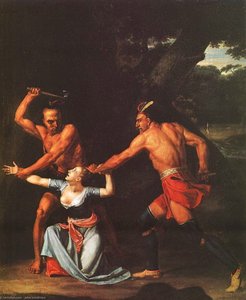 Der Tod der Jane McCrea1804
 Oliver Wolcott, Jr. (1760-1833), B.A. 1778, LL.D. 18191820
 Roger Strong (1762–1836)1802
 Theodosia Burr (Mrs. Joseph Alston, 1783-1813)1802
Essays zu A Muse
 Träume auf Leinwand: Verständnis des automatistischen und des veristischen SurrealismusErfahren Sie alles über den Vergleich zwischen automatistischem und veristischem Surrealismus. Jetzt die Unterschiede entdecken!
 Art Nouveau vs. Art Deco: Wie man diese zwei ikonischen Stile unterscheidetErfahren Sie den Unterschied zwischen Jugendstil und Art Deco anhand ikonischer Werke. Jetzt die Details der Epochen entdecken!
 Amerikanische neoklassizistische MalerEntdecken Sie US-Neoklassizismus von Copley bis Stuart. Erleben Sie Meisterwerke als hochwertige Reproduktionen auf OriginalUniqueArt.com.