Neoclassicism · 1790
Thomas Mifflin (John Trumbull, 1790)
John Trumbull (1756–1843) schuf Thomas Mifflin. Es stammt aus dem Jahr 1790. Es gehört zur Neoclassicism-Strömung. Es ist aus Watercolor gefertigt. Es befindet sich im Metropolitan Museum of Art in New York, Vereinigte Staaten von Amerika. Die Maße sind 9 × 7 cm.
- 1790
- Watercolor
- 9 × 7 cm
- Metropolitan Museum of Art, New York

 Vorschau anzeigen

 Handgemaltes Ölgemälde
 Versenden
 Teilen
 Datenblatt


 Herunterladen
 Ähnliche Objekte
 Röntgenaufnahme
 Diashow
 Fragen & Antworten

 Statistiken
Thomas Mifflin im Überblick
- Titel
- Thomas Mifflin
- Künstler
- John Trumbull (1756–1843)
- Geburtsjahr des Künstlers
- Lebanon, Vereinigte Staaten
- Datum
- 1790
- Medium
- Watercolor
- Maße
- 9 × 7 cm
- Ausstellungsort
- Metropolitan Museum of Art, New York, Vereinigte Staaten von Amerika
- Bewegung
- Neoclassicism
- Epoche
- Early Modern
- Motiv
- man, portrait, suit, cravat, wig, lapel
Was stellt Thomas Mifflin dar?
Portrait of Thomas Mifflin by John Trumbull
This miniature portrait of Thomas Mifflin, painted by John Trumbull in 1790, offers a quiet glimpse into the life of a significant figure from colonial Pennsylvania. Mifflin was a man of considerable influence during the formative years of the American republic. He served as a member of the legislature and eventually held the position of governor of the state. His presence in the political landscape of the era was marked by a steady, formal dignity.
Trumbull captures Mifflin from the chest up, presenting him within an elegant oval frame. The subject is depicted with a sense of gravitas, his attire reflecting the status and respectability of a prominent statesman. There is a certain introspection in his expression, a quality that invites closer observation of the fine details Trumbull has rendered. It is a small work, yet it carries the weight of the history it represents.
Composition and Visual Elements of the Portrait
The composition is centered upon the face and upper torso of Thomas Mifflin, presented from the chest up. While the subject occupies the heart of the arrangement, he is positioned slightly off-center within the oval frame, a subtle choice that lends a sense of movement to an otherwise formal posture. This slight asymmetry prevents the portrait from feeling static, providing a quiet dynamism to his presence. The background remains relatively plain, ensuring that no external distractions pull the eye away from the sitter.
The lighting is soft and diffused, appearing to originate from an unseen source above and slightly to the left. This gentle illumination creates subtle shadows that define the contours of his features and the texture of his clothing. Because of the nature of this miniature, the perspective is relatively flat, typical of the medium. Depth is achieved not through spatial recession, but through the careful layering of tonal variations, where the face appears to sit slightly forward of the clothing.
Technique and Materials Used in the Work
In this miniature portrait, the artist utilizes a meticulous approach to capture the likeness of Thomas Mifflin. The medium is likely watercolor or gouache applied to ivory, a choice that allows for a delicate, luminous quality. Through the use of fine brushstrokes, Trumbull achieves subtle gradations of tone that define the contours of the face and the texture of the hair. This careful layering of tones is essential to the work, as it creates a sense of depth and form within such a small scale. The piece measures 9 x 7 cm, requiring a high degree of precision to execute the details of the cravat and the lapels of the suit.
The physical presence of the original work is captured here through a photograph. The soft, diffused lighting suggests an unseen source from above and to the left, casting gentle shadows that give the subject a sense of quiet introspection. The organic shapes of the face and the voluminous texture of the wig are rendered with a controlled hand, contrasting with the geometric oval of the frame. Every detail, from the fine lines of the facial features to the shading of the skin, relies on the artist's ability to manipulate pigment with extreme restraint.
Related Works by John Trumbull
Trumbull’s career was defined by a profound connection to the American Revolution, a period he witnessed firsthand. His ability to capture the gravity of historical moments is evident in his larger compositions, such as his depictions of the Death of General Mercer at the Battle of Princeton and The Resignation of General Washington. These works demonstrate his capacity to translate significant political and military events into visual narratives. He also applied his skill to the monumental Declaration of Independence in 1817, a piece that helped shape the visual memory of the nation's founding.
Beyond these large-scale historical scenes, the artist was a prolific creator of smaller, more intimate works. He produced approximately 250 miniatures throughout his life, demonstrating a remarkable precision in a much more delicate format. This versatility allowed him to move between the grand scale of history painting and the meticulous detail required for private portraiture. His portraits of key figures, such as his 1790 depiction of George Washington and his 1805 portrait of Alexander Hamilton, reflect the same dedication to likeness and character that defines his broader body of work.
In welchem Museum befindet sich Thomas Mifflin?
Metropolitan Museum of Art
New York, Vereinigte Staaten von Amerika
Ursprung und Geschichte des Metropolitan Museum of Art Das Metropolitan Museum of Art nahm seinen Anfang mit einer Vision, die von einer Gruppe von Geschäftsleuten, Finanzierern sowie führenden Künstlern und Denkern getragen wurde. Nach seiner Gründung im Jahr 1870 suchte die Institution nach einem dauerhaften Heim, um ihre stetig wachsende Sammlung unterzubringen. Bevor das Museum seinen heutigen Standort bezog, war es kurzzeitig im Anwesen der Douglas Mansion in der West 14th Street untergebracht.


Hochauflösende Bilder von Thomas Mifflin

Gemeinfrei: Der Künstler verstarb im Jahr 1843.
Andere Formate, Ausschnitte und Zitierhinweise →John Trumbull, Thomas Mifflin (1790), Metropolitan Museum of Art. Gemeinfreiheit
Fragen zu Thomas Mifflin, beantwortet
In welchem Museum befindet sich das Original von „Thomas Mifflin“?
Das Original von "Thomas Mifflin" von John Trumbull befindet sich im Metropolitan Museum of Art, New York, Vereinigte Staaten von Amerika. Eine Reproduktion ermöglicht es, das Werk zu Hause auszustellen.
Wann wurde "Thomas Mifflin" geschaffen?
"Thomas Mifflin" von John Trumbull entstand im Jahr 1790.
In welcher Technik wurde "Thomas Mifflin" von John Trumbull ausgeführt?
John Trumbull verwendete die Technik der Watercolor für „Thomas Mifflin“. Die Technik bestimmt die materielle Beschaffenheit des Originalwerks.
Welche Maße hat "Thomas Mifflin" von John Trumbull im Original?
Das Originalwerk "Thomas Mifflin" von John Trumbull hat die Maße 9 x 7 cm.
Was stellt "Thomas Mifflin" von John Trumbull dar?
"Thomas Mifflin" von John Trumbull zeigt: man, portrait, suit, cravat, wig, lapel, collar.
Ist "Thomas Mifflin" von John Trumbull gemeinfrei?
"Thomas Mifflin" von John Trumbull ist gemeinfrei – das Urheberrecht ist abgelaufen. Dieser Status bestimmt, wie das Bild des Werkes vervielfältigt werden darf.
Wer hat "Thomas Mifflin" geschaffen?
"Thomas Mifflin" wurde von John Trumbull geschaffen. Die Informationen auf dieser Seite beschreiben das Originalwerk von John Trumbull.
Zu welcher Stilrichtung gehört "Thomas Mifflin"?
Die mit "Thomas Mifflin" von John Trumbull verbundene Stilrichtung ist Neoclassicism. Diese Klassifizierung ordnet das Werk in den Kontext verwandter Künstler und Kunstwerke ein.
Welcher Phase in der künstlerischen Entwicklung von John Trumbull lässt sich "Thomas Mifflin" zuordnen?
Innerhalb der Schaffensperiode von John Trumbull lässt sich „Thomas Mifflin“ der Mature Period zuordnen. Diese Phase ermöglicht einen Vergleich mit anderen Werken des Künstlers.
Über den Künstler, John Trumbull

1756–1843, Vereinigte Staaten
John Trumbull
John Trumbull: Der Maler der Revolution Geboren: 23. Juni 1756, Lebanon, Connecticut Gestorben: 1843 John Trumbull war ein gefeierter amerikanischer Künstler, der vor allem für seine historischen Gemälde bekannt ist, die Szenen aus dem Amerikanischen Unabhängigkeitskrieg darstellen. Oft als "der Maler der Revolution" bezeichnet, bieten Trumbulls Werke eine unschätzbare visuelle Dokumentation dieser entscheidenden Periode der amerikanischen Geschichte und fangen wichtige Ereignisse und Figuren mit akribischer Detailgenauigkeit ein. Frühes Leben und Ausbildung Trumbull besuchte 1771 das Harvard College und schloss sein Studium 1773 ab.
Ebenfalls von John Trumbull
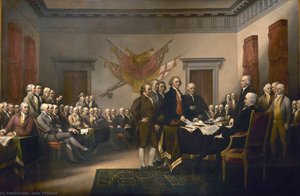 Unabhängigkeitserklärung1817
 Kapitulation von Lord Cornwallis1819
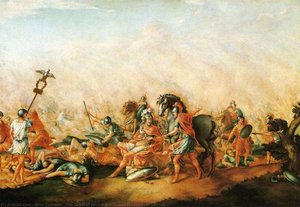 Der Tod des Paulus Aemilius in der Schlacht von Cannae1773
 Die Unabhängigkeitserklärung, 4. Juli 17761787

Essays zu Thomas Mifflin
 The Geometry of Presence: Mastering Composition and Stance in Classical PortraitureMaster the secrets of classical portraiture through geometry and light. Explore the techniques of the Old Masters today.
 Amerikanische neoklassizistische MalerEntdecken Sie US-Neoklassizismus von Copley bis Stuart. Erleben Sie Meisterwerke als hochwertige Reproduktionen auf OriginalUniqueArt.com.
 Amerikanische Kunstwerke der 1800er JahreEntdecken Sie Meisterwerke von Gilbert Stuart und John Trumbull. Erleben Sie US-Kunst des 1800er Jahre auf OriginalUniqueArt.com.