Zum Druck wechseln
 Weiterlesen







































 Bei Kunstwerken oder Reproduktionen, die an einer Seite größer als 105 cm (ca. 41 Zoll) sind, wird der Rahmen zerlegt als Bausatz geliefert. Diese Methode gewährleistet eine sichere Zustellung und verhindert Schäden während des Transports.


A Window Into Parisian Elegance: Exploring Sargent’s “My Dining Room”
John Singer Sargent's "My Dining Room," completed in 1885, isn’t merely a depiction of an interior; it’s a masterful distillation of Impressionistic ideals and a poignant reflection on the social landscape of late Victorian London. Painted during his formative years as a portraitist – a period marked by both scandalous beginnings and enduring success – this canvas transcends its formal subject matter to offer viewers a glimpse into a world defined by refined taste, subtle observation, and an appreciation for fleeting moments of beauty.The Style and Technique: Impressionism Revisited
Sargent’s approach to “My Dining Room” firmly establishes him as a champion of Impressionistic principles, albeit tempered with his own distinctive artistic sensibilities. Unlike the rigid academic conventions prevalent at the time, Sargent prioritized capturing the effects of light and atmosphere—a hallmark of Impressionism pioneered by Monet and Renoir. The artist eschewed meticulous detail in favor of loose brushstrokes that convey movement and luminosity. Notice how the diffused sunlight spills across the dining room table, illuminating the polished surfaces of the furniture and casting delicate shadows on the walls. This technique isn’t simply about reproducing what is seen; it's about conveying *how* it feels—the warmth of a comfortable home, the anticipation of an evening meal. The subtle blending of colors contributes to this immersive experience, creating an illusion of depth that defies the flatness characteristic of earlier artistic styles.Historical Context: London Society and Artistic Innovation
“My Dining Room” emerged during a period of significant social upheaval in Britain—the Victorian era was transitioning into Edwardian modernity. Sargent’s early career was fraught with controversy following his debut at the Paris Salon, where his depiction of Madame Vigée Le Brun sparked outrage due to its perceived lack of conventional decorum. Despite this initial setback, Sargent persevered, establishing himself as one of London's most sought-after portrait painters and becoming a fixture in the social circles frequented by aristocrats and intellectuals. This artistic milieu fostered experimentation and challenged established norms—artists like Sargent actively engaged with new ideas about color, light, and composition, pushing the boundaries of what was considered acceptable art. The dining room itself serves as a microcosm of this broader societal shift, representing a space where tradition mingled with innovation.Symbolism Within Domestic Tranquility
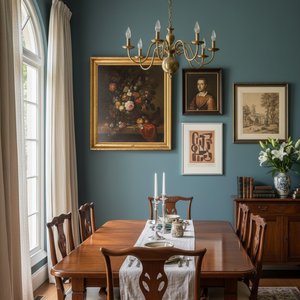
Beyond its technical brilliance, “My Dining Room” is laden with symbolic significance. The carefully arranged table setting—the gleaming silverware, the pristine tablecloth, the strategically placed vases and bottles—represents orderliness and refinement—values deeply ingrained in Victorian culture. However, the slightly pulled-out chair invites contemplation and suggests a sense of openness, hinting at conversations and connections between those gathered around the table. Furthermore, the clocks positioned prominently in the background serve as reminders of time’s passage, subtly underscoring the ephemeral nature of beauty and experience—a theme central to Impressionistic art itself. Sargent's masterful use of color reinforces this symbolic resonance, employing muted tones that evoke a feeling of serenity and understated elegance.Emotional Resonance: Capturing the Essence of Domestic Life
Ultimately, “My Dining Room” succeeds in capturing the very essence of domestic life—a realm where comfort, companionship, and aesthetic appreciation intertwine. The painting evokes feelings of warmth, nostalgia, and contentment, transporting viewers back to a bygone era while simultaneously celebrating the enduring power of art to illuminate human experience. It’s a testament to Sargent's ability to transform a simple scene into something profoundly evocative—a reminder that beauty can be found in the most unassuming corners of our world. Its current residence at Smith College Museum of Art ensures its legacy continues to inspire and delight audiences for generations to come.Fragen & Antworten
Wie alt war John Singer Sargent, als „My Dining Room“ im Jahr 1885 geschaffen wurde?
John Singer Sargent schuf „My Dining Room“ im Alter von 29. Der Künstler wurde 1856 geboren, und das Werk datiert auf 1885.
Welche Atmosphäre verleiht "My Dining Room" von John Singer Sargent einem Raum?
Die Edel und klassisch Atmosphäre von "My Dining Room" von John Singer Sargent passt perfekt zu dem empfohlenen Ort: einem Essbereich.
Wer ist der Urheber von "My Dining Room" und welcher Stilrichtung ist das Werk zuzuordnen?
"My Dining Room" wurde von John Singer Sargent im Stil der Realism geschaffen. Künstler und Epoche bestimmen die Tradition des Werkes.
 Vorschau anzeigen
 Versenden
 Teilen
 Details anzeigen
 Leitfaden

 Herunterladen
 Ähnliche Objekte
 Röntgenaufnahme
 Diashow
 Fragen & Antworten
 Statistiken