

 Vorschau anzeigen
 Versenden
 Teilen
 Details anzeigen
 Leitfaden

 Herunterladen
 Ähnliche Objekte
 Röntgenaufnahme
 Diashow
 Statistiken
Landscape
 Impressionism
 1896
1896 33.0 x 33.0 cm
 Weiterlesen
Handgefertigte Ölreproduktion
Handgemaltes Ölgemälde auf Leinwand in Ihrer Wunschgröße und mit Rahmen, auf Bestellung von unseren Künstlern angefertigt. ( Zum Druck wechseln Zum digitalen Bild wechseln)




P118B €10

P118H €10

P118W €10

P438Z €10

P508JH €12

P508YH €12

P805H €10

P805Z €10

P919BZ €10

P919G €10

P919XJ €10

P959ZH €10

P968JZ €12

W106C €8

W218G €10

W218JH €8

W218Y €10

W307PJ €10

W316G €10

W316PJ €8

W316Y €10

W398PJ €8

W4111J €10

W500HY €15

W500JH €15

W692G €12

W849H €8

W940BG €15

W953PJ €8




Wählen Sie aus unseren vordefinierten Formaten, die den ursprünglichen Proportionen des Kunstwerks entsprechen.

Geben Sie die Breite und die Höhe an, die Sie für Ihren Rahmen oder Ihre Wand benötigen. Da dieses Werk handgemalt ist, kann der Künstler bei einer anderen Form etwas mehr um das Bild herum malen oder etwas abschneiden – Sie entscheiden. Wir senden Ihnen ein digitales Mockup zur Freigabe, bevor mit dem Malen begonnen wird. Das auf dieser Seite gezeigte Bild stellt nicht das tatsächliche Ergebnis dar – dies tut nur das Mockup.
Nach der Bestellung wird das OriginalUniqueArt.com-Team dem Kunden Anweisungen per E-Mail zusenden und eine Mockup-Vorschau bereitstellen.
Weltweiter Versand () in nur 3 bis 4 Wochen statt der üblichen 5 Wochen. (26 Oktober). Keine Kompromisse bei der Qualität.

Kostenloser weltweiter Expressversand

Hochwertige Leinenleinwand

Umfassender Versicherungsschutz beim Versand

Zollgebühren-Rückerstattungsgarantie

Garantie für exakte Farbtreue

100 Tage Rückgaberecht (nur bei Mängeln)

100% Geld-zurück-Garantie

Mengenrabatt verfügbar
 Die Glasoption ist nur für Größen unter 110 cm verfügbar.

Landscape
Art der Reproduktion
Format der Reproduktion
-


Endpreis
€ 263
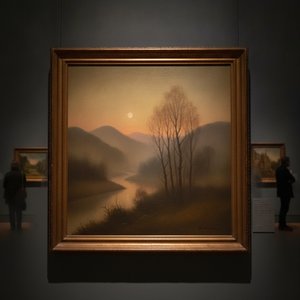
A Symphony of Atmosphere: John Henry Twachtman’s 1896 Landscape
John Henry Twachtman's *Landscape*, created in 1896, is a quintessential example of American Impressionism subtly infused with the emerging principles of Tonalism. Measuring a delicate 33 x 33 cm, this pastel work isn’t about grand narratives or meticulous detail; it’s an intimate study of mood and light, capturing a fleeting moment of tranquility along a quiet riverbank. The scene depicts a serene waterway bordered by trees, their forms softened and blended through the masterful application of pastel. Unlike the vibrant, broken color of French Impressionism, Twachtman favors a restrained palette – muted greens, golds, and subtle blues – creating an atmosphere of peaceful contemplation. This isn’t simply *a* landscape; it's an evocation of a feeling, a sensory experience translated onto paper.Technique & The Allure of Pastel
Twachtman’s choice of pastel is crucial to the painting’s effect. Unlike oil or acrylic, pastel allows for direct application of pure pigment, resulting in a velvety texture and luminous quality. He doesn't blend extensively; instead, he layers colors, allowing them to optically mix in the viewer’s eye. This technique contributes to the work’s ethereal feel, as if the scene is gently dissolving before us. The photo description highlights the “granulated surface” and “visible brushstrokes,” emphasizing the materiality of the pastel itself – a deliberate choice that distinguishes Twachtman's approach from smoother, more polished techniques. The soft application enhances the reflective quality of the water, creating an illusion of depth without relying on harsh lines or strong contrasts.Tonalism & The American Voice
While influenced by Impressionism gained during his European travels, Twachtman carved out a distinctly *American* artistic identity through Tonalism. This movement, flourishing in the late 19th century, prioritized atmospheric effects and emotional resonance over precise representation. Landscape embodies this perfectly. The emphasis isn’t on identifying specific trees or plants but rather on experiencing the overall mood – a sense of quietude, solitude, and harmony with nature. Twachtman wasn't merely depicting what he *saw*; he was conveying how it *felt* to be present in that landscape. Comparing this work to his other paintings like *Path in the Hills, Branchville, Connecticut*, reveals a consistent exploration of these themes – serene landscapes rendered with a poetic sensibility.Symbolism & Emotional Resonance
The solitary tree featured prominently in the composition can be interpreted as a symbol of resilience and enduring beauty amidst the ever-changing natural world. The reflective water suggests introspection and the passage of time, inviting viewers to contemplate their own connection to nature and the fleeting moments of life. The overall emotional impact is one of serenity and peaceful melancholy – a feeling that resonates deeply with those seeking respite from the complexities of modern life. This painting isn’t just a decorative object; it's an invitation to pause, breathe, and reconnect with the natural world.- Artist: John Henry Twachtman
- Painting Title: Landscape
- Medium: Pastel
- Date: 1896
- Size: 33 x 33 cm
Fragen & Antworten
Wie lässt sich "Landscape" in das Gesamtwerk von John Henry Twachtman einordnen?
"Landscape" teilt mit anderen Werken von John Henry Twachtman den Stil der Impressionism sowie die wiederkehrenden Themen: impressionism, tonalism, nature observation, pastel techniques, american landscape, rural life", peaceful atmosphere, "serene.
Wie schafft "Landscape" das Gleichgewicht zwischen Hell und Dunkel?
"Landscape" von John Henry Twachtman weist eine Helligkeit von brilliant mit einer Luminanz von Bright Balance auf.
In welche Phase von John Henry Twachtmans Schaffen lässt sich "Landscape" einordnen?
"Landscape" repräsentiert die Mature Period von John Henry Twachtman.
Künstlerbiografie
Frühes Leben und künstlerische Entwicklung
John Henry Twachtman, ein amerikanischer Maler, wurde am 4. August 1853 in Cincinnati, Ohio, geboren. Seine künstlerische Reise begann unter der Anleitung von Frank Duveneck in seiner Heimatstadt. Diese grundlegende Ausbildung legte den Grundstein für seine späteren Erkundungen in verschiedenen Kunstrichtungen.Europäische Studienzeit und künstlerische Entwicklung
Zwischen 1875 und 1877 besuchte Twachtman die Akademie der Schönen Künste in München, wo er seine Fähigkeiten in einer locker gebürsteten, schattigen Technik verfeinerte. Diese Zeit war geprägt von seinem Besuch in Venedig mit William Merritt Chase, wodurch sich seine künstlerischen Horizonte weiter erweiterten. Seine Landschaftsbilder aus dieser Zeit spiegeln die Einflüsse seiner europäischen Ausbildung wider.Pariser Intermezzo und Tonalismus
Von 1883 bis 1885 studierte Twachtman an der Académie Julian in Paris, was seinen Stil deutlich in einen weichen, grauen und grünen tonalistischen Ansatz verlagerte. Diese Zeit wird oft als der Höhepunkt seiner Karriere angesehen, mit bemerkenswerten Werken wie *Arques-la-Bataille* (in der Sammlung des Metropolitan Museum of Art, New York) und *Frühling* (in der Sammlung des Cincinnati Art Museum).Amerikanische Rückkehr und Cos Cob Einfluss
Nach seiner Rückkehr in die Vereinigten Staaten ließ sich Twachtman in Connecticut nieder und kaufte einen Bauernhof in Greenwich. Seine Anwesenheit in der Cos Cob Kunstkolonie war entscheidend, sie entfachte den kreativen Geist seiner Freunde und Schüler mit seiner Kunst, seinen Gesprächen und seinem Unterricht.Vermächtnis und bedeutende Werke
Twachtmans spätere Arbeit ist durch eine hochpersönliche impressionistische Technik gekennzeichnet, die oft schneebedeckte Landschaften seines Bauernhofs und Gartens darstellt. Seine Serie lebendiger Szenen in Gloucester, Massachusetts, kündigte einen moderneren Stil in der amerikanischen Kunst an.- Landschaft 3 (200 x 152 cm, Metropolitan Museum of Art, New York, Tonalismus, Öl)
- Der Holland Dyke (Tonalismus, Öl)
- Weitere Werke von John Henry Twachtman
Referenzen:

John Henry Twachtman
1853 - 1902 , Vereinigte Staaten von Amerika
Kurzinfos
- Beeinflusste Künstler:
- Marsden Hartley
- Arthur Dove
- Milton Avery
- Bemerkenswerte Werke:
- Landschaft 3
- The Holland Dyke
- Einflüsse:
- Frank Duveneck
- Claude Monet
- Geburtsdatum: 04. August 1853
- Geburtsort: Cincinnati, USA
- Künstlerische Richtung: Impressionismus, Tonalismus
- Nationalität: Amerikanisch
- Todatum: 08. August 1902
- Vollständiger Name: John Henry Twachtman
Ähnliche Artikel

Evocations of Place: A Historical Journey Through Landscape Art
Explore the rich history of landscape art with OriginalUniqueArt. Discover renowned artists, movements like Impressionism & Romanticism, and expert guidance for collecting timeless pieces. Find your perfect serene escape today!
Tonalism Explained: The Art of Mood, Mist, and Masterful Color in Landscape Painting
Discover the evocative world of Tonalism. Explore how masters like Whistler and Tryon used mist, shadow, and subtle color to capture profound mood and atmosphere in landscape art. An expert guide for fine art enthusiasts and collectors.

Romantische Landschaften: Die 10 Meisterwerke, die eine Epoche prägten | OriginalUniqueArt
Entdecken Sie die 10 Meisterwerke der Romantischen Landschaftsmalerei! Von Caspar David Friedrich bis Turner – erleben Sie die Kunst, Emotion & Natur. Hochwertige Reproduktionen auf OriginalUniqueArt.com

Impressionistische Landschaften: Die 10 Meisterwerke, die eine Epoche prägten | OriginalUniqueArt
Entdecken Sie die 10 Meisterwerke des Impressionismus! Von Monet bis Renoir – erleben Sie die Geschichte, Technik und zeitlose Schönheit ikonischer Landschaftsbilder. Hochwertige Kunstdrucke auf OriginalUniqueArt.com. Jetzt entdecken!

Impressionistische Landschaften: Die 10 Meisterwerke, die eine Kunstrichtung prägten | OriginalUniqueArt
Entdecken Sie die 10 Meisterwerke des Impressionismus! Von Monet bis Van Gogh – erleben Sie die Geschichten hinter berühmten Landschaftsbildern. Hochwertige Kunst Reproduktionen für Ihr Zuhause auf OriginalUniqueArt.com.


