Zum Druck wechseln
 Weiterlesen







































 Bei Kunstwerken oder Reproduktionen, die an einer Seite größer als 105 cm (ca. 41 Zoll) sind, wird der Rahmen zerlegt als Bausatz geliefert. Diese Methode gewährleistet eine sichere Zustellung und verhindert Schäden während des Transports.


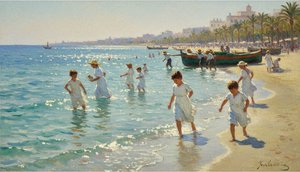
Joaquín Sorolla’s “Sea Idyll”: A Sun-Drenched Reverie of Leisure
Joaquin Sorolla y Bastida, a pivotal figure in late 19th and early 20th century Spanish art, possessed an extraordinary gift for capturing the ephemeral beauty of light and life. His "Sea Idyll," completed in 1908 and currently residing within the walls of the Hispanic Society of America in New York City, is a prime example of this talent—a luminous tableau that invites viewers into a moment of serene contemplation by the Mediterranean coast. More than just a depiction of a seaside scene, it’s an exploration of joy, connection, and the simple pleasures of existence, rendered with Sorolla's signature vibrant palette and masterful brushwork.
The painting immediately establishes a mood of blissful tranquility. Two women – one reclining gracefully on the sand, partially submerged in the cool water, and the other seated upright, her straw hat casting a delicate shadow – are presented in an intimate tableau. Their postures suggest effortless relaxation, their hands raised to their faces as if lost in thought or perhaps engaged in playful interaction. Scattered throughout the composition are several birds, adding a touch of lively movement and further enhancing the sense of natural harmony. The backdrop is dominated by the shimmering expanse of the sea under a clear, azure sky, punctuated by fluffy white clouds that drift lazily across the horizon. Sorolla’s use of horizontal lines creates a feeling of spaciousness and openness, while the warm tones of the sand and water contrast beautifully with the cooler hues of the sky.
A Masterclass in Impressionistic Technique
Sorolla's technique is characterized by its remarkable immediacy and spontaneity. He employed loose, expressive brushstrokes—a hallmark of Impressionism—to capture the fleeting effects of light and atmosphere. Notice how he doesn’t meticulously render every detail; instead, he relies on suggestive strokes to convey texture and form. The water, for instance, isn't painted with precise lines but rather with a series of broken colors that create an illusion of shimmering movement. Similarly, the figures are rendered with a sense of fluidity, their forms dissolving into the surrounding light. This technique wasn’t simply about replicating what he saw; it was about conveying how he *felt* looking at the scene – a vibrant, almost palpable energy.
Sorolla's background in academic training is evident in his careful attention to color and composition, yet he skillfully subverts traditional conventions. He utilizes a steep horizon line, pushing the sky forward and creating a sense of depth that draws the viewer into the scene. The high horizon also contributes to the painting’s feeling of lightness and airiness. Furthermore, Sorolla's use of complementary colors—the warm yellows and oranges of the sand and water juxtaposed against the cool blues and greens of the sky—intensifies the visual impact of the work.
Historical Context and Symbolic Resonance
“Sea Idyll” was painted during a period of significant artistic innovation in Spain, as artists began to break away from the rigid academic traditions of the past. Sorolla’s work reflects this shift towards greater freedom and experimentation. He drew inspiration from his travels throughout Europe, particularly his time in Paris, where he encountered the Impressionist movement. However, unlike many of his European contemporaries, Sorolla retained a distinctly Spanish sensibility, capturing the warmth and light of his homeland with unparalleled skill.
The painting’s subject matter—a leisurely afternoon by the sea—holds symbolic significance as well. It represents a moment of respite from the pressures of modern life, a celebration of friendship and connection. The two women in the painting embody a sense of carefree joy and feminine grace. Some art historians interpret the scene as an allegory for the “golden age” of Spain, evoking memories of a time when life was simpler and more idyllic. Sorolla’s frequent depiction of young women in these settings—often nude or partially clothed—has been interpreted by some as reflecting a fascination with beauty and sensuality, while others see it as a celebration of female freedom and independence.
A Timeless Masterpiece: Reproduction and Beyond
“Sea Idyll” remains one of Sorolla’s most beloved works, admired for its luminous quality, evocative atmosphere, and profound sense of joy. High-quality reproductions capture much of the original's magic, offering a beautiful addition to any home or office space. When selecting a reproduction, consider factors such as print material (canvas, paper), color accuracy, and detail level. The Hispanic Society of America offers stunning prints that faithfully reproduce Sorolla’s masterful brushwork and vibrant palette. For those seeking an authentic experience, exploring the original painting in person at the Hispanic Society of America is highly recommended – a chance to truly immerse oneself in the world of this remarkable artist.
Fragen & Antworten
Ist "Sea Idyll" von Joaquín Sorolla y Bastida im Hoch-, Quer- oder Quadratformat angeordnet?
Das Format von „Sea Idyll“ ist Landscape. Dies ist hilfreich bei der Planung, wo eine Reproduktion platziert werden soll.
Wer ist der Urheber von "Sea Idyll" und welcher Stilrichtung ist das Werk zuzuordnen?
Joaquín Sorolla y Bastida schuf „Sea Idyll“ im Rahmen der Impressionism-Bewegung.
Wirken die Farben von "Sea Idyll" eher kräftig oder sanft?
Die Farbsättigung von „Sea Idyll“ ist Monochromatic. Die Intensität beschreibt, wie kräftig die Farben wirken.
 Vorschau anzeigen
 Versenden
 Teilen
 Details anzeigen
 Leitfaden

 Herunterladen
 Ähnliche Objekte
 Röntgenaufnahme
 Diashow
 Q&A
Q&A Statistiken