

 Vorschau anzeigen
 Versenden
 Teilen
 Details anzeigen
 Leitfaden

 Herunterladen
 Ähnliche Objekte
 Röntgenaufnahme
 Diashow
 Statistiken
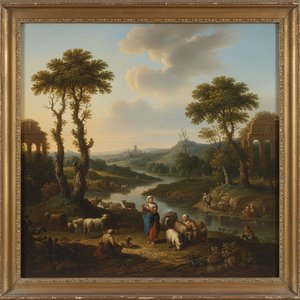
Italian Landscape
 Oil On Canvas
- WallArt
- Italianate Landscape
 31.0 x 40.0 cm
 Fitzwilliam-Museum
 Weiterlesen
Handgefertigte Ölreproduktion
Handgemaltes Ölgemälde auf Leinwand in Ihrer Wunschgröße und mit Rahmen, auf Bestellung von unseren Künstlern angefertigt. ( Zum Druck wechseln Zum digitalen Bild wechseln)




P118B €10

P118H €10

P118W €10

P438Z €10

P508JH €12

P508YH €12

P805H €10

P805Z €10

P919BZ €10

P919G €10

P919XJ €10

P959ZH €10

P968JZ €12

W106C €8

W218G €10

W218JH €8

W218Y €10

W307PJ €10

W316G €10

W316PJ €8

W316Y €10

W398PJ €8

W4111J €10

W500HY €15

W500JH €15

W692G €12

W849H €8

W940BG €15

W953PJ €8




Wählen Sie aus unseren vordefinierten Formaten, die den ursprünglichen Proportionen des Kunstwerks entsprechen.

Geben Sie die Breite und die Höhe an, die Sie für Ihren Rahmen oder Ihre Wand benötigen. Da dieses Werk handgemalt ist, kann der Künstler bei einer anderen Form etwas mehr um das Bild herum malen oder etwas abschneiden – Sie entscheiden. Wir senden Ihnen ein digitales Mockup zur Freigabe, bevor mit dem Malen begonnen wird. Das auf dieser Seite gezeigte Bild stellt nicht das tatsächliche Ergebnis dar – dies tut nur das Mockup.
Nach der Bestellung wird das OriginalUniqueArt.com-Team dem Kunden Anweisungen per E-Mail zusenden und eine Mockup-Vorschau bereitstellen.
Weltweiter Versand () in nur 3 bis 4 Wochen statt der üblichen 5 Wochen. (26 Oktober). Keine Kompromisse bei der Qualität.

Kostenloser weltweiter Expressversand

Hochwertige Leinenleinwand

Umfassender Versicherungsschutz beim Versand

Zollgebühren-Rückerstattungsgarantie

Garantie für exakte Farbtreue

100 Tage Rückgaberecht (nur bei Mängeln)

100% Geld-zurück-Garantie

Mengenrabatt verfügbar
 Die Glasoption ist nur für Größen unter 110 cm verfügbar.

Italian Landscape
Art der Reproduktion
Format der Reproduktion
-


Endpreis
€ 263
A Glimpse of Italian Pastoral: Jan Asselijn’s “Italian Landscape”
Jan Asselijn's "Italian Landscape," painted circa 1625-1652, isn’t merely a depiction of a picturesque vista; it’s an invitation to step into a carefully constructed world of serene beauty and subtle drama. This oil on canvas transports the viewer to a hypothetical Italian landscape – a deliberate choice by Asselijn that speaks volumes about the evolving artistic sensibilities of the Dutch Golden Age. The painting, now housed in collections like Bonhams, exemplifies the influence of both the Venetian masters and the burgeoning tradition of “pure” landscape painting emerging from Italy itself.
Asselijn’s style is distinctly characterized by a meticulous attention to detail and a masterful command of atmospheric perspective. He leans heavily into the techniques pioneered by Bamboccio – a contemporary painter known for his evocative, almost dreamlike landscapes – creating an image that feels both familiar and subtly unsettling. The composition unfolds with deliberate grace: a modest, classically-inspired building anchors the left foreground, its geometric solidity providing a grounding element against the undulating hills and hazy distance. The artist skillfully employs a muted palette of browns, ochres, and blues, avoiding bright colors to emphasize the painting’s contemplative mood. This restrained approach allows the subtle shifts in tone – from the dark shadows cast by distant trees to the luminous highlights reflecting off water – to create a remarkably convincing sense of depth and atmosphere.
The Influence of Venetian Masters and Italianate Tradition
Asselijn's work is deeply rooted in the artistic currents flowing through Italy at the time. He was profoundly influenced by the Venetian landscape painters, particularly those who favored a looser, more atmospheric style than their predecessors. However, unlike many of his contemporaries who simply copied Italian scenes directly, Asselijn imbued them with a distinctly Dutch sensibility – a focus on light, texture, and a carefully considered composition. This blending of influences is evident in the painting’s balanced structure, its subtle use of color, and its overall sense of quiet contemplation.
Furthermore, “Italian Landscape” reflects the broader trend toward what became known as "Italianate landscape" within Dutch art circles. This style sought to emulate the idealized landscapes depicted by artists like Claude Lorrain, who had established a dominant visual language for representing Italian scenery in Northern Europe. Asselijn’s painting isn't a literal transcription of an Italian vista; rather, it’s a carefully constructed fantasy – a “imaginary Italian Landscape” as described in some historical sources – designed to evoke the spirit and beauty of Italy while adhering to Dutch artistic conventions.
Symbolism and Emotional Resonance
Beyond its technical merits, "Italian Landscape" is rich in symbolic meaning. The solitary building, often interpreted as a villa or farmhouse, suggests themes of rural life, tranquility, and perhaps even isolation. The distant mountains, shrouded in mist, evoke a sense of mystery and the sublime – a recognition of nature’s power and grandeur. The figures scattered across the foreground, riding horses and walking along the riverbank, add a touch of human presence to the scene, reminding us of our connection to the natural world.
The painting's overall effect is one of profound serenity and contemplative beauty. It invites the viewer to slow down, to appreciate the subtle details of the landscape, and to lose themselves in its timeless atmosphere. It’s a testament to Asselijn’s skill as an artist – his ability to capture not just the appearance of a scene but also its emotional essence.
A Reproduction for Today's Spaces
Reproductions of “Italian Landscape” offer a beautiful addition to any interior space. The painting’s calming colors and evocative imagery create a sense of tranquility and sophistication, making it ideal for living rooms, bedrooms, or studies. The detailed depiction of the landscape invites contemplation and provides a visual connection to the natural world – a welcome respite from the stresses of modern life. Consider framing this piece in a classic wooden frame to further enhance its timeless appeal.
Fragen & Antworten
Welche Farbpalette und welche Stimmung vereint "Italian Landscape"?
Die Dark-Palette von "Italian Landscape" von Jan Asselyn harmoniert mit seinem Melancholic emotionalen Tonfall. Farbe ist eine der Arten und Weisen, wie ein Werk Gefühle vermittelt.
Welches Motiv und welche Atmosphäre vereint "Italian Landscape" von Jan Asselyn?
"Italian Landscape" zeigt landscape, figures, ruin, italy, asselijn, pastoral, tranquility, scenic, und die eingefangene Stimmung ist Calm.
Ist "Italian Landscape" von Jan Asselyn ein helles oder ein dunkles Kunstwerk?
Insgesamt wird „Italian Landscape“ mit einer Helligkeit von shadow erfasst. Die wahrgenommene Helligkeit beschreibt, wie hell oder dunkel das Werk erscheint.
Künstlerbiografie
A Life Forged in Landscape: The World of Jan Asselijn
Born Jean Asselin in the French port city of Dieppe around 1610, Jan Asselijn’s journey was one shaped by religious upheaval and artistic exploration. His family, Huguenots fleeing persecution, relocated to Amsterdam in 1621, a vibrant hub of commerce and burgeoning artistic talent during the Dutch Golden Age. This relocation proved pivotal, immersing young Jean into a world where landscape painting was rapidly evolving beyond traditional depictions toward more atmospheric and emotionally resonant scenes. He initially trained with Jan Martszen the Younger, honing his skills in battle pieces before discovering his true calling – capturing the beauty and drama of both natural landscapes and animal life. Asselijn’s early exposure to the Dutch light and expansive skies would become a defining characteristic of his work, though it was a sojourn to Italy that truly solidified his artistic vision.The Italianate Embrace & The Bentvueghels
Like many ambitious Northern European painters of the era, Asselijn sought refinement in Italy, likely arriving sometime after 1635. It was there he fully embraced the *Italianate* style – a genre characterized by sun-drenched vistas, classical ruins, and pastoral scenes imbued with a sense of romanticism. He joined the ranks of the *Bentvueghels*, a colorful society of Dutch and Flemish artists working in Rome. These “Birds of a Feather” were known for their unconventional behavior, satirical nicknames, and dedication to painting directly from life – rejecting the constraints of studio work. Within this boisterous community, Asselijn earned the moniker "Krabbetje" (little crab) due to a physical disability affecting his hand, yet he thrived creatively. He absorbed the influence of artists like Pieter van Laer (Bamboccio), whose depictions of Roman peasant life and landscapes resonated deeply with Asselijn’s own developing style. This period was crucial in shaping his ability to convey atmosphere, light, and a sense of narrative within his compositions.Mastering Light & Symbolism: Key Works
Asselijn returned to Amsterdam with a refined technique and a distinctive voice. His paintings are characterized by a clarity of execution and a masterful handling of light – qualities that quickly gained him recognition. While he produced historical and battle scenes, it was his landscapes and animal paintings that truly set him apart. The Threatened Swan, painted in the 1640s, remains his most celebrated work. More than just a depiction of avian defense, this painting became a powerful symbol of Dutch national resistance against external threats. The fiercely protective swan, aggressively warding off intruders near its nest, resonated with contemporary anxieties and was even interpreted as an allegory for Johan de Witt, a prominent Dutch statesman. Intriguingly, later owners added symbolic inscriptions to the canvas – “Holland” on one of the eggs and “Enemy of the state” beside the menacing dog – further cementing its political undertones. Other notable works include Cavalry Attack at Sunset, showcasing his earlier training in battle scenes with dramatic flair, and depictions of rural life like Drovers with Cattle under an Arch of the Colosseum in Rome, which beautifully blend Italianate landscapes with animal studies. The Breach of the Saint Anthony’s Dike near Amsterdam demonstrates his ability to capture a moment of national crisis, reflecting the ever-present threat of water and the ingenuity required for Dutch land reclamation.Influence & Legacy: A Lasting Impression
Jan Asselijn's impact extended beyond his own prolific output. He was admired by contemporaries like Rembrandt, who even created etchings of the artist at work – though notably, these etchings obscure Asselijn’s hands, perhaps a sensitive acknowledgement of his physical challenge. He also served as a mentor to Frederik de Moucheron, another prominent Dutch landscape painter who further popularized the Italianate style. Asselijn's innovative approach to light and atmosphere influenced a generation of artists, paving the way for greater naturalism and emotional depth in landscape painting. His works are now held in prestigious collections such as the Rijksmuseum in Amsterdam, ensuring his legacy endures as a significant figure within the Dutch Golden Age. He died relatively young, in 1652, but left behind a body of work that continues to captivate viewers with its beauty, drama, and subtle layers of meaning.
Jan Asselyn
1610 - 1652 , Frankreich
Kurzinfos
- Artistic Movement Or Style: Italienische Landschaftsmalerei
- Artists Or Movements Influenced By This Artist: ['Frederick de Moucheron']
- Artists Who Influenced This Artist:
- Pieter van Laer
- Esaias van de Velde
- Rembrandt
- Date Of Birth: c. 1610
- Date Of Death: c. 1652
- Full Name: Jan Asselin
- Nationality: Niederlande
- Notable Artworks:
- Die Bedrohte Weißhuhn
- Aufenthalt in Italien
- Übernahme der Stadt Rom
- Place Of Birth: Dieppe, Frankreich
Ähnliche Artikel

Mastering Light & Land: An Art Historian's Guide to the Dutch Golden Age Landscape
Explore the breathtaking mastery of Dutch Golden Age landscapes. From Italianate light to atmospheric realism, discover the techniques of 17th-century masters and learn how to bring these timeless, museum-quality masterpieces into your home through expert oil reproductions.

Die 10 Meisterwerke des Goldenen Zeitalters der niederländischen Malerei |
Entdecken Sie die 10 Meisterwerke des Niederländischen Goldenen Zeitalters! Von Rembrandt bis Vermeer – erleben Sie Kunstgeschichte, Techniken & Emotionen. Hochwertige Gemäldereproduktionen für Ihr Zuhause auf .

Golden Light & Dutch Skies: The Timeless Magic of Dutch Golden Age Landscapes
Discover the breathtaking beauty of Dutch Golden Age landscapes. Explore the mastery of light, chiaroscuro, and 17th-century realism through an expert art history lens, celebrating the enduring legacy of the Dutch Masters for discerning collectors and art lovers.

Golden Light & Dutch Skies: Bringing the Magic of Dutch Golden Age Landscapes into Your Home
Transform your home with the breathtaking light of Dutch Golden Age landscapes. Discover how hand-painted oil reproductions of masterworks like Ruisdael and Vermeer bring timeless elegance, atmosphere, and soulful texture to modern interiors. Elevate your space with museum-quality art.
Nicolaes Berchem und das Goldene Zeitalter: Pastoralismus, Idealisierung & Künstlerische Innovation
Entdecken Sie die faszinierende Welt von Nicolaes Berchem und das Goldene Zeitalter der niederländischen Landschaftsmalerei. Expertenanalyse, Hintergrundinformationen & künstlerische Innovationen.


