

 Vorschau anzeigen
 Versenden
 Teilen
 Details anzeigen

 Herunterladen
 Ähnliche Objekte
 Röntgenaufnahme
 Diashow
Plague Below, Plague Above, Plague Everywhere

 Weiterlesen
Giclée / Kunstdruck
Giclée- oder Leinwanddruck in Museumsqualität mit schneller Produktion und flexiblen Veredelungsoptionen. ( Handgemalte Reproduktion bestellen Bild kaufen)




P118B $10

P118H $10

P118W $10

P438Z $10

P508JH $12

P508YH $12

P805H $10

P805Z $10

P919BZ $10

P919G $10

P919XJ $10

P959ZH $10

P968JZ $12

W106C $8

W218G $10

W218JH $8

W218Y $10

W307PJ $10

W316G $10

W316PJ $8

W316Y $10

W398PJ $8

W4111J $10

W500HY $15

W500JH $15

W692G $12

W849H $8

W940BG $15

W953PJ $8




Wählen Sie aus unseren vordefinierten Formaten, die den ursprünglichen Proportionen des Kunstwerks entsprechen.

Sie können Ihre eigenen Maße eingeben, um ein bestimmtes Format oder einen speziellen Platz einzupassen. Wenn das von Ihnen gewählte Format nicht den Proportionen des Originalbildes entspricht, werden wir das Kunstwerk entweder beschneiden oder das Bild mit einem gespiegelten oder einfarbigen Rand erweitern. Ein digitaler Entwurf wird Ihnen zur Genehmigung zugesandt, bevor die Produktion beginnt.
Bitte beachten Sie, dass die Vorschau auf dem Bildschirm nicht den tatsächlichen Zuschnitt oder die Erweiterung widerspiegelt. Nur der Entwurf zeigt die endgültige Komposition präzise an.
Obwohl Sondermaße verfügbar sind, empfehlen wir die Auswahl eines Maßes aus der vordefinierten Liste, um die ursprünglichen Proportionen zu bewahren.
Weltweiter Versand () innerhalb von 2 Wochen statt der üblichen 4/5 Wochen. (22 August)

Kostenloser weltweiter Expressversand

Hochwertige Leinenleinwand

Umfassender Versicherungsschutz beim Versand

Zollgebühren-Rückerstattungsgarantie

Garantie für exakte Farbtreue

60 Tage Rückgaberecht (nur bei Mängeln)

100% Geld-zurück-Garantie

Mengenrabatt verfügbar
 Die Glasoption ist nur für Größen unter 110 cm verfügbar.

Plague Below, Plague Above, Plague Everywhere
Giclée / Kunstdruck
Format der Reproduktion
-


Gesamtpreis
$ 80
Sammlerstück-Beschreibung
Plague Below, Plague Above, Plague Everywhere: An Exploration of James Ensor’s Disturbing Vision
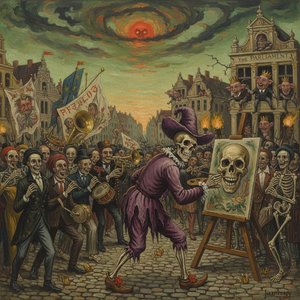
James Ensor's "Plague Below, Plague Above, Plague Everywhere" stands as a cornerstone of Symbolist art and Belgian Expressionism—a haunting tableau that confronts viewers with unsettling imagery and profound psychological insight. Painted in 1904, this monochrome etching captures the artist’s preoccupation with mortality, societal hypocrisy, and the pervasive influence of masks upon human experience. Let's delve into the layers of meaning embedded within this iconic artwork.The Visual Landscape: Composition and Technique
The painting’s composition immediately establishes a sense of unease. A group of figures—nine individuals in total—are seated on a bench overlooking a stylized map or drawing of a city. The stark black and white palette amplifies the drama, emphasizing textures and contours with meticulous detail achieved through Ensor's masterful etching technique. Lines are drawn with considerable pressure, creating deep shadows and highlighting surfaces to convey an atmosphere of claustrophobia and impending doom. Notice how Ensor utilizes hatching—parallel lines closely spaced—to build up tonal variations, simulating the gloominess of a rainy day and mirroring the pervasive sense of dread that permeates the scene. The artist’s deliberate choice of monochrome underscores his desire to strip away superficial appearances, exposing the underlying anxieties of his time.Symbolism: Masks, Mortality, and Societal Critique
At the heart of Ensor's artistic vision lies a preoccupation with masks—a motif recurrent throughout his oeuvre. In “Plague Below, Plague Above,” the figures on the bench are adorned with masks that obscure their faces, symbolizing the deceptive nature of human identity and concealing true emotions. This visual metaphor aligns perfectly with Symbolist concerns about unveiling hidden realities and confronting uncomfortable truths. The skeletal figure dominating the composition serves as a stark reminder of mortality—a deliberate allusion to Dante’s Inferno and a commentary on humanity's inevitable confrontation with death. Ensor doesn’t shy away from portraying grotesque imagery, reflecting his belief that art should challenge conventional notions of beauty and provoke contemplation about existential anxieties.Historical Context: The Symbolist Movement and Belgian Artistic Expression
James Ensor emerged during the height of the Symbolist movement—a reaction against Impressionism's focus on fleeting sensations and optical realism. Symbolists sought to express inner emotions and spiritual truths through evocative imagery, prioritizing psychological depth over visual accuracy. Ensor’s work embodies this ethos, rejecting academic conventions in favor of a raw, emotionally charged style that anticipates Expressionism’s later explorations of subjective experience. The painting reflects the anxieties prevalent in Belgium at the turn of the century—concerns about social upheaval, religious skepticism, and the looming shadow of war. Ensor's unflinching portrayal of human suffering speaks to broader themes of disillusionment and despair, cementing his place as a pivotal figure in Belgian art history.Emotional Impact: Confronting Darkness Within Ourselves
“Plague Below, Plague Above” isn’t merely aesthetically striking; it possesses a profound emotional impact on the viewer. Ensor compels us to confront uncomfortable truths about human nature—our vulnerability to fear, our tendency towards deception, and our inescapable awareness of mortality. The painting's unsettling atmosphere lingers long after viewing, prompting reflection on the darker aspects of existence. It’s a testament to Ensor’s ability to translate psychological anxieties into visual form, demonstrating that art can serve as a catalyst for introspection and a powerful tool for exploring the complexities of the human condition. This artwork continues to resonate with audiences today because it captures an enduring preoccupation—the unsettling realization that beneath the veneer of social convention lies a pervasive darkness within ourselves.Über den Künstler
frühes Leben und künstlerische Reise
James Sidney Edward, Baron Ensor, ein prominenter belgischer Maler und Grafiker, wurde am 13. April 1860 in Ostend, Belgien, geboren. Sein frühes Leben war von einem vielfältigen kulturellen Hintergrund geprägt, mit einem englischen Vater, James Frederic Ensor, und einer belgischen Mutter, Maria Catherina Haegheman. Ensor zeigte wenig Interesse an traditionellen akademischen Studien und verließ die Schule mit fünfzehn Jahren, um sich der Kunst zu widmen, zunächst bei lokalen Malern und später am Académie Royale des Beaux-Arts in Brüssel.Künstlerischer Stil und Themen
Ensor's künstlerischer Stil war durch seine Auseinandersetzung mit dem Unterbewusstsein und traumhaften Bildern gekennzeichnet, der die Expressionismus und Surrealismus maßgeblich beeinflusste. Seine Gemälde zeigten oft bizarre Motive, darunter Karnevale, Masken, Puppenspiel, Skelette und fantastische Allegorien. Bekannte Werke sind Die Schändlichen Masken (1883) und Skelette kämpfen um eine gehängte Person (1891), die seine einzigartige Mischung aus Groteskem und Fantasievollem zeigen.Anerkennung und Vermächtnis
Trotz anfänglicher Ablehnung gewann Ensor's Werk allmählich Anerkennung und Anklang. Bis 1920 war er das Thema bedeutender Ausstellungen; im Jahr 1929 wurde er zum Baron durch König Albert ernannt, und 1933 erhielt er die Légion d’honneur. Sein Vermächtnis als Pionier der modernen Kunst ist in seinem Einfluss auf nachfolgende künstlerische Bewegungen, einschließlich Expressionismus und Surrealismus, erkennbar.Wichtige Werke und Ausstellungen
* Die Intrige (90 x 150 cm, Koninklijk Museum voor Schone Kunsten, Antwerpen, Belgien) * Die Qualen des Heiligen Antonius (1887, heute im Besitz der Sammlung des Museum of Modern Art, New York)- Erfahren Sie mehr über das Leben und Werk von James Ensor auf OriginalUniqueArt: James Ensor
- Entdecken Sie das Museum Mu.Zee in Ostend, Belgien, das eine Sammlung belgischer Kunst von 1830 bis heute beherbergt auf OriginalUniqueArt: Entdecken Sie das Museum Mu.Zee in Ostend, Belgien
- Erfahren Sie mehr über Malerei des Symbolismus und seinen Einfluss auf Expressionismus und Surrealismus auf Wikipedia: Symbolistische Malerei

James Ensor
1860 - 1949 , Belgien
Kurzinfos
- Beeinflusste Künstler:
- Pieter Bruegel der Ältere
- Francisco Goya
- Bemerkenswerte Werke:
- Die Schmählichen Masken
- Christus in Brüssel
- Tribulationen des Heiligen Antonius
- Geburtsdatum: 1860-04-13
- Geburtsort: Ostende, Belgien
- Künstlerische Richtung: Expressionismus, Symbolismus
- Nationalität: Belgisch
- Todatum: 1949-11-19
- Vollständiger Name: James Ensor
- Von Künstlern Beeinflusst: ['']
Ähnliche Artikel

James Abbott McNeill Whistler: Die 25 Meisterwerke für Ihr Zuhause | OriginalUniqueArt
Entdecken Sie die 25 Meisterwerke von James Abbott McNeill Whistler! Von den berühmten Nocturnes bis zu ikonischen Porträts – erleben Sie Ästhetizismus, Impressionismus & Tonalismus. Hochwertige Reproduktionen auf OriginalUniqueArt.com.
James Ensor und die groteske Vision: Gesellschaftskritik und künstlerische Innovation
Entdecken Sie James Ensors faszinierende Welt der Groteske! Analysieren Sie seine Gesellschaftskritik, den Einfluss des Symbolismus und seinen einzigartigen Stil. Expertenwissen zur modernen Kunst.
Die 10 legendärsten Radierungen: Meisterwerke, die Kunstgeschichte schrieben | OriginalUniqueArt
Entdecken Sie die 10 legendärsten Radierungen von Rembrandt, Dürer & Goya! Erfahren Sie die Geschichten hinter diesen Meisterwerken der Kunstgeschichte und lassen Sie sich für Ihre Wohnräume inspirieren. Hochwertige Kunstdrucke auf OriginalUniqueArt.com.

Etching: A Historical Survey of Technique, Aesthetic Qualities & Enduring Artistic Significance
Explore the rich history of etching, from its origins to Rembrandt's masterful innovations. Discover the technique, aesthetic qualities & enduring legacy of this captivating art form. Expert insights for collectors and enthusiasts.

Sir Alfred James Munnings: Die 25 Meisterwerke des Pferdebildes | OriginalUniqueArt
Entdecken Sie die 25 Meisterwerke von Sir Alfred James Munnings! Erleben Sie seine beeindruckenden Pferdebilder, geprägt vom Impressionismus und Realismus. Hochwertige Kunstdrucke & Reproduktionen auf OriginalUniqueArt.com – für elegante Wandkunst & stilvolles Interieurdesign.



